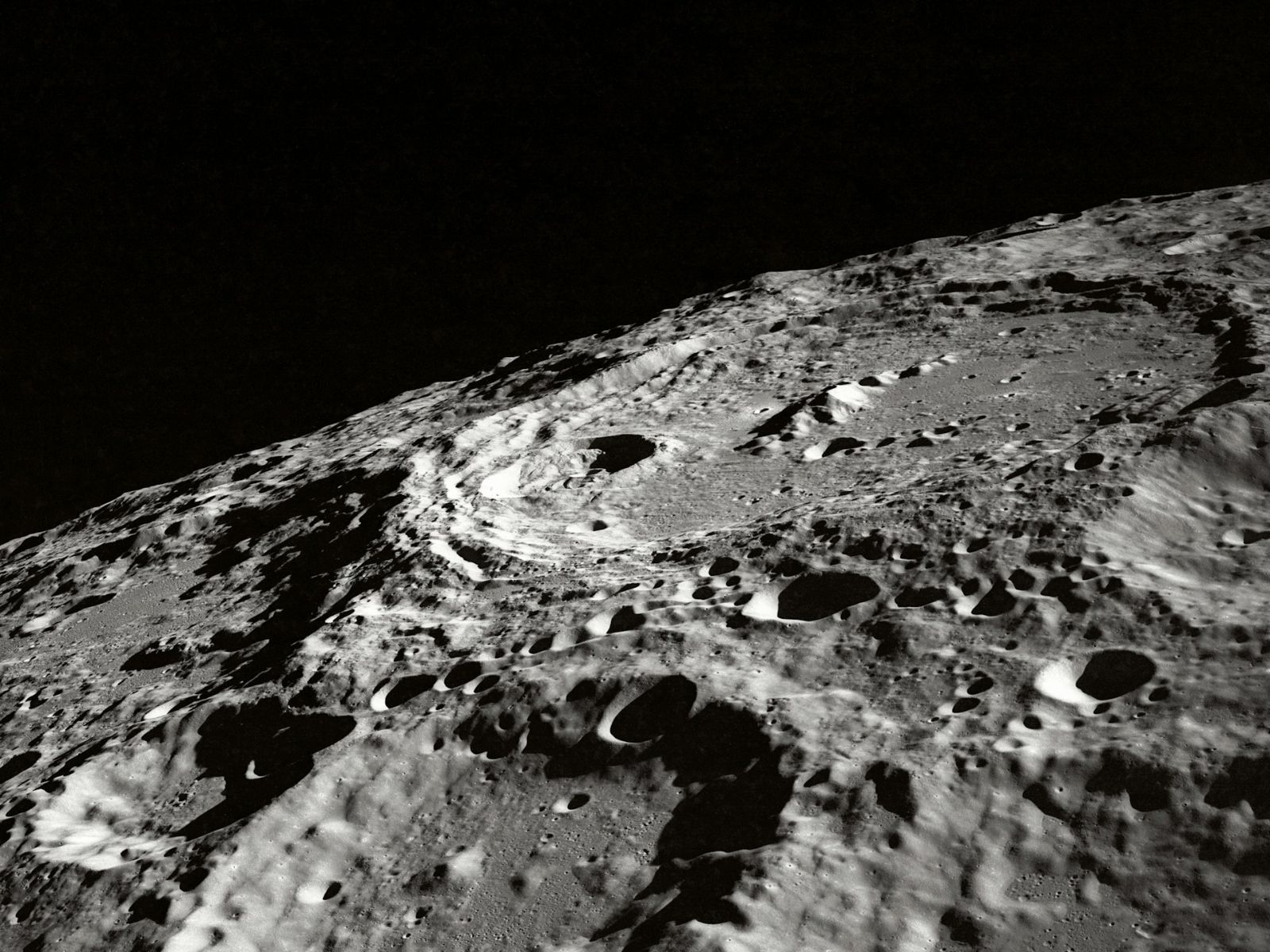
The Moon’s surface is a time capsule covered in impact scars, and one of them stands out above the rest. Scientists now believe the largest crater on the Moon, the South Pole–Aitken (SPA) basin, may have been carved by an enormous asteroid roughly 260 kilometers wide. Even more intriguing: future astronauts could potentially pick up pieces of that ancient collision during upcoming lunar missions.
Visible even from afar as a vast, battered region, the South Pole–Aitken basin stretches more than 1,550 miles (about 2,500 kilometers) across, making it the biggest known impact basin on the Moon. Despite its size and scientific value, it has remained surprisingly mysterious. Researchers have long been interested in it because the impact may have excavated deep layers of the Moon, potentially exposing material from the lunar mantle. If confirmed and sampled, that could reveal critical clues about how the Moon formed and evolved.
A research team led by Shigeru Wakita of Purdue University used advanced 3D simulations to trace the likely origin of this giant crater. Their results point to a massive asteroid around 260 km in diameter. According to the study, the object wasn’t just a typical space rock—it was likely made of a mix of iron and rock, a composition that would have helped deliver the immense energy needed to produce a basin as large as SPA.
The simulations also suggest the asteroid hit the Moon at a shallow angle of about 30 degrees, traveling at roughly 13 kilometers per second. That kind of glancing, high-speed strike would have blasted enormous volumes of debris outward. Based on the modeled aftermath, scientists estimate that chunks of the Moon’s mantle may have been thrown toward the lunar south pole—an area that’s drawing intense interest for exploration because of its unique terrain and the presence of permanently shadowed regions.
This is where the story becomes especially exciting for future lunar exploration. The study’s authors argue that astronauts landing near the Moon’s south polar region could be in a prime position to collect ejecta—material thrown out by the original impact. If a planned mission reaches the targeted region, astronauts could potentially retrieve these fragments and bring them back for laboratory analysis.
Those samples could help researchers narrow down when the South Pole–Aitken impact occurred, which would refine timelines for major events in the early solar system. Pinning down the age of this basin would also improve our understanding of lunar geology, the history of impacts near Earth, and how rocky worlds develop their internal layers over time.
In short, what looks like a distant, ancient scar on the Moon may soon become a hands-on scientific treasure hunt—one that could finally reveal the origins of the Moon’s greatest crater and unlock new details about our closest celestial neighbor.