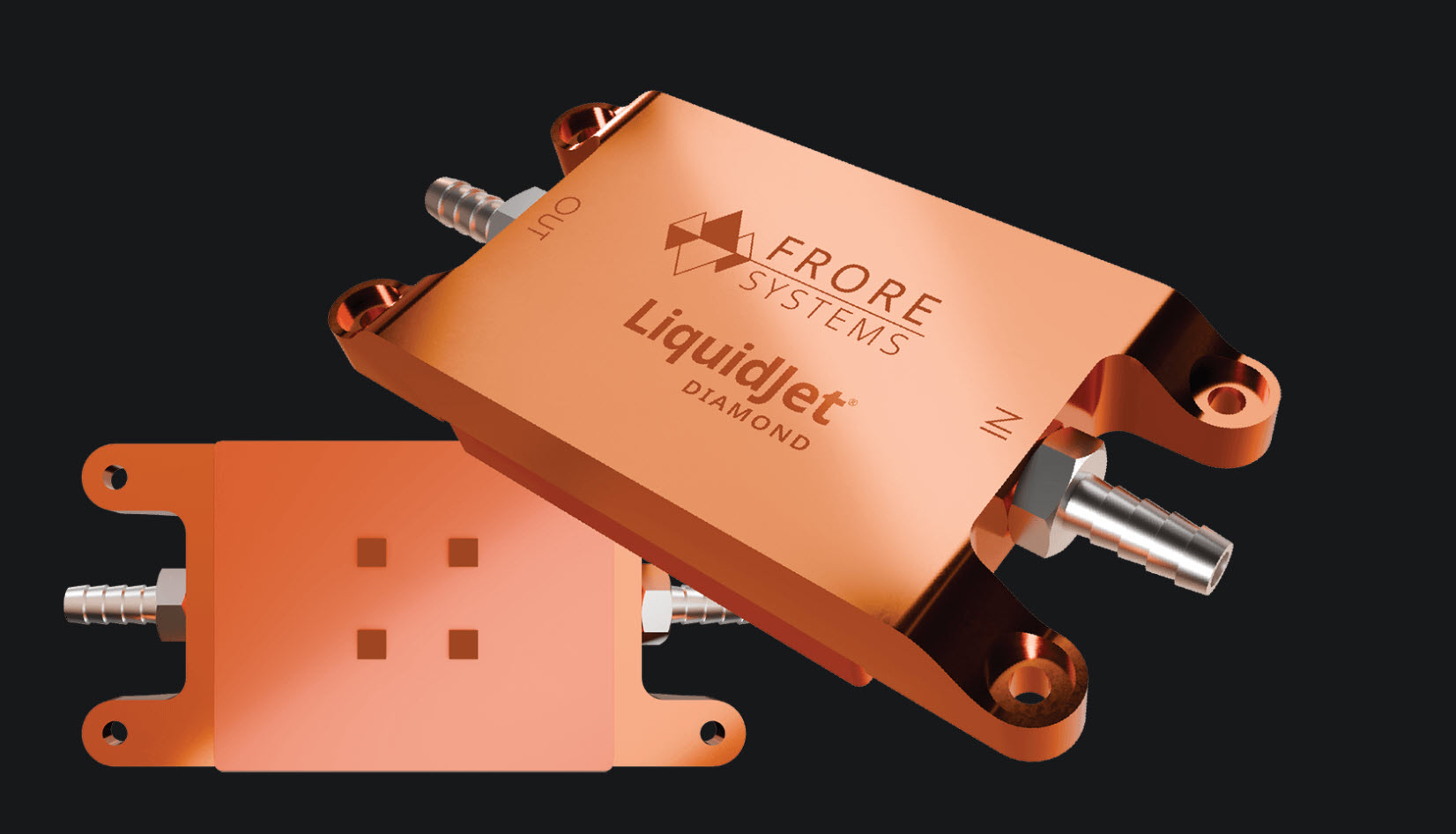
Frore Systems has introduced a new data center cooling technology designed for the fast-growing enterprise AI market. Called LiquidJet Diamond, the new cold plate is built to help AI factories run high-power GPUs and accelerators at lower temperatures while improving performance per watt.
As AI data centers expand worldwide, cooling has become one of the biggest challenges for operators. Modern AI GPUs are consuming more power, generating more heat, and creating extreme hotspots that can limit performance if not managed properly. Frore Systems says LiquidJet Diamond is designed to address this issue by improving thermal efficiency and helping AI systems generate more tokens within the same power budget.
LiquidJet Diamond builds on the company’s existing LiquidJet cold plate design, which uses a 3D ultra-short-loop multi-stage cooling architecture. This design can be customized for different GPUs and AI accelerators, allowing the cold plate to match the exact thermal layout of each chip, including its hottest areas.
The original LiquidJet design is already claimed to reduce GPU die temperatures by around 12°C, which Frore Systems says can deliver up to a 25% improvement in tokens per watt. With LiquidJet Diamond, the company adds an integrated diamond spreader to the bottom of the cold plate. Diamond is known for its exceptional thermal conductivity, and Frore says this addition can reduce temperatures by another 10°C.
Together, these improvements are said to provide up to a 35% increase in AI tokens per watt compared with traditional skived cold plates. In practical terms, that means AI infrastructure could produce more output using the same amount of power, which may help reduce operating costs and improve profitability for AI data centers.
Seshu Madhavapeddy, founder and CEO of Frore Systems, said AI factories are running into major performance barriers as GPUs become more power-dense and create intense hotspots. He explained that if these hotspots are not cooled effectively, GPUs cannot reach their full performance potential.
According to Madhavapeddy, LiquidJet Diamond combines the company’s 3D ultra-short-loop multi-stage design with an integrated diamond spreader, allowing it to cool hotspots up to 770 W/cm². He added that improved cooling makes each GPU more efficient, lowers the cost of producing AI tokens, and allows more tokens to be generated within the same power limits and infrastructure.
Compared with traditional cold plates, Frore Systems claims LiquidJet Diamond can deliver more than 150% higher maximum power density for hotspot cooling, 75% better heat transfer efficiency, GPU temperatures that are 16°C to 22°C lower, and 30% to 35% more AI tokens per watt. The company also describes the solution as a seamless drop-in upgrade, which could make adoption easier for existing AI server designs.
The technology is also being positioned for the future of larger and more powerful chips. AI processors and accelerators continue to grow in size and complexity, making heat management even more important. As chip packages become larger and power demands rise, traditional cooling approaches may struggle to keep up with next-generation workloads.
Frore Systems plans to demonstrate LiquidJet Diamond during OCP 2026. The company says it will show the cold plate running on a 2300W NVIDIA Rubin-based solution with a hotspot density of 770 W/cm².
LiquidJet Diamond highlights how data center cooling is becoming a major part of AI infrastructure innovation. As demand for AI compute continues to rise, technologies that improve GPU cooling, energy efficiency, and tokens-per-watt output could become increasingly important for data center operators looking to maximize performance without expanding power consumption.