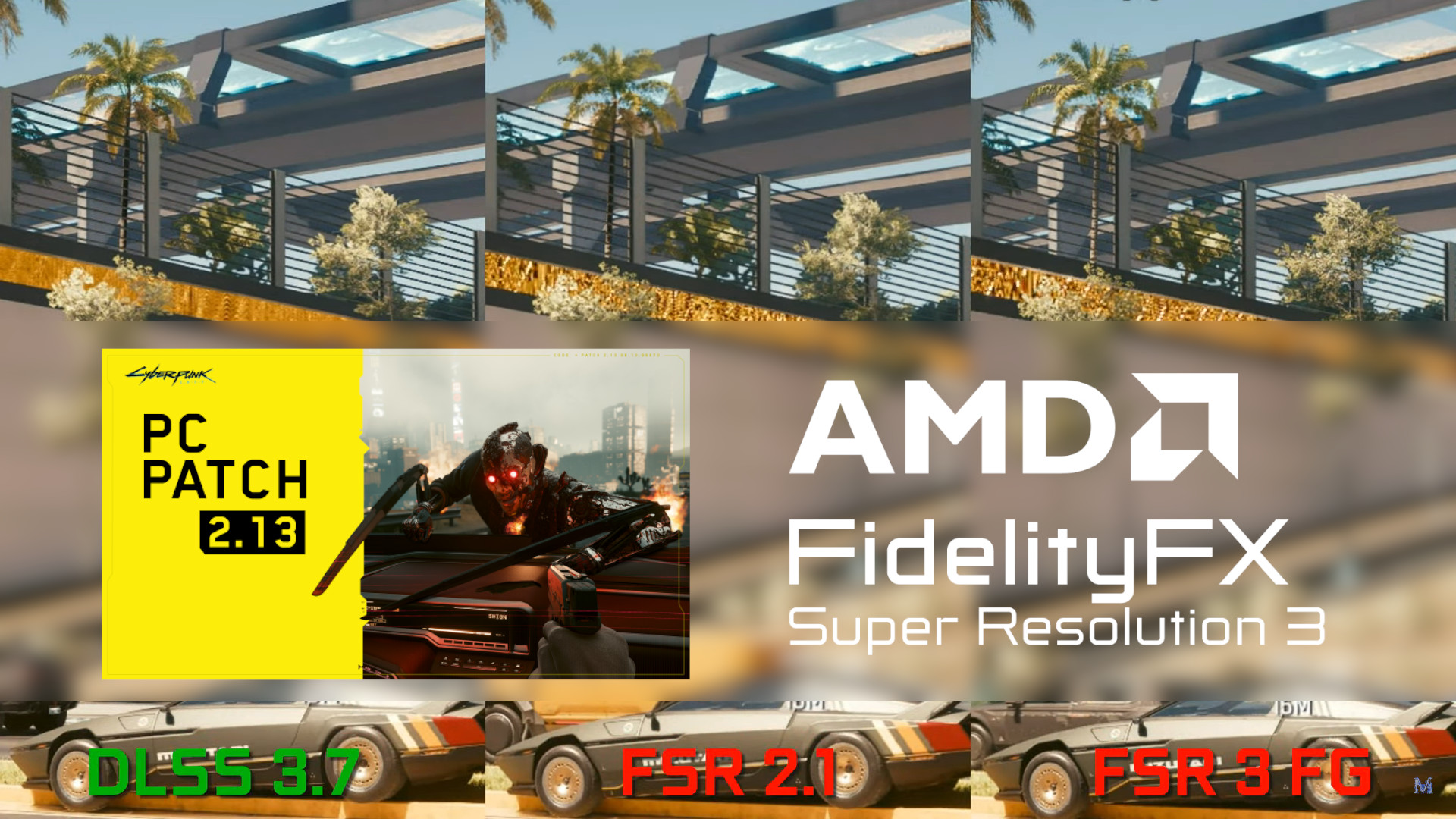
CD Projekt Red has recently integrated AMD FSR 3 with Frame Generation into Cyberpunk 2077, bringing a promising boost in frame rates, particularly appealing for handheld gamers. However, side-by-side evaluations indicate that AMD’s FSR upscaling and Frame Generation aren’t without their issues in this high-stakes gaming environment.
Several hardware configurations were tested to get a comprehensive view. On YouTube, Steam Deck Gaming provided an insightful examination of Cyberpunk 2077’s performance with patch 2.13 and FSR 3 on the Steam Deck—a scenario where performance gains are most beneficial. Testing revealed a significant performance increase, with FSR 3 and Frame Generation boosting frame rates from about 30-35 fps using FSR 2.1 to roughly 45-55 fps.
Intriguingly, Cyberpunk 2077’s map reacted differently to FSR 3 and Frame Generation. While some map areas exhibited severe image quality degradation, urban environments experienced fewer visual artifacts. FSR 3 Native combined with Frame Generation and low graphics settings achieved a balanced blend of visual quality and frame rate, averaging around 50 fps with decent image clarity.
This hardware-agnostic feature of AMD’s FSR 3 also enabled 54 FPS and MxBenchmarkPC on YouTube to test the upscaling technology on both an Nvidia GeForce GTX 1650 and GeForce RTX 3080. The GTX 1650 registered a notable frame rate increase, ranging from 60-85 fps with FSR 3 and Frame Generation, compared to a previous 25-45 fps in 1080p. However, similar to the Steam Deck, it faced flickering, shimmering, and blurring issues during high-speed movements.
The RTX 3080 showed a comparable performance surge, reaching about 71-75 fps in 1440p with FSR 3 and Frame Generation, a significant jump from 40 fps with FSR 2.1. Nevertheless, issues like shimmering on reflective surfaces and foliage persisted. At 4K resolution with FSR 3 Performance mode, ray tracing, and Frame Generation, the RTX 3080 achieved around 45-53 fps. When Nvidia’s DLSS 3.7 in Performance mode with Ultra ray tracing was used, it managed similar frame rates with superior image quality, making FSR less compelling for Nvidia hardware users.
For slower hardware like the AMD Radeon iGPU in the Steam Deck, performance remained lackluster, accompanied by significant visual artifacts. Additionally, various bugs were identified, particularly when using in-game vehicles like cars and motorcycles. Future updates to FSR 3.1 are anticipated to offer improved visual and performance metrics over current iterations.
Despite the graphical issues seen with FSR 3, which also affected previous versions like FSR 2.1, the performance gains are notable. This is encouraging for gamers who rely on features like FSR 2.1 to achieve playable frame rates.
The release of AMD FSR 3 represents a step in the right direction for performance improvements, but it remains a mixed bag, especially when considering visual fidelity against performance metrics. Gamers and tech enthusiasts will be watching closely for any forthcoming updates that could address current shortcomings.


