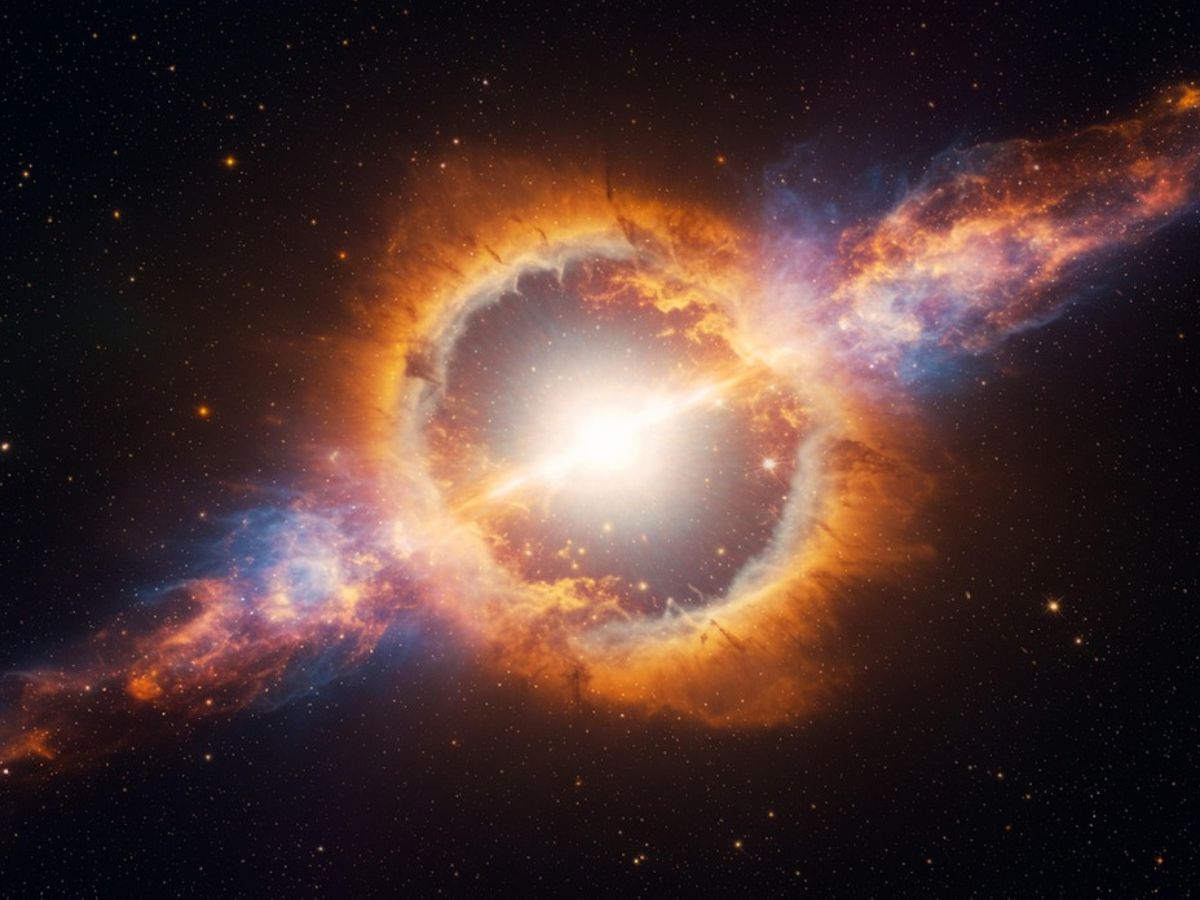
A potential daytime spectacle: the star system that could light up our sky
The cosmos is full of curveballs, from mysterious interstellar visitors to stars on the brink of dramatic transformation. One of the most tantalizing candidates for a truly unforgettable show is V Sagittae, a volatile double-star system more than 10,000 light-years from Earth that astronomers have watched closely for over a century.
V Sagittae is an extreme pairing: a massive normal star and a super-dense white dwarf locked in a dizzying embrace, completing an orbit around each other roughly every 12 hours. That tight dance fuels chaos. The white dwarf’s intense gravity siphons gas from its companion, piling up matter on its surface. This relentless feeding triggers violent thermonuclear reactions—sudden surges and dips in brightness that have kept observers fascinated for decades.
Using one of the world’s most powerful instruments, the Very Large Telescope, astronomers have revealed a vast ring of gas surrounding the system. That discovery underscores how ravenous—and yet overwhelmed—the white dwarf is. It simply can’t swallow everything its companion star sheds, leaving material to accumulate in a sprawling envelope around the pair.
Why does that matter? Because this steady buildup is a recipe for an explosive finale. If enough material amasses and conditions line up, V Sagittae could erupt in a spectacular outburst, with some researchers suggesting the event might be visible to the naked eye—and possibly even in daylight. The most dramatic scenario involves the two stars spiraling inward and colliding, unleashing a burst so bright it could dominate the sky for days to weeks.
How soon could this happen? That’s the big unknown. Predicting the exact timing and intensity of stellar explosions is notoriously difficult. The system’s behavior is unstable, and other cosmic processes could nudge the timeline forward or backward. Some estimates point to the event occurring within human lifetimes, while others caution that it could take longer. What’s clear is that V Sagittae is evolving rapidly on astronomical timescales, making it a prime target for ongoing monitoring.
For skywatchers, here’s what to know:
– Location and distance: V Sagittae lies in the direction of the constellation Sagitta, more than 10,000 light-years away—far enough that any outburst poses no danger to Earth.
– What you might see: If the system erupts with exceptional brightness, it could appear as a “new star” in the sky, visible to the naked eye and potentially even in daylight, depending on the peak luminosity.
– Why it’s special: Daytime-visible stellar events are rare. A bright outburst from V Sagittae would be a once-in-a-lifetime sight and a treasure trove of data for astronomers studying how binary systems evolve and explode.
Even without a fixed date, the science is thrilling. V Sagittae encapsulates the life-and-death drama of stars: gravity at war with pressure, matter falling and flaring, and the ultimate possibility of a colossal explosion that could briefly outshine almost everything else in the night sky.
Keep an eye on updates from observatories tracking the system. If and when V Sagittae makes its move, you’ll want to be ready for one of the most extraordinary natural spectacles our sky can offer.