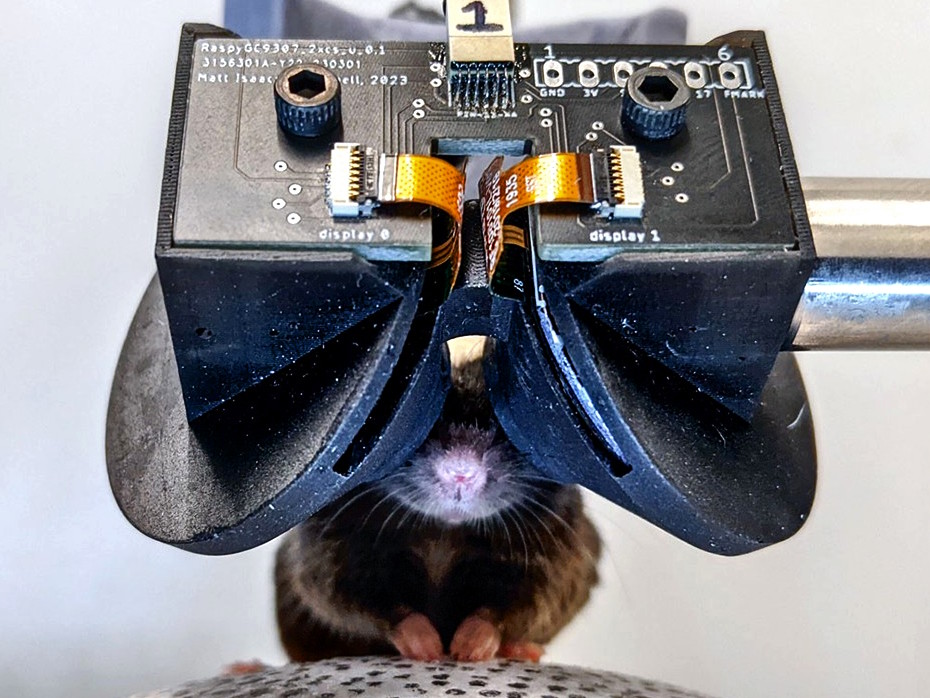
Incredible advancements in neuroscience have arrived, thanks to the ingenuity of Cornell researchers who have taken a giant leap forward in understanding our mind’s mysteries by designing MouseGoggles—a tiny, immersive VR headset for mice. Traditionally, mice have been a key model for studying behavior and neurological systems due to their genetics, maze skills, and love for cheese. These adorable creatures have now ventured into uncharted territories of virtual reality, potentially unraveling complexities of spatial navigation and memory in the process.
The project, led by Professor Chris Schaffer and Assistant Professor Ian Ellwood, showcases these revolutionary headsets made using everyday components like smartwatch displays and small lenses. This affordable technology not only stimulates a wide field of vision but also tracks the mice’s eye movements, offering a wealth of data on neural behavior. This new window into rodent minds could pave the way for breakthroughs in understanding Alzheimer’s and other neurodegenerative diseases.
The detailed study, published in December in Nature Methods, has ignited the research community. It emphasizes the headset’s potential to serve as an accessible tool for numerous labs aiming to explore cognitive function recovery and neuronal activity. Exciting advances from Schaffer’s lab have already shown improvements in memory function by enhancing blood flow in mice with Alzheimer’s. The next step? Finding out just how these enhancements boost brain function.
Developers have solved the previous challenges of bulky and costly VR setups that often distracted from research with light pollution and noise. The MouseGoggles offer a sleek, immersive experience that gets closer to naturalistic neural studies. By employing a “hacker ethos,” Isaacson, one of the study’s lead authors, capitalized on readily available technology to build a stationary yet deeply immersive setup.
On the experimental front, the MouseGoggles have undergone extensive testing, utilizing neurological assessments to gauge their efficacy. For example, they have been used to ensure mice are experiencing high-quality virtual images and that their brains are mapping these virtual environments correctly. The ultimate test? Witnessing mice react convincingly to stimuli, like a perceived looming predator, which they previously ignored in older VR setups.
Adding to their impressive functionality, the researchers enhanced the device with eye-tracking capabilities based on reviewer feedback during their Nature Methods submission. This critical feature enables further exploration of engagement and arousal states, which are key to understanding cognitive processes.
The Cornell team is not stopping here. Plans are in motion to adapt the goggles for larger rodents and explore multi-sensory experiences by integrating taste and smell. Such advances may unravel how these animals synthesize information to make conscious decisions.
These innovative MouseGoggles, brought to life by a team including doctoral students, postdoctoral researchers, and recent graduates, received support from notable institutions such as the Cornell Neurotech Mong Family Fellowship and the National Institutes of Health. This research is set to inspire and empower a wave of neuroscience studies, making monumental strides in unraveling the neural enigmas of life.