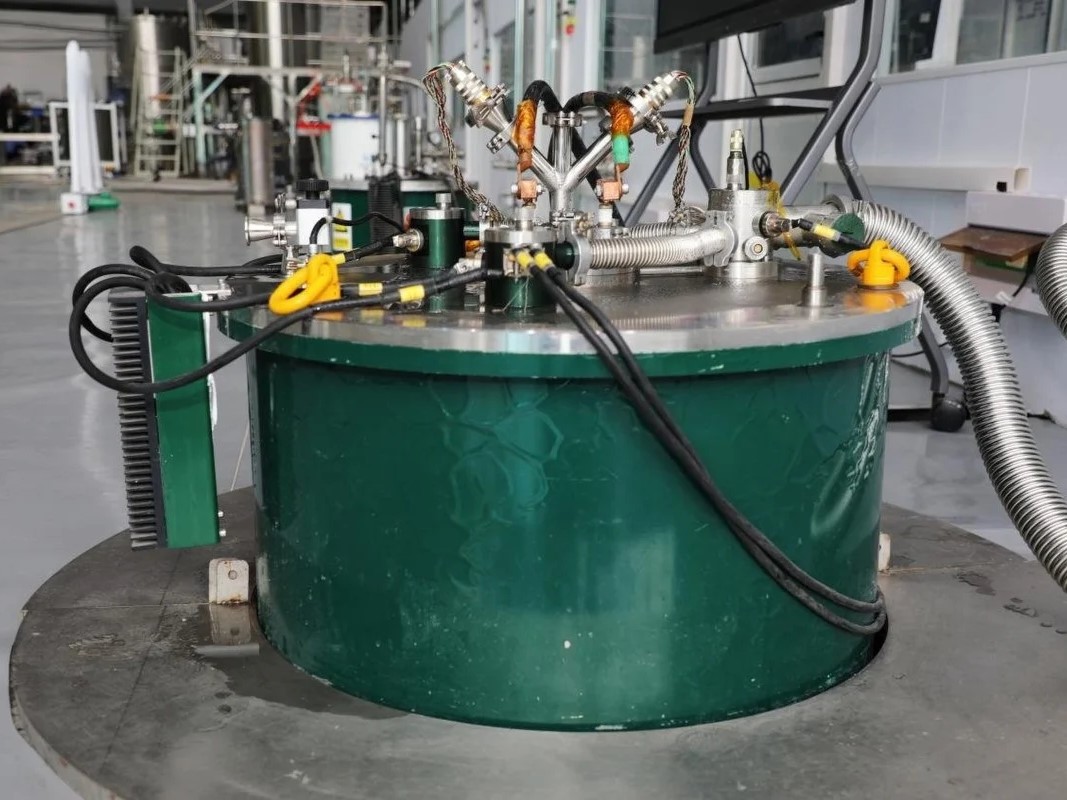
China sets new world record with a 35.5‑tesla all‑superconducting magnet
Researchers at the Chinese Academy of Sciences’ Institute of Plasma Physics (ASIPP) have generated a steady magnetic field of 35.5 tesla using a fully superconducting magnet, setting a new world record and pushing the frontiers of magnet technology. For perspective, that’s more than 350,000 gauss—about 700,000 times stronger than Earth’s magnetic field.
Developed in Hefei with partners including Tsinghua University, the magnet surpasses the previous 32.35‑tesla benchmark from 2019. It sustained peak performance for 30 minutes at a time before being demagnetized, a sign of impressive stability and precise engineering under extreme conditions.
The system uses a hybrid, all‑superconducting architecture: a high‑temperature superconducting inner coil nested inside a conventional low‑temperature superconducting outer magnet. Researchers said this approach helped them overcome severe mechanical stress and complex interactions between multiple magnetic fields, challenges that typically limit performance at such high intensities.
Why it matters: high‑field, steady magnets are essential for advancing nuclear fusion. They form the magnetic “cage” needed to confine ultra‑hot plasma and keep fusion reactions stable—one of the biggest hurdles on the path to practical fusion energy. Beyond fusion, this breakthrough can accelerate innovations in magnetic levitation (maglev) transport, electromagnetic propulsion, and other high‑field applications across research and industry.
ASIPP also announced full localization of the required superconducting materials and systems, establishing a domestic supply chain that can support future scaling and deployment.
With a record‑breaking 35.5‑tesla steady field, extended stable operation, and a resilient materials pipeline, this achievement positions China at the forefront of superconducting magnet development and moves the global fusion and advanced engineering communities a step closer to real‑world solutions.