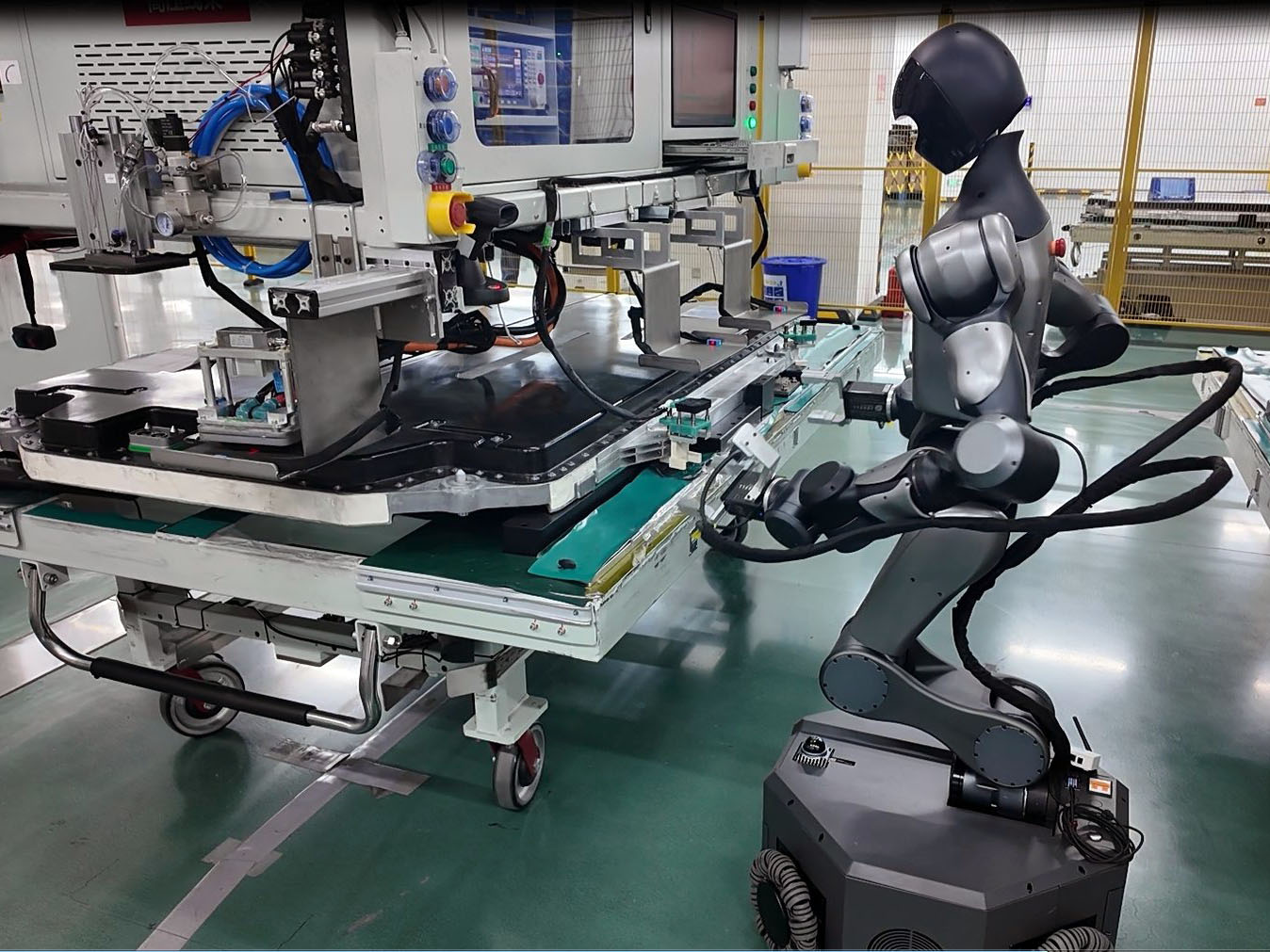
CATL has taken a major step toward bringing humanoid robots into real, large-scale factory work, and it appears to be doing it ahead of Tesla’s Optimus—at least when it comes to actual deployment in mass EV battery production. According to CATL, its Moz industrial humanoid robot is already operating on a battery pack production line and can now perform certain precision tasks at a level that matches skilled human workers.
The company says Moz, created by its Spirit AI subsidiary, has been commissioned at scale and is now working on what CATL describes as the world’s first power battery pack production line to achieve large-scale deployment of humanoid embodied intelligence robots. In practical terms, CATL is positioning Moz as more than a pilot project or showroom demo. It’s presented as a working system inside a real production environment—where reliability, repeatability, and quality standards matter every minute.
What makes CATL’s announcement especially notable is the type of work Moz is supposedly doing. Rather than performing simple pick-and-place motions, the robot has been deployed at key quality assurance points in the manufacturing process. CATL says Moz handles tasks such as attaching battery connectors—jobs that demand high precision, consistent speed, and careful control to avoid damaging components.
CATL claims Moz has reached a 99% insertion success rate, driven by an end-to-end vision model designed to adapt on the fly. The robot reportedly compensates for material position deviations and connection point changes, adjusting its posture in real time to keep the operation accurate. Just as important in battery pack assembly, Moz is said to gauge and apply the correct amount of force when securing a harness, helping prevent damage to thin wiring while still ensuring a reliable connection.
The company also emphasizes Moz’s broader capabilities beyond a single repetitive motion. CATL describes strong environmental perception and task generalization, which suggests the robot isn’t limited to one tightly scripted routine and can better handle the small variations that tend to show up in real factory conditions.
This development also arrives at a time when China is seeing a surge of humanoid robot and AI-focused companies, with some observers warning that the space is becoming crowded. Even so, a major manufacturer putting humanoid robots into mass production lines—especially for EV battery packs—signals that the technology is moving beyond prototypes and into the kind of industrial deployment that can reshape manufacturing efficiency, quality control, and labor planning.
If CATL’s results hold up at scale, Moz could become one of the clearest examples yet of humanoid robots performing complex factory tasks at near-human capability—inside the global EV battery supply chain where speed, precision, and uptime are everything.