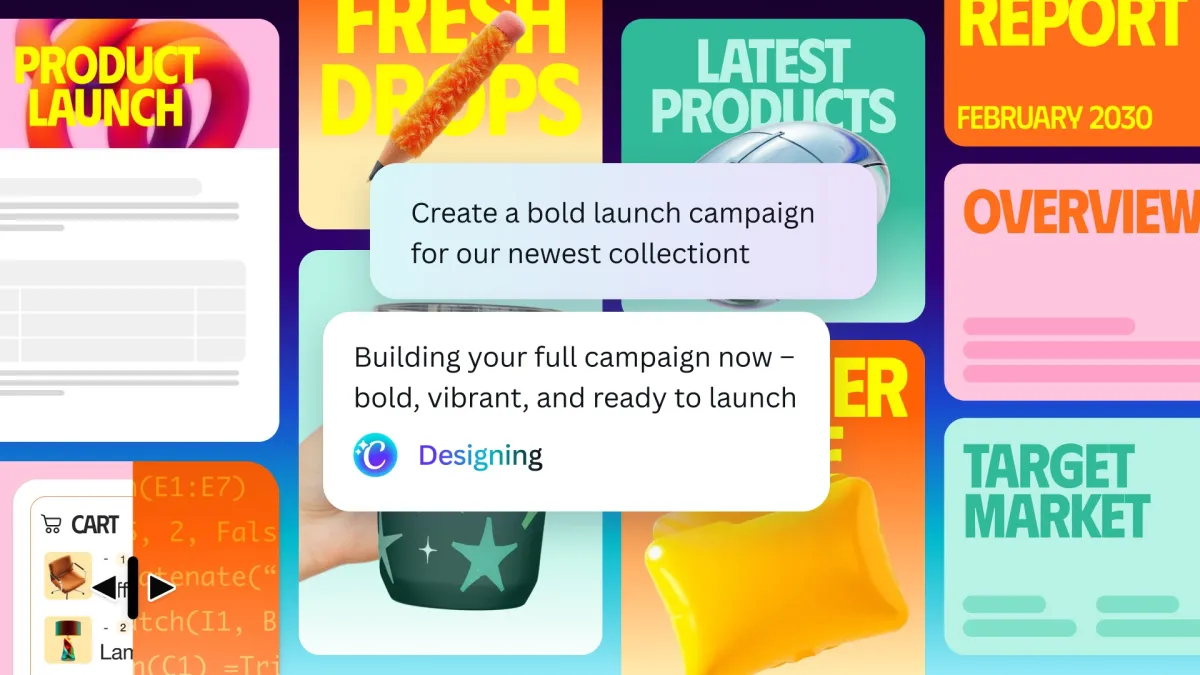
AI assistants are quickly reshaping how people get work done online. The big promise behind these new “agentic” AI platforms is simple: you tell an assistant what you need, it figures out the steps, uses the right tools on your behalf, and remembers your preferences so future tasks get faster and more consistent. For design professionals and marketers especially, that predictability matters. They don’t just want a cool one-off image. They want a reliable workflow that repeatedly produces editable, on-brand assets.
That’s exactly the direction Canva is pushing with the newest version of its Canva AI assistant. In this update, Canva AI can turn plain-language prompts into editable designs. You describe what you want—like a social post, a flyer, or a campaign graphic—and the assistant automatically pulls in the tools needed to produce multiple design options. A key detail is that the results are built with layers, so users can fine-tune individual elements instead of being stuck with a flat, uneditable output. For anyone who needs control over typography, layout, colors, and brand elements, layered editing makes AI-generated designs far more practical.
This release is part of a broader effort to make Canva AI the center of the Canva workflow. The company has been steadily expanding its AI features, including image generation and website generation, with the goal of letting users move from idea to finished publish-ready content without jumping between a dozen tools.
The competitive landscape is moving in the same direction, too. Other major design platforms are also building AI assistants and AI agents designed to coordinate tasks across their product suites, signaling a shift toward “one prompt, many tools” creative workflows.
Canva co-founder and COO Cliff Obrecht says Canva’s strength is where many businesses want to do the final mile: editing, collaboration, and publishing. In his view, plenty of teams may experiment with different AI systems to generate content, but they often prefer to bring that content into Canva to finish it properly with teammates and get it ready for deployment. He also noted that Canva works closely with leading AI model providers, which helps connect Canva into broader agentic workflows, even when a user starts in another AI tool.
On the business side, Obrecht said Canva continues to draw a large share of revenue from individuals and small teams, but its enterprise segment is increasing rapidly, growing 100% year over year. He added that Canva—most recently valued at $42 billion, according to PitchBook—will likely go public next year.
Beyond design creation, the update adds integrations designed to help Canva AI understand a user’s context. New connections include Slack, Gmail, Google Drive, Calendar, and Zoom. The idea is that, if a user allows it, Canva AI can read relevant emails, conversations, documents, and meeting details to better inform what it creates. Canva is also introducing a web research skill, enabling the assistant to browse the internet to help complete tasks.
Another practical addition is scheduling. Users will be able to tell Canva AI to run repeatable tasks in the background. Importantly, these scheduled actions won’t auto-publish; they’ll generate drafts that users can review and post when ready, which balances automation with control.
Canva is also upgrading existing AI capabilities inside the platform. Its AI code generator can now import HTML, and Canva can generate spreadsheets from text prompts, letting users describe what they want and have the tool build it.
On the performance front, Canva says it has improved the efficiency of its AI models. The company claims its Lucid Origin image generation model is now five times faster and thirty times cheaper, while its 12V image-to-video model is seven times faster and seventeen times cheaper. If these gains hold up across real projects, they could make AI-driven creative production more accessible, especially for teams producing content at scale.
Canva AI 2.0 is rolling out as a research preview this week, with broader availability planned for all users in the coming weeks. For creators, marketers, and small businesses looking for faster ways to produce editable, collaborative design work, Canva’s new assistant is clearly aiming to be more than a gimmick—it’s trying to become the workflow itself.