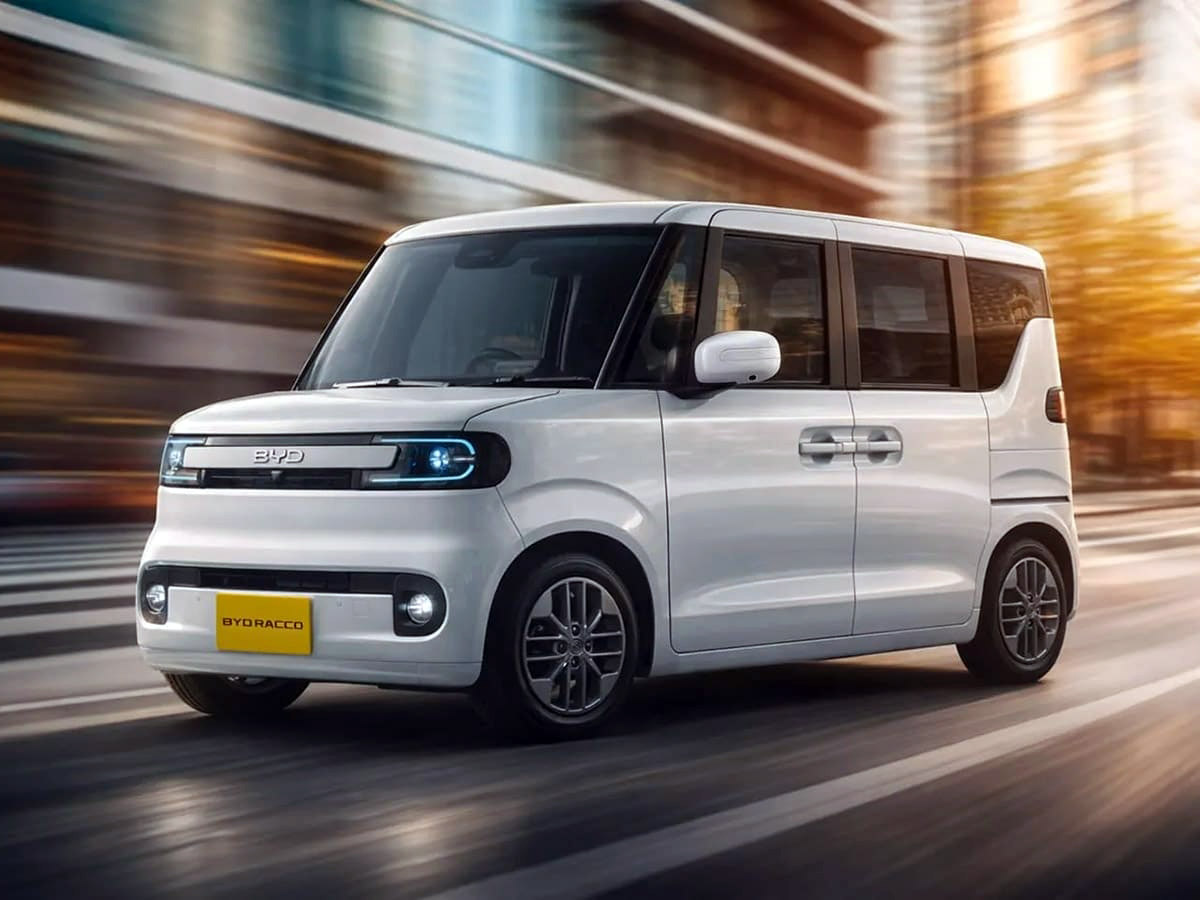
BYD Racco Debuts in Japan as a Low-Cost Electric Kei Car With 320 Km Range
BYD is taking a bold step into one of Japan’s most difficult automotive segments with the launch of the Racco, a compact electric kei car designed specifically for Japanese roads, cities, and buyers. Rather than simply resizing an existing EV, BYD has developed the Racco from the ground up to fit Japan’s strict kei-car rules and everyday driving needs.
Japan’s kei-car market is one of the most important vehicle categories in the country. These small, space-efficient cars are popular because they are affordable, easy to park, and well suited to Japan’s narrow streets and limited urban space. Kei cars also benefit from tax advantages, helping them account for around 40% of new vehicle sales in Japan.
That makes the BYD Racco a major launch. It is the first electric kei car from a Chinese automaker aimed directly at this highly competitive and traditionally local-dominated market.
The BYD Racco follows Japan’s kei-car size limits, measuring 3,395 mm long, 1,475 mm wide, and 1,800 mm tall. Its tall, boxy shape is designed to maximize cabin space while keeping the footprint small. This places it in the popular “super height wagon” category, where models such as the Honda N-BOX and Suzuki Spacia have become household names.
Range is one of the Racco’s biggest selling points. BYD claims the Racco can travel around 320 km on the WLTC cycle, giving it a notable advantage over the Nissan Sakura, which offers about 180 km. It also positions the Racco strongly against upcoming electric kei-car rivals.
Price could be another key factor in its success. After Japan’s electric vehicle subsidies, the BYD Racco is expected to cost the equivalent of about $12,200. That aggressive pricing makes it one of the more affordable options in the segment and gives budget-conscious buyers a strong reason to consider switching to an electric kei car.
Charging is practical for daily use, though not especially fast on a standard Japanese 100V household outlet. A full charge takes roughly six hours, but the Racco also supports DC fast charging for drivers who need quicker top-ups.
BYD appears to have carefully studied Japan’s market before introducing the Racco. The company reportedly tested and developed the vehicle across different regions of Japan, focusing on areas where kei cars are especially popular. This local-first approach could help the Racco feel less like an imported experiment and more like a vehicle tailored for Japanese lifestyles.
To build awareness, BYD is also investing in local marketing. Actress Alice Hirose has been featured in Racco advertising, giving the brand a familiar face as it tries to win over Japanese consumers.
Still, BYD faces a major challenge. The company has only around 80 showrooms in Japan, while established Japanese automakers sell through thousands of dealerships nationwide. Even with strong specifications, a low price, and a practical design, dealership access and brand trust will be crucial if the Racco is to compete seriously with long-running local favorites.
The BYD Racco arrives at a time when Japan’s small electric car market is beginning to heat up. With its compact dimensions, spacious interior, competitive range, and low subsidized price, it could become one of BYD’s most important models in Japan. If buyers respond well, the Racco may prove that foreign brands can compete in one of Japan’s most protected and uniquely local car segments.