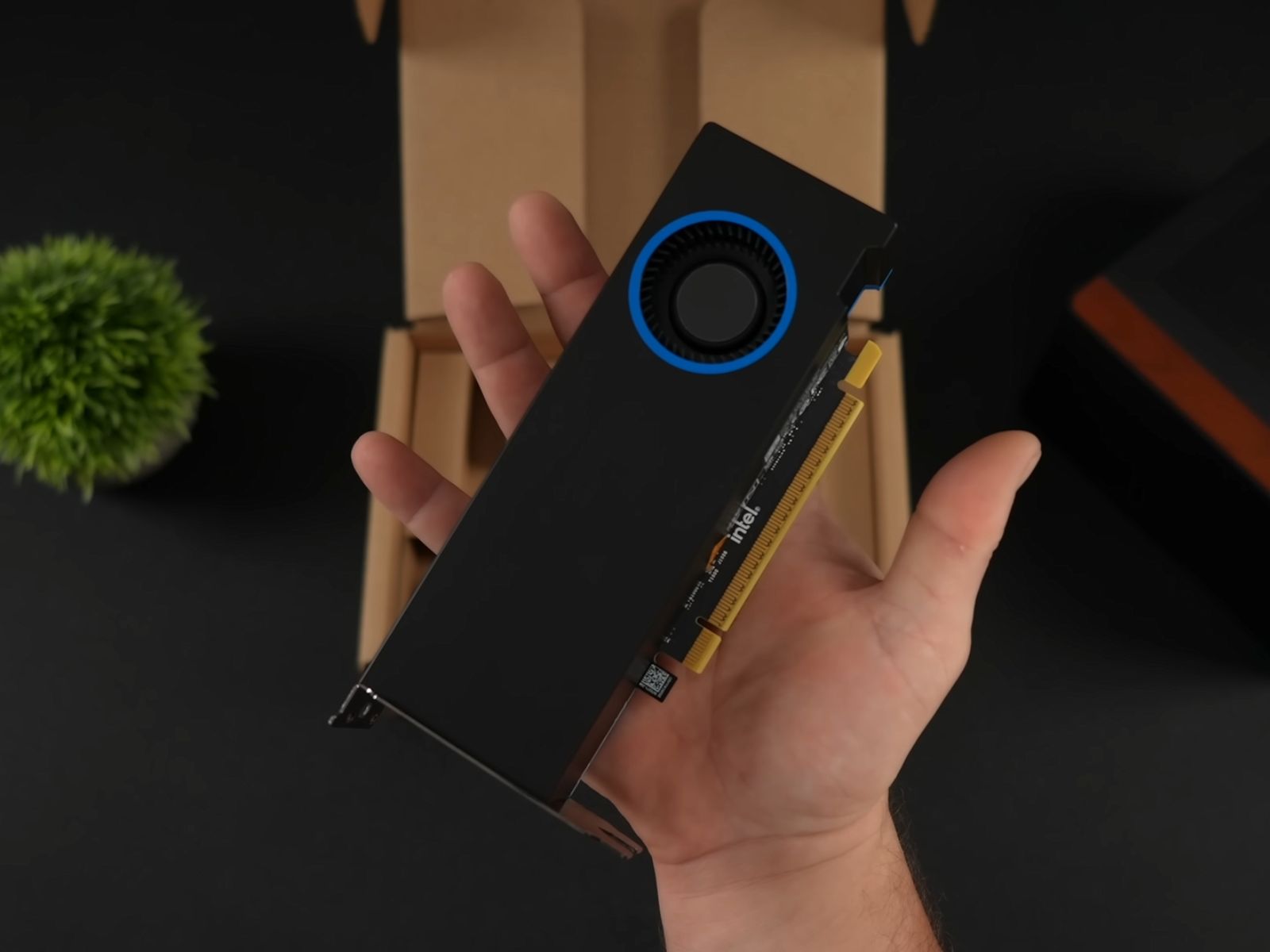
A workstation graphics card that wasn’t built for play has quietly turned into a surprisingly capable gaming option. By swapping from the professional driver to Intel’s gaming driver, recent tests on the Intel Arc Pro B50 show how far smart settings and modern upscaling can go.
In Cyberpunk 2077 at 1440p with Ultra settings and XeSS Super Resolution 2.0 on Quality, the Arc Pro B50 delivered 40–50 FPS. Switching XeSS to Balanced pushed that to 50–60 FPS. The real breakthrough came by enabling Intel XeSS Frame Generation, setting Intel Xe Low Latency Frame Rate Target to zero, and returning XeSS to Quality, which boosted performance to a smooth 80–90 FPS.
Marvel Rivals also impressed. At 1440p High with XeSS on Quality, frame rates stayed comfortably above 60 FPS even during chaotic team fights. Doom: The Dark Ages averaged about 71 FPS at 1080p on Nightmare with no scaling, while Forza Horizon 5 soared past 100 FPS on average at 1440p Ultra without any upscaling at all.
Perhaps most notable is power behavior. Across the test suite, the GPU’s draw hovered around 50 W, with utilization pinned between 98% and 100%. That combination of high efficiency and near-peak usage suggests the card is being leveraged effectively while maintaining modest power consumption.
The takeaway is clear: although the Intel Arc Pro B50 isn’t marketed as a gaming GPU, it can deliver very playable performance in modern titles when paired with the gaming driver and features like XeSS Super Resolution and Frame Generation. If you already have this card for creative or workstation tasks, enabling the gaming driver and dialing in these settings can unlock surprisingly strong 1080p and 1440p results without heavy power demands.
There’s also a full build and gameplay showcase available from the tester for those who want to see the setup and performance in action.


