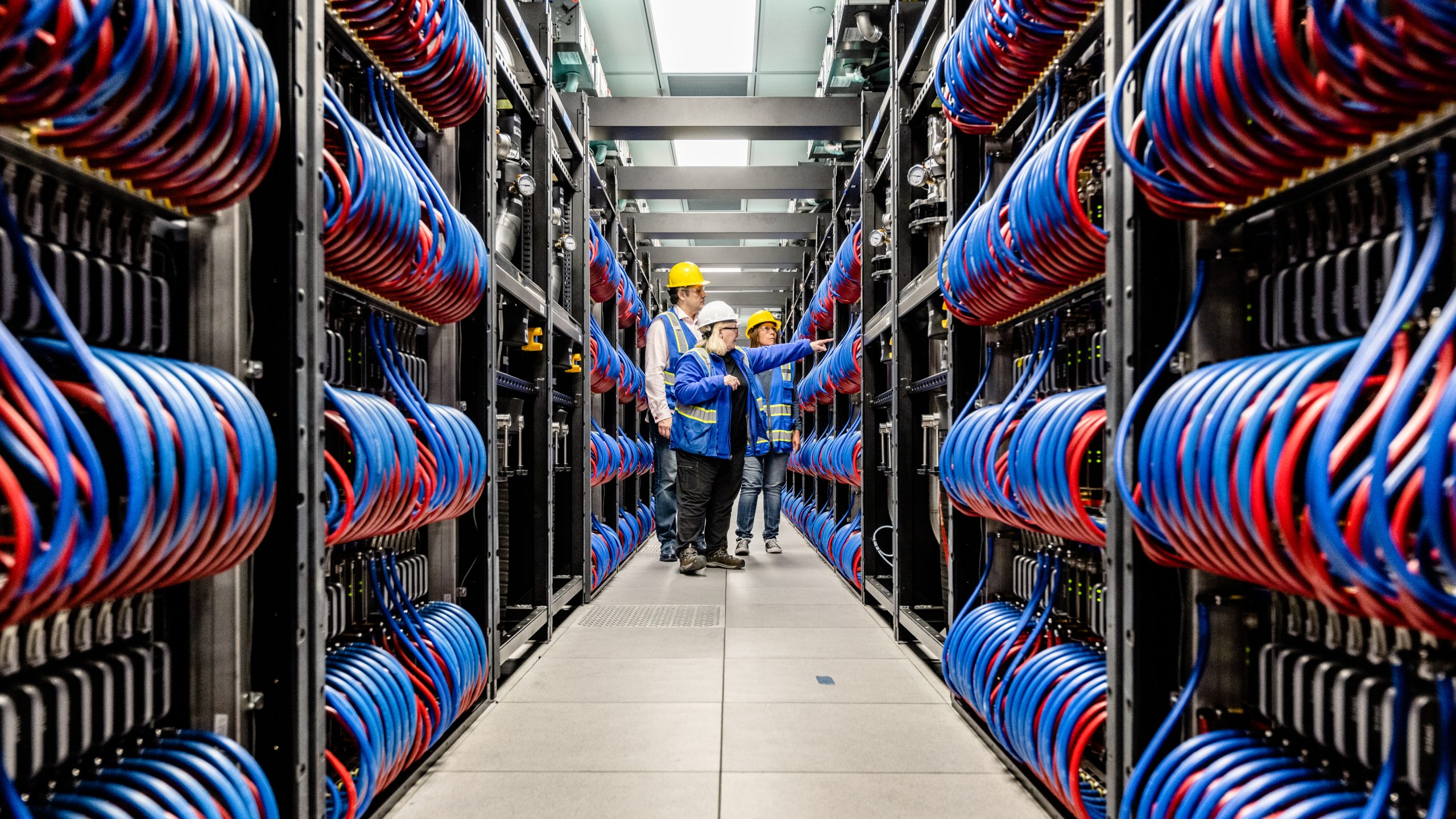
The realm of high-performance computing (HPC) and artificial intelligence (AI) has witnessed a monumental achievement with the Aurora supercomputer, powered by Intel technology, surpassing the exascale barrier and attaining the title of the fastest AI supercomputer. This breakthrough showcases the combined prowess of Intel’s Ponte Vecchio hardware and the collaborative effort of the Argonne National Laboratory and HPE (Hewlett Packard Enterprise).
## Intel’s Aurora Supercomputer Reaches New Computing Heights
The much-anticipated Aurora system, situated at the Argonne National Laboratory, was designed to be at the forefront of HPC and AI innovation. Equipped with high-end Intel Xeon CPU Max and Data Center GPU Max series, the ambitiously constructed Aurora was engaged in a tight race with AMD, which was also vying for exascale computing success. Despite an initial announcement back in 2019 and a few challenges along the way, Aurora has impressively reached 87% operational capacity, which equates to 9234 nodes of the total 10,624.
At ISC High Performance 2024, announcements came forth revealing that Aurora had shattered the exascale computing threshold, achieving 1.012 exaflops and setting a new benchmark for AI systems engaged in open science with a monumental 10.6 AI exaflops. As a nod to the importance of collaborative ecosystems, these advancements in AI-accelerated HPC were highlighted.
## A Closer Look at the Aurora Supercomputer’s Specifications
The state-of-the-art Aurora supercomputer boasts a configuration comprising 166 racks with 10,624 blades, which house 21,248 Intel Xeon CPU Max chips (4th Gen Sapphire Rapids) and 63,744 Intel Data Center GPU Max series cards (Ponte Vecchio). Its infrastructure is interconnected through the HPE Slingshot fabric, encompassing 84,992 endpoints.
In performance testing, Aurora not only came in second in the HPL LINPACK benchmark but also crossed the coveted exascale performance mark at 1.012 exaflops, despite only utilizing 87% of its full node capacity. Furthermore, the system claimed third place in the HPCG benchmark, with a performance rating of 5612 TFLOPs per second, using just 39% of its capacity.
The supercomputer’s AI performance is particularly noteworthy, topping the performance charts at 10.6 AI Exaflops, as measured by the LINPACK-mixed precision (HPL-MxP) benchmark. This strength is attributed to the Xe core architecture, which includes specialized AI hardware blocks.
## The Future of Supercomputing and AI with Intel
The deployment of new supercomputers employing the latest Intel Xeon CPU Max Series and Intel Data Center GPU Max Series technologies signifies Intel’s dedication to advancing the fields of HPC and AI. Notable systems utilizing these innovations include the Euro-Mediterranean Centre on Climate Change’s Cassandra for enhancing climate change models; Italy’s ENEA’s CRESCO 8 for facilitating fusion energy breakthroughs; TACC for comprehensive data analysis across various scientific disciplines; and the UKAEA supercomputer for solving complex memory-bound problems relevant to future fusion powerplants.
As Intel prepares to introduce its next-generation GPU for AI and HPC, code-named Falcon Shores, they aim to build upon this success. Falcon Shores is expected to merge the upcoming Intel Xe architecture with the best aspects of Intel Gaudi, promising a unified programming interface and significant performance enhancements.
In fact, early performance metrics indicate that Intel Xeon 6, with P-cores and Multiplexer Combined Ranks (MCR) memory at 8800 MT/s, can deliver performance improvements of up to 2.3 times for real-world HPC applications compared to previous generations. This progress places Intel as a favored provider of HPC solutions.
The Aurora supercomputer’s achievements are poised to serve as the foundation for the burgeoning era of exascale computing, driving innovation in AI, climate research, energy development, and a myriad of scientific pursuits.