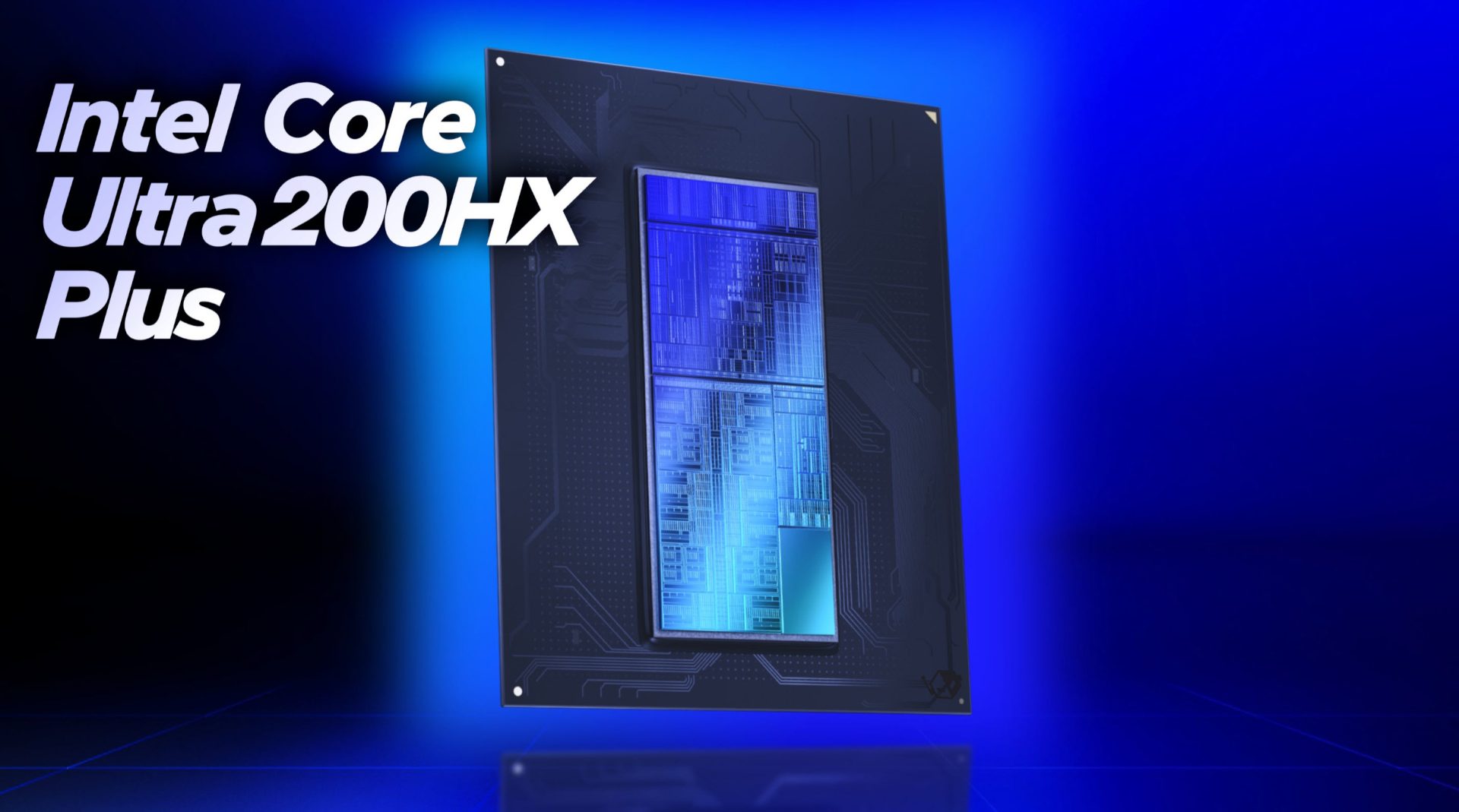
Intel is expanding its Arrow Lake refresh for high-end laptops with the new Core Ultra 200HX Plus lineup, aiming to squeeze more gaming performance, lower latency, and better platform features out of the same enthusiast-class mobile ecosystem. The headline is simple: these “Plus” chips are meant to be a faster, more feature-rich evolution of the existing Core Ultra 200HX family, especially for gaming laptops and creator notebooks that already target the top of the market.
This Core Ultra 200HX Plus refresh focuses on three major themes: small architectural and process tuning, more performance on the current platform, and a stronger “best-of-gen” expression of Intel’s newest mobile architecture. Intel is positioning the 200HX Plus series as its fastest gaming laptop processors so far, highlighting improved value, higher multi-core capability, and new performance-focused technologies.
Two new processors lead the update: the Intel Core Ultra 9 290HX Plus and the Intel Core Ultra 7 270HX Plus.
Intel Core Ultra 9 290HX Plus specs and what’s new
The Core Ultra 9 290HX Plus sits at the top of the refreshed stack. It packs 24 total cores made up of 8 performance cores (Lion Cove) and 16 efficiency cores (Skymont). Intel lists a maximum boost clock of up to 5.5 GHz, along with 36 MB of L3 cache and 40 MB of L2 cache. Integrated graphics include 4 Xe cores clocked up to 2.0 GHz. Like the prior flagship HX parts, it’s built for high-power gaming laptops with a maximum turbo power (MTP) set at 160W.
Compared to the Core Ultra 9 285HX, the 290HX Plus keeps the same core count and the same top boost rating. The main shifts are slightly lower peak P-core frequency (down 100 MHz) and slightly higher E-core frequency (up 100 MHz), while cache capacity remains unchanged. One of the biggest platform-level changes is a much higher die-to-die (D2D) frequency: 3.0 GHz versus 2.1 GHz previously, which is designed to improve responsiveness and gaming performance by speeding up internal communication.
Intel Core Ultra 7 270HX Plus specs and what’s new
The Core Ultra 7 270HX Plus succeeds the Core Ultra 7 265HX with a similar approach: keep the core layout, refine the tuning, and upgrade the internal fabric. It includes 20 total cores, split into 8 Lion Cove P-cores and 12 Skymont E-cores. Maximum boost reaches up to 5.3 GHz. Cache configuration is listed at 30 MB of L3 and 36 MB of L2, with 4 Xe iGPU cores clocked up to 1.9 GHz. MTP is also 160W, reinforcing that this chip is aimed at thick-and-powerful gaming systems rather than thin-and-light laptops.
Versus the Core Ultra 7 265HX, the 270HX Plus keeps the same core count and the same maximum boost, but shifts clocks around (P-cores down 200 MHz, E-cores up 100 MHz), keeps cache the same, and again makes the big jump in D2D frequency to 3.0 GHz from 2.1 GHz.
A key performance lever: nearly 1 GHz higher D2D fabric
A standout change across the Plus refresh is the faster die-to-die fabric. Intel cites up to a 900 MHz increase to a 3.0 GHz D2D frequency, which effectively boosts the speed of the CPU-to-memory-controller link. The practical goal here is lower system latency and higher gaming performance, especially in scenarios where fast frame delivery can be limited by platform responsiveness rather than raw GPU horsepower.
New Intel Binary Optimization Tool support
Another attention-grabber is support for the Intel Binary Optimization Tool, described as an optimization technology built to raise instructions per cycle (IPC) and real-world performance on supported workloads. Intel’s pitch is that this tool leverages decades of workload tuning know-how to improve performance even when software has been tuned for other x86 processors, game consoles, or older architectures. In enthusiast terms, it’s meant to help games and applications run better without requiring developers to ship a fresh patch for every new CPU generation, though actual gains will depend on workload support and deployment.
Connectivity upgrades aimed at gamers and creators
Gaming laptops aren’t just about CPU and GPU anymore, and Intel is leaning into that with modern I/O and wireless support. The Core Ultra 200HX Plus platform highlights discrete Intel Wi‑Fi 7 (5 Gig), Intel Wireless Bluetooth 5.4, and Intel Thunderbolt 5. Thunderbolt 5 is especially notable for high-end laptop users, offering up to 80 Gbps of bidirectional bandwidth for fast external storage, high-resolution media workflows (including 8K), charging, and multi-accessory setups over a single connection.
Core Ultra 9 290HX Plus performance claims in gaming and productivity
For gaming, Intel’s comparison focuses on the Core Ultra 9 290HX Plus versus the Core Ultra 9 285HX using similarly configured MSI Titan 18 laptops paired with a high-end RTX 5090 discrete GPU. In that setup, Intel claims an average uplift of about 8% across multiple games at 1080p, with the best-case improvement quoted at up to 24% depending on the title.
Intel also highlights a much larger generational jump for upgraders coming from older systems. When comparing to a laptop built around the Core i9‑12900HX, Intel claims up to a 62% average uplift in gaming. It’s important context that the referenced configurations use different GPUs (RTX 5090 versus RTX 3080 Ti), meaning the improvement reflects a platform-level upgrade rather than a pure CPU-to-CPU comparison.
On the productivity side, Intel reports smaller but still measurable gains for the 290HX Plus versus the 285HX: up to 7% in core-focused benchmarks and up to 6% in productivity and content creation tests. Intel suggests that users upgrading from much older generations could see significantly larger gains, including “over 2x” in certain scenarios, depending on the workload and system configuration.
Availability
Intel says Core Ultra 200HX Plus processors will be available starting today through OEM partners, with new laptop announcements already underway. For buyers shopping premium gaming laptops, mobile workstations, or creator-focused machines, the Core Ultra 9 290HX Plus and Core Ultra 7 270HX Plus are positioned as the refreshed options to watch—especially for those who want top-tier power budgets, faster internal communication for lower latency, and the latest connectivity standards in one platform.