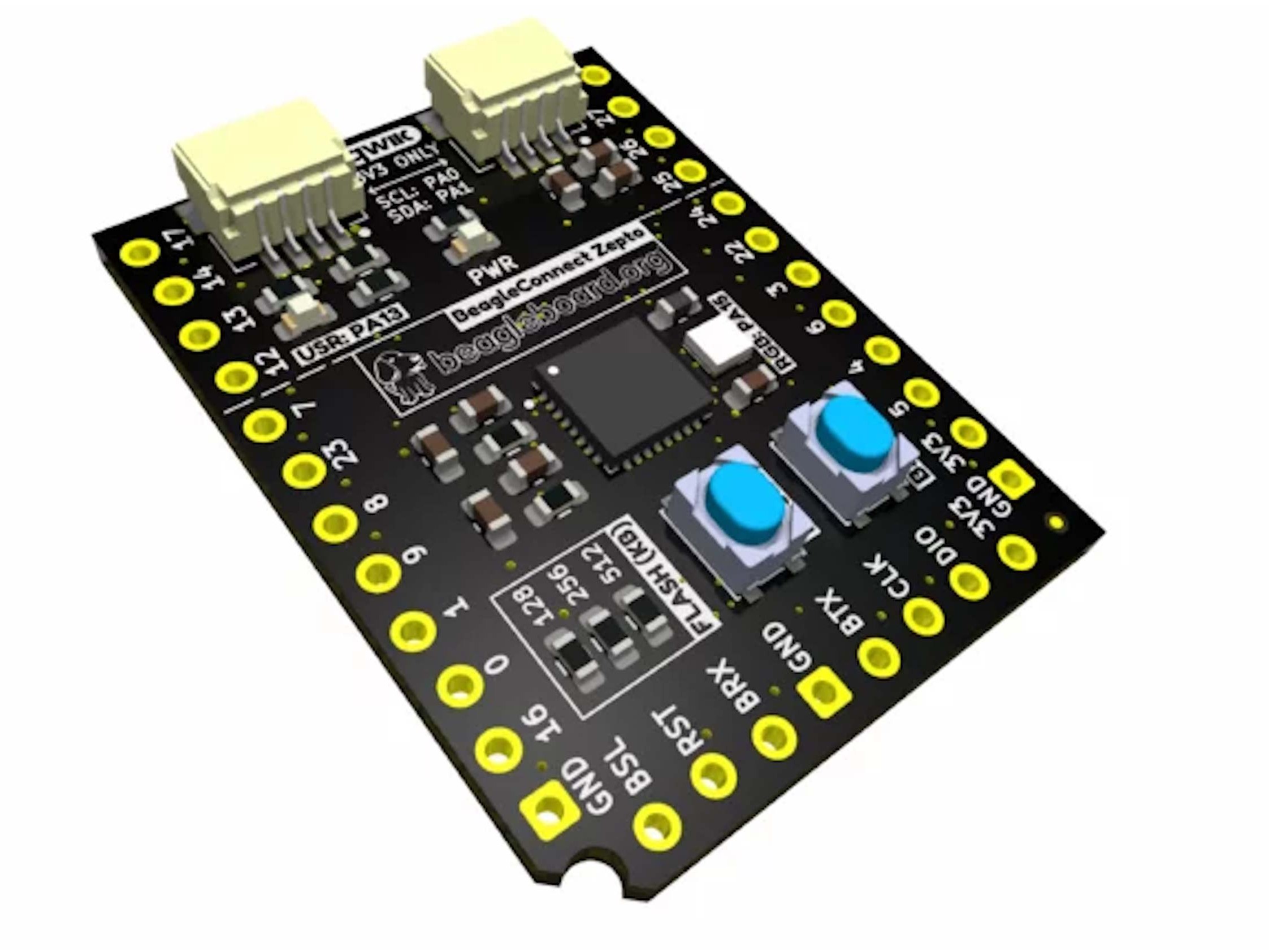
BeagleBoard is preparing to shake up the maker world with the BeagleConnect Zepto, an ultra-affordable developer board expected to debut at an astonishing price of just $1. While it’s being described as a “computer,” it’s better understood as a microcontroller board built for practical experimentation, smart home gadgets, and DIY electronics projects rather than running a full desktop operating system.
The BeagleConnect Zepto is powered by a Texas Instruments MSPM0L1117 microcontroller featuring a 32 MHz ARM Cortex-M0+ CPU. In real-world terms, that puts it in the same general performance class as entry-level Arduino-style boards, making it suitable for common maker tasks like reading sensors, controlling motors, triggering relays, handling simple automation routines, and running lightweight embedded code.
So how does a $1 development board become possible? BeagleBoard is keeping costs down with a straightforward design approach: a low-cost microcontroller, a simple two-layer PCB, and a deliberately trimmed set of interfaces. For example, there’s no built-in support for displays or cameras, which helps avoid the added complexity and expense that typically pushes board prices higher. The goal here clearly isn’t to compete with single-board computers meant for multimedia or desktop-like workloads—it’s to deliver a tiny, accessible platform that lowers the barrier to entry for learning electronics and prototyping connected devices.
Expansion is where the Zepto still aims to be surprisingly flexible. The board uses the license-free mikroBUS standard, a widely used approach for plugging in add-on modules without increasing the base price of the board itself. On top of that, it includes two QWIIC connectors, making it easy to connect popular sensors and actuators using simple, plug-and-play cabling—an important quality-of-life feature for beginners and rapid prototyping.
A standout detail is that the Zepto can also operate as a QWIIC device, meaning it can work like an expansion module itself. That opens up interesting use cases where it acts as a compact helper board within a larger build, rather than always being the “main” controller.
BeagleBoard is also positioning the Zepto as an open platform and is encouraging developers to get involved and contribute, which could help the board quickly gain real-world project examples, community libraries, and broader module support. If the promised $1 pricing holds up at launch, BeagleConnect Zepto could become one of the most accessible entry points yet for microcontroller programming, smart home tinkering, and hands-on STEM learning.