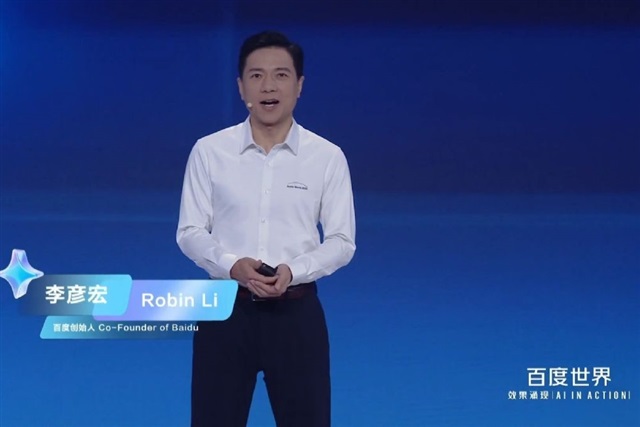
Baidu is doubling down on artificial intelligence, and CEO Robin Li is making it clear that the company sees AI as the engine behind China’s next phase of economic growth. Speaking about the direction of the industry and national priorities, Li said AI is set to become the core driver of China’s “new-quality productive forces,” a term increasingly used to describe the next generation of productivity fueled by advanced technologies.
At the center of Baidu’s plan is deeper, long-term investment in the foundations of AI. That includes building out AI infrastructure and continuing to develop stronger AI models—two areas that are quickly becoming the most important battlegrounds for companies racing to lead in generative AI and large-scale machine learning.
Li’s comments align closely with Beijing’s national “AI+” strategy, which encourages the use of AI across industries to upgrade manufacturing, services, transportation, healthcare, and more. The idea is straightforward: AI shouldn’t be limited to a handful of consumer apps—it should be layered into the real economy to improve efficiency, automate complex workflows, and enable new kinds of products and services.
For Baidu, this push signals a future that’s “AI-native” by design—where products and platforms are built around AI from the ground up rather than adding it later as a feature. It also suggests the company is positioning itself not just as an AI application provider, but as a key player in the broader AI ecosystem, supplying the underlying infrastructure and models that power enterprise and government adoption.
As China accelerates its AI ambitions, Baidu’s renewed commitment indicates the competition will increasingly be about scale, computing power, and model performance. And with national policy actively encouraging AI deployment across the economy, the companies that invest early in foundational technology may be best placed to shape how AI transforms industries in the years ahead.