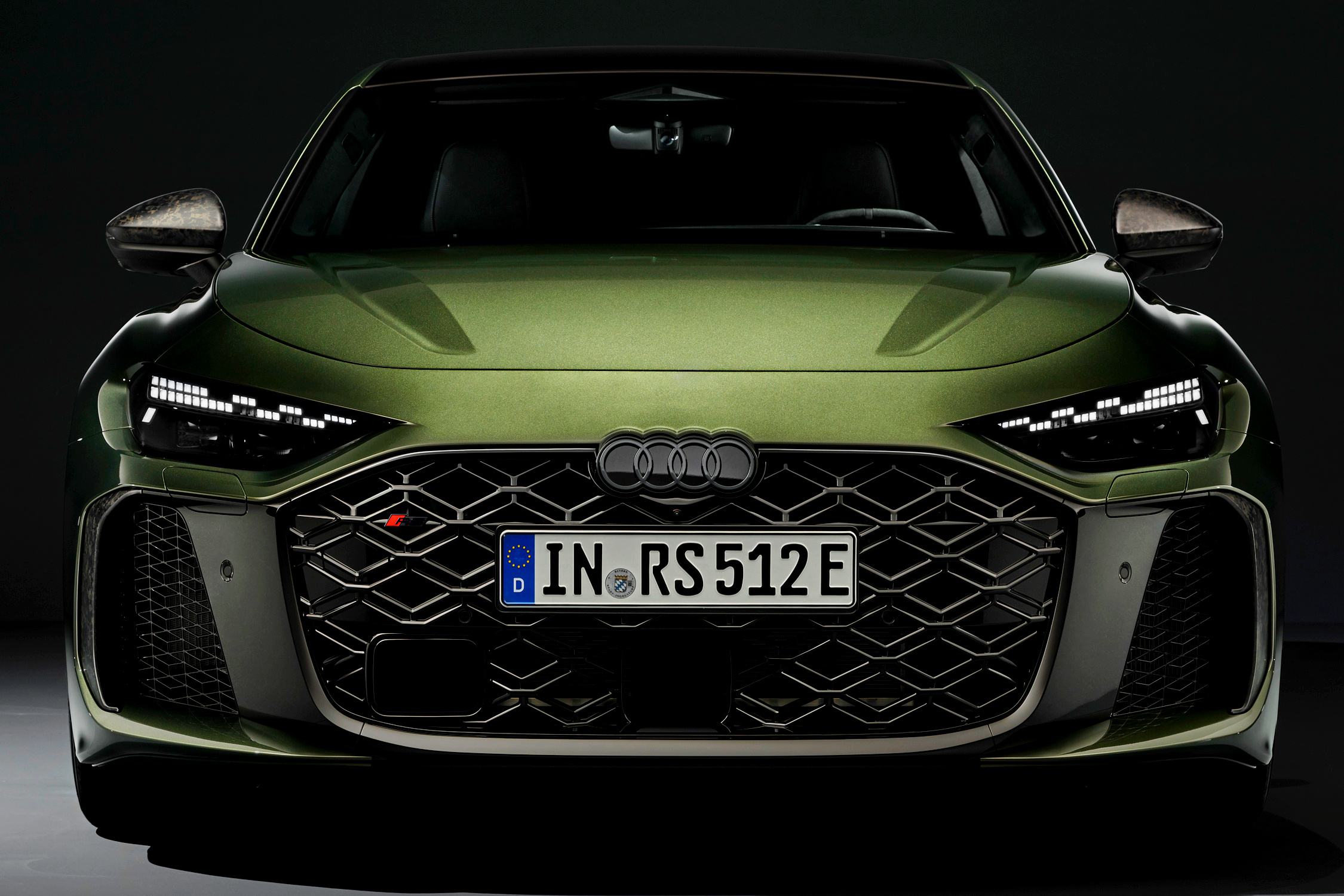
Audi is using the next RS 5 to signal a major shift in its performance playbook. Arriving as a sedan and an Avant and scheduled to launch in summer 2026, the new Audi RS 5 PHEV is being positioned as the brand’s first true performance-focused plug-in hybrid. And judging by the numbers, it’s not a gentle introduction to electrification—it’s a full-strength Audi Sport statement.
At the heart of the RS 5 PHEV is a heavily revised 2.9-liter V6 TFSI biturbo engine. On its own, the combustion unit produces 510 hp. The real story, though, is the way Audi integrates electrification into the drivetrain: a 130 kW electric motor is built directly into the eight-speed tiptronic transmission. Together, the system delivers a combined 639 hp and 825 Nm of torque, giving the RS 5 PHEV the kind of output typically reserved for far more exotic hardware.
Performance figures back up the headline power. Audi quotes a 0–100 km/h time of 3.6 seconds. Choose the optional Audi Sport package and the top speed climbs to 285 km/h, underscoring that this is designed to feel like a genuine RS model first, and a plug-in hybrid second.
The plug-in portion isn’t just there for short, low-speed city runs, either. A high-voltage battery with 25.9 kWh gross capacity enables an all-electric driving range of more than 80 km, giving the RS 5 PHEV meaningful EV capability for commuting and everyday use—while still keeping the intensity on tap when the road opens up.
One of the most interesting engineering upgrades sits at the rear axle. Audi pairs quattro all-wheel drive with a new system it calls Dynamic Torque Control, and the setup goes far beyond a conventional torque splitter. A separate, water-cooled 400-volt electric motor is integrated at the rear axle and works as a high-voltage actuator in combination with a mechanical superimposed transmission. The result is an aggressive torque-vectoring effect of up to 2,000 Nm, with power distribution between the left and right rear wheels happening in as little as 15 milliseconds.
The key advantage is how the system behaves when you’re not actively accelerating. Unlike typical torque-vectoring systems that depend on drive torque, this electromechanical approach can operate independently—even during braking or deceleration. In other words, the RS 5 PHEV can still actively shape cornering attitude and stability when you’re trailing the brakes or lifting off the throttle, which is exactly where confident, repeatable handling matters most.
Audi also supports the new drivetrain and torque-vectoring hardware with broader chassis revisions aimed at sharper precision and improved ride control. The RS 5 PHEV uses a new center differential and dual-valve dampers that control compression and rebound separately, helping the car feel more composed and refined without dulling responsiveness. A chassis said to be 10 percent stiffer and a quick 13:1 steering ratio round out the mechanical package, promising crisp turn-in and confident mid-corner behavior.
Inside, Audi keeps the focus on the driver with a cockpit dominated by a large MMI panoramic display, matching the RS 5’s high-tech powertrain with a similarly modern cabin layout.
Pricing reflects the level of engineering and output. In Europe, the Audi RS 5 PHEV sedan starts at €106,200 (around $115,000). The RS 5 Avant, with its extra practicality, starts at €107,850 (roughly $125,100). For buyers who want everyday usability, substantial electric range, and supercar-quick acceleration wrapped in an RS badge, the new RS 5 PHEV is shaping up to be one of the most important performance hybrids Audi has ever built.