ASUS Expands Agent Computer Ecosystem to Bring Local AI to DIY PCs, Gaming Rigs, and Workstations
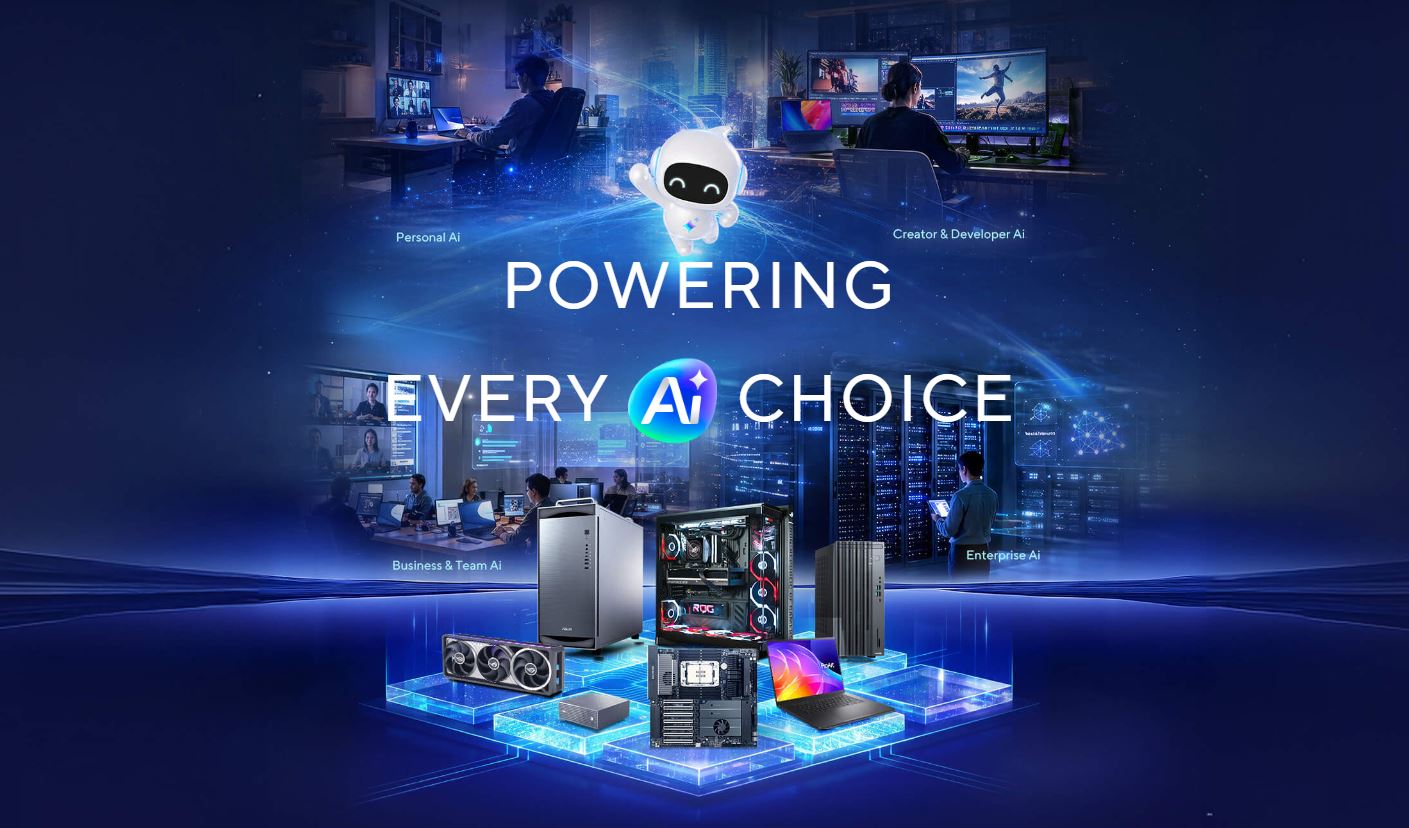
ASUS is widening its AI hardware strategy with a major push into what it calls the Agent Computer ecosystem, a new initiative aimed at bringing local AI and AI agents to a broader range of PCs. Instead of limiting AI features to standard laptops or prebuilt AI PCs, ASUS wants users to build or buy systems that can run advanced AI workloads across gaming desktops, creator machines, DIY PCs, mini PCs, external GPU setups, and professional workstations.
The idea behind the Agent Computer initiative is simple: give users more choice in how they use artificial intelligence. Depending on their needs, they can rely on local AI for privacy and speed, cloud AI for scalable performance, or a hybrid setup that combines both. This approach is especially relevant as more users begin working with large language models, AI assistants, content generation tools, and agentic AI workflows that can perform multi-step tasks with less manual input.
For PC builders, ASUS is positioning its popular motherboard families as the foundation for AI-ready desktop systems. The company says its PRIME, TUF Gaming, ROG, and ProArt motherboards can support Agent Computer builds when paired with modern AI-capable graphics cards such as NVIDIA RTX GPUs or AMD Radeon AI hardware. This gives enthusiasts a path to create custom local AI PCs without being locked into a single prebuilt design.
ASUS is also targeting professionals and enterprise users with higher-end systems designed for heavier workloads. ExpertCenter Pro workstations, including models such as the ET900A X9, are being positioned for demanding AI tasks where performance, reliability, and expandability matter. These systems could appeal to developers, researchers, engineers, creators, and businesses that want to run AI applications locally instead of depending entirely on cloud services.
To make the process easier for users, ASUS has introduced a “Find Your ASUS Agent Computer” tool on its official website. The tool helps users choose between local and hybrid AI or cloud-based AI, then recommends suitable computers or components based on their requirements. This could be useful for buyers who are interested in AI PCs but may not know what hardware they need for specific workloads.
One of the most interesting parts of ASUS’ AI strategy is its focus on compact yet powerful local AI hardware. The ProArt GR1X mini PC is one example. Built around NVIDIA’s RTX Spark platform, the system features a 6,144-core Blackwell GPU, a 20-core Grace CPU, and up to 128 GB of unified memory. Despite its small size, ASUS says the ProArt GR1X can run large AI models and agentic workflows locally, including models with up to 120 billion parameters.
That kind of capability could make compact AI systems more appealing to creators, developers, and advanced users who want strong AI performance without using a full-size desktop tower. Running AI models locally can also reduce reliance on remote servers, which may help users maintain better control over sensitive data while potentially lowering ongoing cloud computing costs.
ASUS is also expanding local AI acceleration beyond desktops. The company recently introduced the XG Core external GPU, powered by a low-profile AMD Radeon RX 9060 XT with 16 GB of VRAM. This external GPU is designed to bring additional AI performance to laptops while also delivering a stronger gaming experience for mobile users. For people who want a portable system during the day and more graphics or AI power at home, an external GPU could offer a flexible upgrade path.
Hardware is only part of the company’s plan. ASUS is also developing software to support its Agent Computer ecosystem. One example is Zenni Claw, a software solution designed to bring agentic AI capabilities to consumer devices. Agentic AI refers to AI systems that can plan, make decisions, and complete tasks through a sequence of actions, rather than simply responding to one prompt at a time.
Another software tool, Multi-LM Tuner, is being developed to help users deploy optimized large language models across ASUS platforms. This could make it easier to run AI models efficiently on different types of ASUS hardware, whether users are working on a compact mini PC, a DIY desktop, or a workstation.
ASUS is also integrating AI-related functionality into its display ecosystem through DisplayWidget Center. The company describes it as a bridge between ASUS monitors and emerging AI workflows, suggesting that displays may play a more active role in AI-enhanced productivity, content creation, and system control in the future.
The broader message is clear: ASUS wants AI PCs to move beyond a single product category. Instead of treating AI as a feature limited to select laptops or premium desktops, the company is building an ecosystem that spans motherboards, graphics hardware, mini PCs, workstations, external GPUs, displays, and software.
For gamers, this could mean gaming PCs that also serve as local AI machines. For creators, it could mean faster workflows for image generation, video tools, 3D work, and AI-assisted editing. For businesses, it could mean more control over data and AI processing. For PC builders, it opens the door to custom AI-ready systems built from familiar components.
As AI workloads continue to grow, local AI performance is becoming an important part of the PC market. ASUS’ Agent Computer initiative shows how major hardware brands are preparing for a future where personal computers do more than run apps and games. They may also host AI agents, process large models locally, and assist users with complex tasks in real time.


