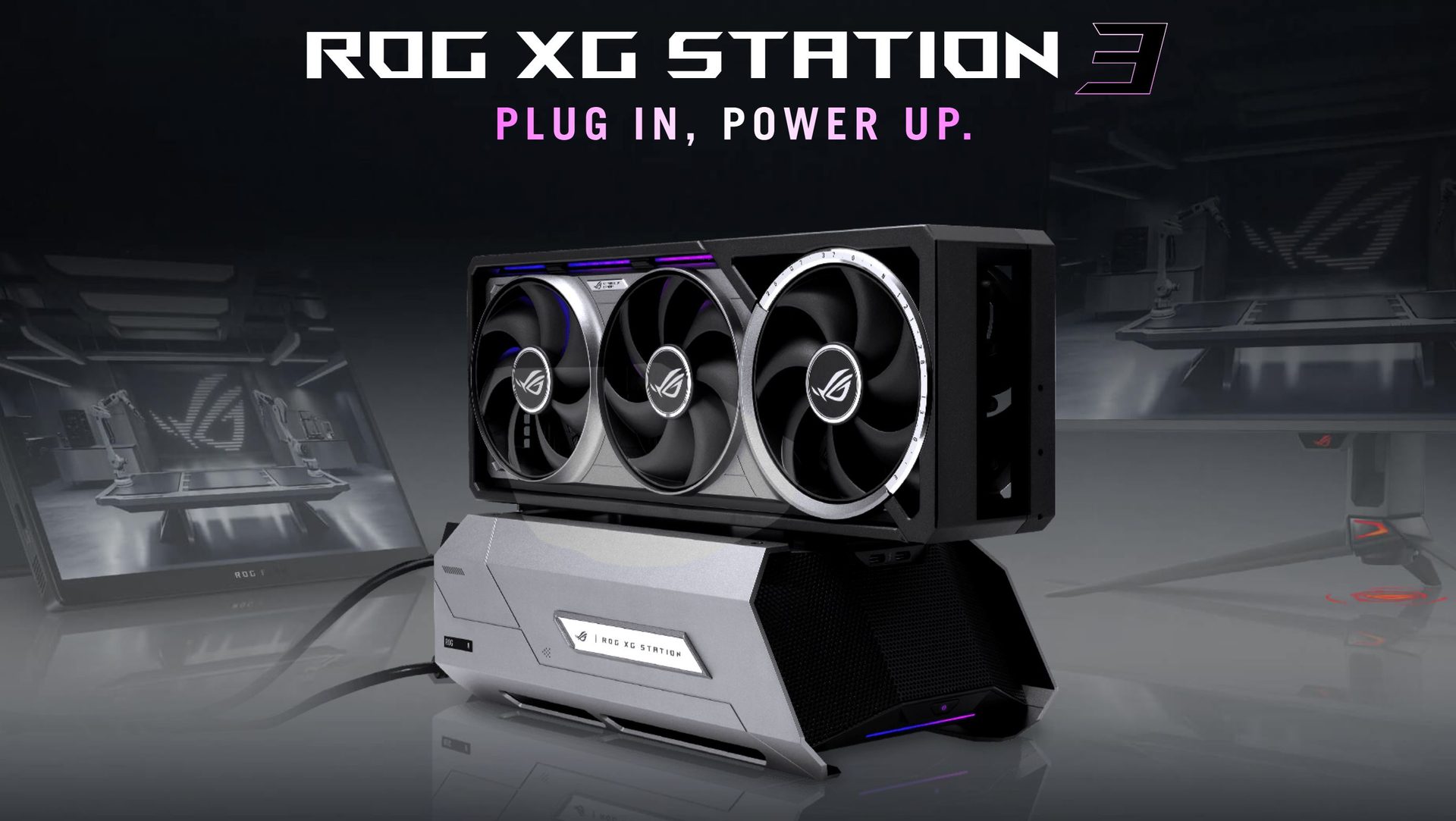
ASUS has introduced the ROG XG Station 3, a new external GPU dock designed to bring desktop-class graphics performance to compatible laptops. As the latest entry in the long-running XG Station family, this new model makes a major leap forward with Thunderbolt 5 support, modern GPU compatibility, and a design aimed at gamers, creators, and professionals who want more graphics power without giving up laptop portability.
The ROG XG Station lineup dates back to 2007, and ASUS is positioning the XG Station 3 as its most capable external GPU solution yet. The concept is straightforward: connect the dock to a laptop, install a dedicated desktop graphics card inside the enclosure, and use that GPU to boost gaming performance, creative workloads, rendering, AI tasks, and multi-display setups.
One of the biggest upgrades is the move to Thunderbolt 5. The ASUS ROG XG Station 3 is the company’s first external GPU dock to feature the newer interface, offering up to 80 Gbps of bidirectional bandwidth. Thunderbolt 5 also supports bandwidth boost of up to 120 Gbps for demanding video workloads, making it especially useful for high-resolution display output and heavy graphics-related tasks.
While an external GPU dock cannot always match the exact performance of a graphics card installed directly into a desktop PC, the higher bandwidth offered by Thunderbolt 5 gives the ROG XG Station 3 a stronger foundation than older Thunderbolt-based eGPU solutions. For laptop users who need extra graphical power at a desk, it could be a practical alternative to building a separate desktop system.
The dock is built to support the latest graphics cards from major GPU brands. ASUS lists compatibility with modern NVIDIA GeForce RTX 50 series cards, AMD Radeon RX 9000 series GPUs, RTX PRO 6000-class professional graphics cards, and Intel Arc GPUs. This broad support makes the XG Station 3 suitable for different users, from high-refresh-rate gamers to workstation users handling 3D modeling, video production, or GPU-accelerated applications.
Another standout feature is ASUS BTF compatibility. The ROG XG Station 3 includes a GC-HPWR connector designed for ASUS BTF graphics cards, allowing supported GPUs to be installed without using a visible external 16-pin power cable. This can help create a cleaner internal layout and simplify installation for users investing in ASUS’s cable-hidden graphics card ecosystem.
Connectivity is another major focus. The ROG XG Station 3 includes two Thunderbolt 5 ports. One acts as the upstream connection to the laptop and supports up to 140 W USB Power Delivery, meaning it can charge many compatible laptops while also carrying high-speed data. This reduces cable clutter and makes the dock more convenient for users who want a single-cable desk setup.
The second Thunderbolt 5 port works as a downstream connection. It can be used with USB-C monitors and supports up to three 4K displays through daisy-chaining. This makes the dock attractive not only for gaming but also for productivity setups that rely on multiple screens. In addition, ASUS includes two USB Type-C ports rated at 10 Gbps for peripherals such as external drives, capture devices, keyboards, mice, or other accessories.
One important detail is that the ASUS ROG XG Station 3 does not include a power supply in the box. Users will need to provide their own SFX or SFX-L power supply, depending on the graphics card they plan to install. This gives buyers flexibility to choose a PSU that matches their GPU’s power requirements, but it also means the total cost of the setup will be higher than the dock alone.
The launch of the ROG XG Station 3 shows that external GPU docks are still evolving, especially as laptop performance and high-speed connectivity continue to improve. With Thunderbolt 5, support for next-generation graphics cards, USB-C display expansion, and high-wattage laptop charging, ASUS is targeting users who want a powerful desktop experience while keeping the mobility of a laptop.
For gamers, the dock could help turn a thin-and-light notebook into a capable gaming station when connected at home. For creators, it offers a way to accelerate demanding workloads such as video editing, 3D rendering, visual effects, and AI-assisted content creation. For professionals, the ability to drive multiple 4K displays and use workstation-class GPUs may make it a strong option for flexible office setups.
The ASUS ROG XG Station 3 is shaping up to be one of the more advanced Thunderbolt 5 external GPU docks on the market, especially for users already invested in the ASUS ROG or BTF ecosystem. With modern GPU support and a focus on high-speed connectivity, it could become a compelling upgrade for laptop owners who need more graphics horsepower without committing to a full desktop PC.