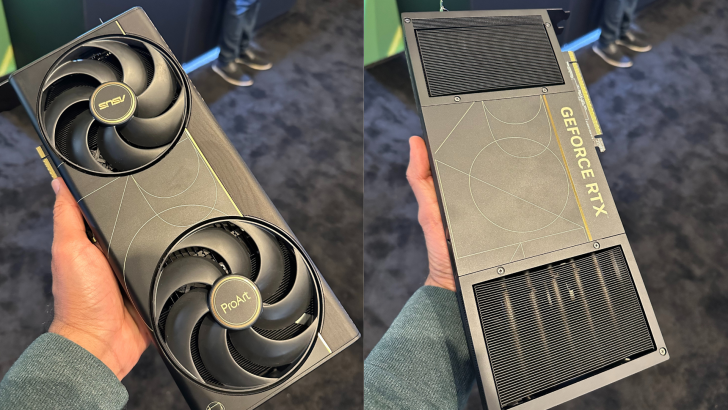
ASUS has found a way to make NVIDIA’s fastest-tier graphics hardware far easier to fit into real-world builds. The new ProArt GeForce RTX 5090 trims the usual oversized footprint down to a compact 2.5-slot design, aiming to deliver flagship-class performance without forcing creators to redesign their entire PC around a massive GPU.
High-end GPUs have steadily grown larger with every generation, and the RTX 5090 category is no exception. Many models push into very thick, space-hungry designs that can crowd out other expansion cards, limit airflow, and make small form factor systems nearly impossible. ASUS is taking a different approach with the ProArt line, focusing on professional users who want top performance in a cleaner, more workstation-friendly package.
The obvious question is cooling. The GeForce RTX 5090 is a high-power graphics card, and shrinking the cooler usually means higher temperatures or louder fans. ASUS addresses that by borrowing core ideas from the airflow approach seen on modern reference-style cards, pairing it with premium thermal materials. The ProArt GeForce RTX 5090 uses a liquid metal thermal compound on the GPU die along with a vapor chamber designed to spread heat evenly across the cooling assembly.
One of the key design choices is a double-vented backplate that supports a double flow-through cooling setup. Instead of pushing hot air into one congested area, airflow is directed through the card more effectively, with ventilation zones at both ends to help heat escape. ASUS claims this design delivers around 11% better cooling efficiency while keeping the overall card about 27% smaller compared to typical single flow-through designs. For creators who need sustained performance for rendering, AI workloads, and long production sessions, that balance of thermals and size is exactly the point.
This ProArt RTX 5090 also isn’t positioned primarily as a gamer-focused showpiece. ASUS says the card is designed with multi-GPU workstations in mind, where thinner 2.5-slot hardware makes it more practical to install multiple cards in one system. That matters for compute-heavy professional tasks, including content creation pipelines and AI acceleration, where scaling across more than one GPU can be a major advantage.
Visually, the ProArt variant leans into a minimalist workstation aesthetic rather than aggressive gaming styling. ASUS includes subtle wooden accents integrated into the shroud, paired with a clean, mostly black look intended to blend into professional builds. It’s also SFF-compliant, which helps it fit into a wider range of cases, including more compact creator and studio systems.
ASUS hasn’t shared official pricing or an exact release date yet, but the ProArt GeForce RTX 5090 already stands out as one of the most practical takes on a flagship GPU: top-tier performance, a compact 2.5-slot form factor, and cooling designed to handle demanding workloads without turning your build into a space management problem.