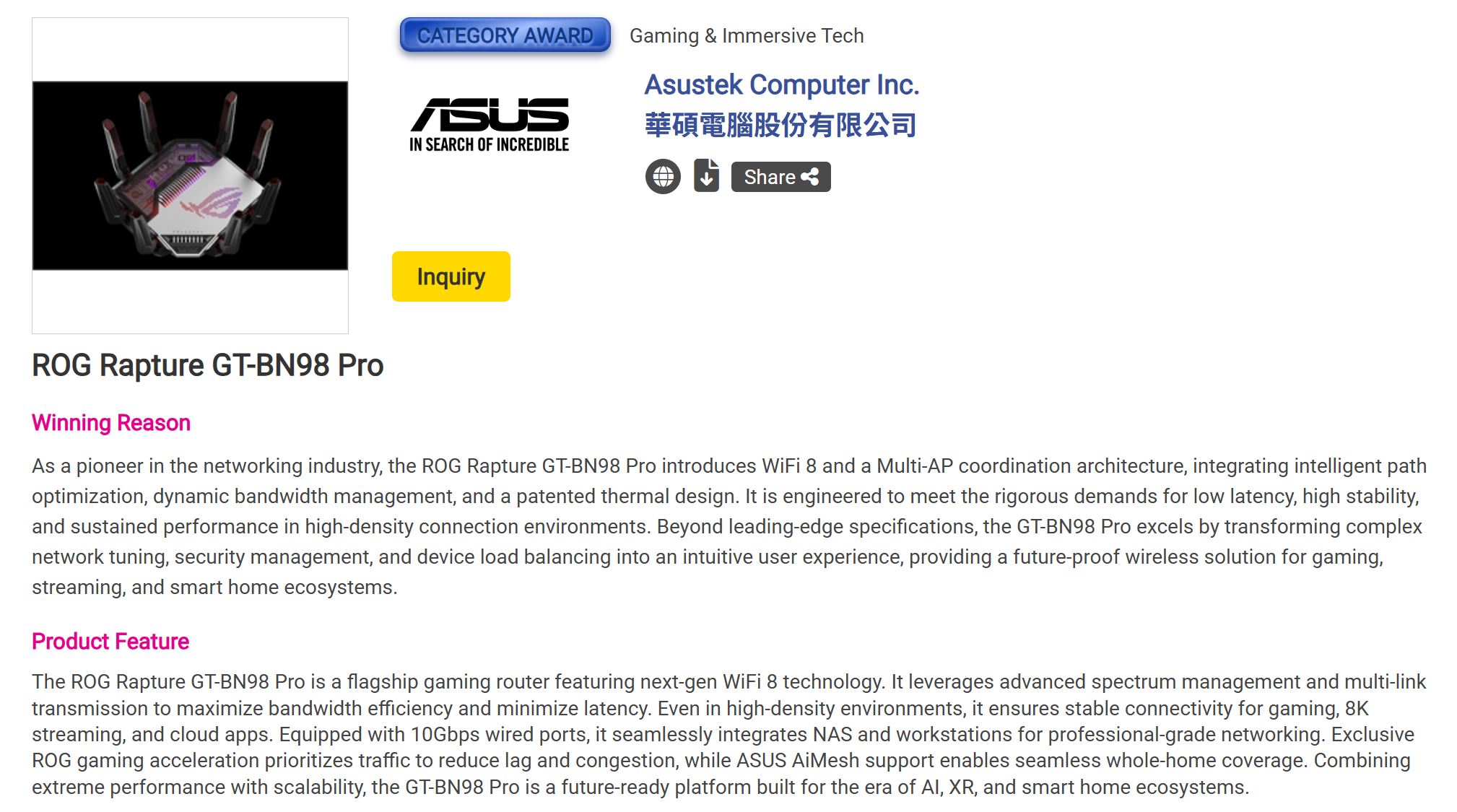
ASUS ROG Rapture GT-BN98 Pro Becomes the First WiFi 8 Gaming Router to Win a Computex 2026 Award
ASUS is pushing high-performance home networking into a new era with the ROG Rapture GT-BN98 Pro, a next-generation gaming router built around WiFi 8 technology. The router has already gained attention after receiving a Computex 2026 Best Choice Award in the Gaming & Immersive Tech category, highlighting its focus on low-latency gaming, 8K streaming, AI-powered homes, and dense multi-device environments.
The ROG Rapture GT-BN98 Pro stands out as ASUS’s first WiFi 8 gaming router and one of the earliest consumer-facing products to showcase what the next wireless standard is expected to bring. While WiFi 8 is not designed to dramatically increase peak bandwidth over WiFi 7, it aims to solve one of the biggest challenges in modern networking: keeping connections stable, responsive, and consistent when many devices are active at the same time.
According to the Computex award details, the ROG Rapture GT-BN98 Pro features a Multi-AP coordination architecture, intelligent path optimization, dynamic bandwidth management, and a patented thermal design. Together, these technologies are intended to improve network efficiency, reduce lag, and maintain strong performance even in busy homes filled with phones, laptops, smart TVs, consoles, IoT devices, and AI-enabled hardware.
Unlike previous WiFi generations that often focused heavily on higher maximum speeds, WiFi 8 is expected to prioritize reliability. The maximum throughput is expected to remain similar to WiFi 7 at up to 23 Gbps, but the real improvement comes from smarter handling of connections. That means better performance at mid-range distances, wider coverage for connected devices, and lower latency during demanding tasks.
ASUS previously demonstrated a WiFi 8 concept router known as ROG NeoCore, which was used to show early real-world WiFi 8 performance. The company claimed that its testing showed up to twice the mid-range throughput, twice the IoT coverage, and up to six times lower P99 latency compared with WiFi 7. These gains are especially important for competitive gamers, streamers, and households where multiple users are gaming, watching high-resolution video, working remotely, or using cloud-based services at the same time.
For gamers, the ROG Rapture GT-BN98 Pro is designed to deliver the kind of responsiveness that can make a real difference during online play. The router includes advanced spectrum management and multi-link transmission, helping maximize bandwidth efficiency while reducing latency spikes. ASUS’s ROG gaming acceleration features are also expected to prioritize gaming traffic, limiting the impact of network congestion and helping keep gameplay smooth.
The router is not only aimed at gamers. With 10 Gbps wired ports, the GT-BN98 Pro also targets users with high-performance storage systems, NAS setups, workstations, media servers, and small-office networks. This makes it suitable for users who need both powerful wireless connectivity and fast wired networking for heavy file transfers, local backups, content creation, and professional workloads.
Thermal performance is another key part of the design. High-end routers often run under constant load, especially in homes with dozens of connected devices. ASUS’s patented thermal design is intended to help the ROG Rapture GT-BN98 Pro maintain stable performance over long periods, reducing the risk of throttling or instability during demanding use.
The arrival of the ROG Rapture GT-BN98 Pro suggests that WiFi 8 is moving closer to commercial availability. While full pricing, launch timing, and detailed specifications have not yet been revealed, its Computex 2026 award win signals that ASUS is preparing to position this router as a flagship networking product for the next generation of connected homes.
Overall, the ASUS ROG Rapture GT-BN98 Pro looks like a major step forward for premium gaming routers. Instead of chasing only higher headline speeds, it focuses on the areas that matter most in real-world use: lower latency, better stability, smarter traffic handling, stronger multi-device performance, and faster wired connectivity. For gamers, streamers, creators, and smart-home users, WiFi 8 could be less about raw speed and more about making every connection feel faster, smoother, and more dependable.