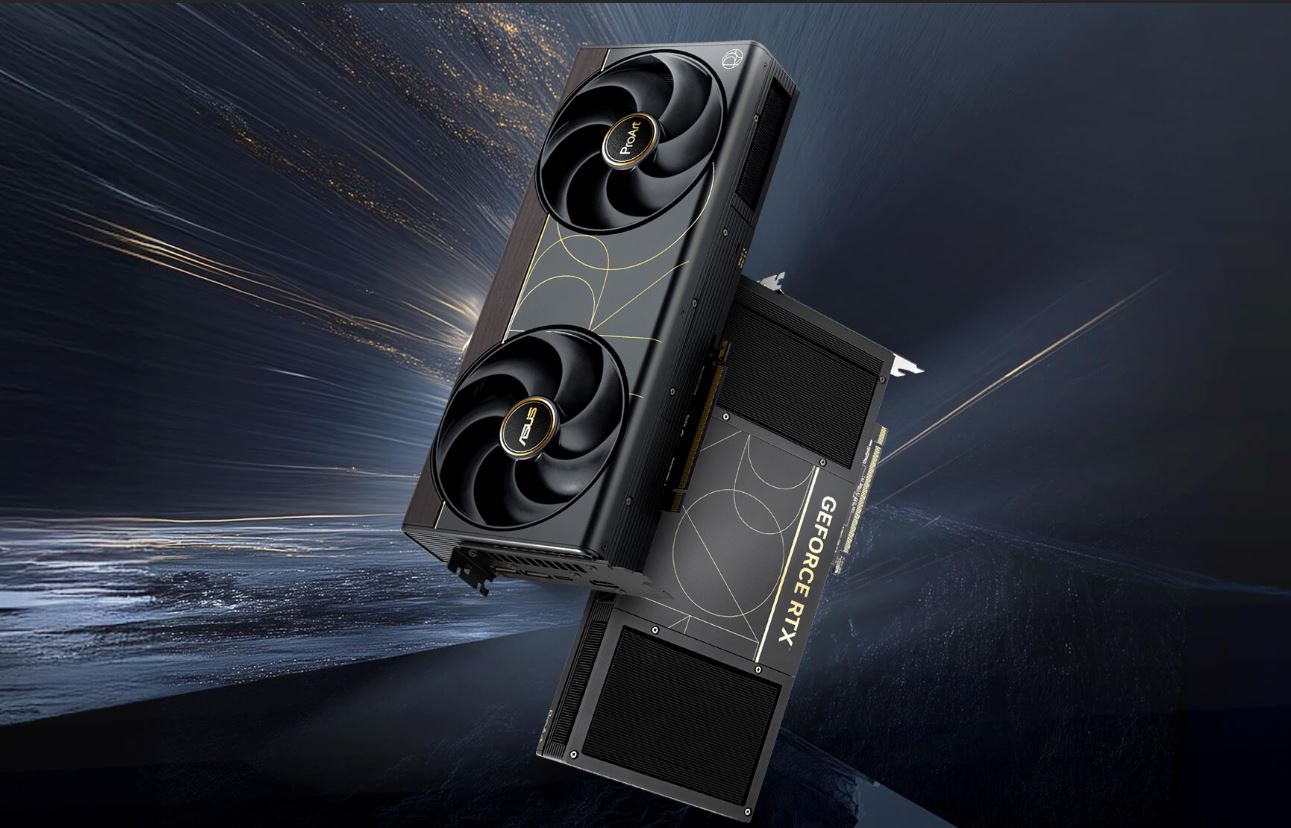
ASUS has quietly added a new flagship graphics card to its lineup: the ProArt GeForce RTX 5090 OC. While the company previously showed it off at CES, the card has now appeared on ASUS’s official product pages, giving PC builders and creators a closer look at what makes this model different from the typical oversized RTX 5090 designs.
What immediately stands out is the ProArt RTX 5090’s strong design resemblance to the GeForce RTX 5090 Founders Edition. The Founders Edition became popular in part because it managed a clean, compact 2-slot form factor paired with a double-vented backplate that improves airflow. ASUS takes that same overall idea and pushes it further with a premium cooling approach, while only slightly increasing the size.
Instead of sticking to a strict 2-slot thickness, the ProArt RTX 5090 expands to a 2.5-slot design. That may sound like a small change, but in today’s high-end GPU market, it’s notable because many RTX 5090 partner cards are considerably thicker. For users trying to fit a top-tier GPU into tighter cases, or anyone who prefers a cleaner multi-slot layout, the ProArt’s relatively slim profile could be a major advantage.
Cooling is clearly a central focus. ASUS uses a double-vented backplate for stronger airflow, paired with two large axial-tech fans mounted on top. On top of that, the ProArt RTX 5090 uses liquid metal on the GPU to help improve heat transfer, which can translate into better sustained performance and lower temperatures under load.
ASUS also keeps the power connector placement and orientation similar to the Founders Edition, making this one of the closest-looking alternatives to the FE design philosophy. That detail can matter more than people think, especially for cable routing and overall build neatness.
Beyond the cooler and layout, ASUS adds a few practical upgrades. There’s a Dual BIOS switch, letting you choose between P (Performance) mode and Q (Quiet) mode depending on whether you want maximum performance or lower noise. ASUS also includes a USB Type-C port, which can be especially useful for certain displays and for portable monitors that often rely on USB-C connectivity.
On the clock speed side, the ProArt RTX 5090 comes with a 2482 MHz frequency in its default mode and boosts up to 2512 MHz in OC mode. That’s higher than the Founders Edition, while the rest of the specifications follow the expected RTX 5090 baseline.
Pricing hasn’t been announced yet, but expectations are high. With many RTX 5090 models selling for well over $4,000, it’s unlikely the ProArt RTX 5090 OC will come in at a lower price point—especially given its premium cooling design and feature additions.
For creators, workstation users, and enthusiast builders who want flagship RTX 5090 performance in a more refined, relatively slimmer design, the ASUS ProArt GeForce RTX 5090 OC looks positioned as a compelling alternative to bulkier partner cards—while staying visually and structurally close to the Founders Edition style that many people prefer.