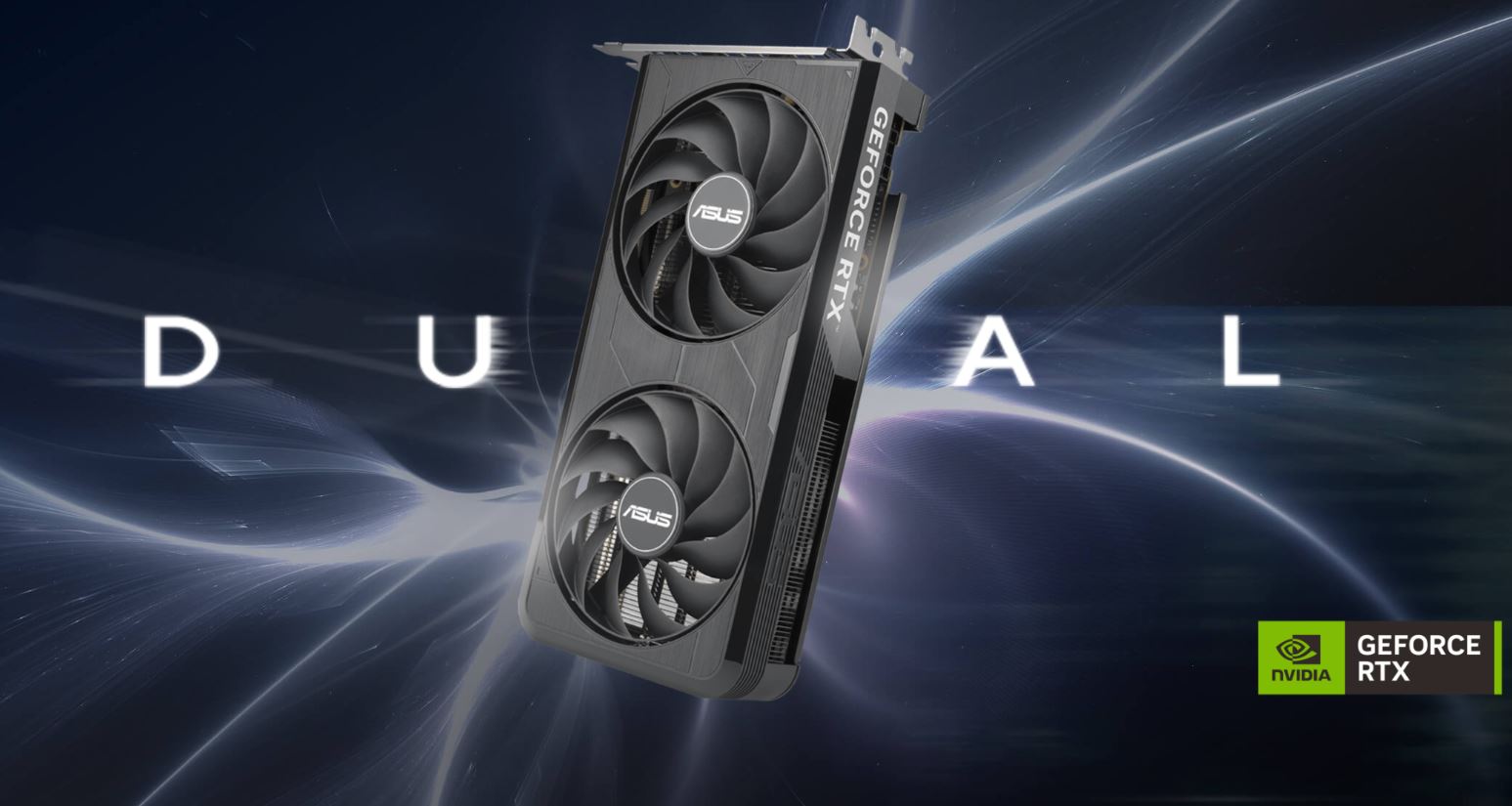
ASUS has quietly expanded its GeForce RTX 5060 Ti lineup with a fresh variant that looks familiar at first glance, but brings several noteworthy physical changes. It’s called the Dual GeForce RTX 5060 Ti EVO 16G, and while it sticks to the same core performance profile as the existing Dual RTX 5060 Ti 16G, the EVO model is clearly built with a slimmer, more compact design in mind.
The biggest difference is the cooler. ASUS keeps the dual-fan layout with its Axial-tech fans and heat pipes paired with an aluminum heatsink, but the overall heatsink design has been reworked. On the EVO version, the heat pipes are no longer visible from the sides like they are on the non-EVO card. The heatsink fins have also changed orientation and the entire assembly is more compact, helping ASUS slim the card down from a 2.5-slot design to a 2.1-slot footprint. In real terms, that’s roughly a 12 mm reduction in thickness, plus the card is about 4 mm shorter in length, making it a more appealing option for tighter PC builds and smaller cases.
Despite the slimmer cooling package, the RTX 5060 Ti EVO 16G doesn’t alter the GPU’s advertised performance levels. It retains the same boost clock behavior, including a 2602 MHz boost clock in OC mode, with no spec changes mentioned beyond the physical redesign.
ASUS also made a connector change that will stand out to experienced builders. The 8-pin power connector has been moved to the left side of the card, closer to the rear I/O area. That placement is less common, since many graphics cards position power connectors toward the far end of the PCB. Depending on your case layout and cable routing, this could either be a helpful tweak for cleaner runs or simply something to plan for during installation.
A few other design differences help distinguish the EVO from the original Dual version. ASUS has removed its GPU Guard feature on this model, which is used on the non-EVO edition to reinforce the corners and reduce the risk of PCB cracking. The EVO also drops the Dual-BIOS switch, moving to a single BIOS setup instead.
Another noticeable change involves the PCIe edge connector. The RTX 5060 Ti EVO 16G uses a shorter PCIe connector, matching what’s commonly seen on cards that are designed around a PCIe 5.0 x8 interface rather than a full-length x16 connector. That shorter connector sometimes raises concerns, but in this case it shouldn’t impact real-world performance. The GeForce RTX 5060 Ti is electrically limited to an x8 interface anyway, and many manufacturers use a full-length x16 connector mainly for compatibility and mechanical reasons. In other words, you should expect the EVO to run at the same speed as versions using a physically longer x16 connector.
Overall, the Dual GeForce RTX 5060 Ti EVO 16G looks like ASUS is targeting compact form-factor gaming PCs and space-conscious builds, offering a thinner card with a revised cooler and a few streamlined feature choices. ASUS hasn’t shared pricing yet, so it’s unclear where this EVO edition will land compared to the existing Dual RTX 5060 Ti models.