Googlebook OS Shows Promise, but Early Gaming Tests Reveal Android Compatibility Gaps
Googlebook OS is shaping up to be one of Google’s most interesting software experiments yet. Designed as a blend of Android and ChromeOS, the platform appears to focus on lightweight productivity, cloud-first features, Android app support, and deeper Google Gemini AI integration for smarter workflows.
On paper, that combination sounds ideal. A laptop-style device with access to Android apps, ChromeOS-like simplicity, and AI-powered tools could appeal to students, remote workers, casual users, and anyone who wants a fast, simple machine for everyday tasks. However, early hands-on testing suggests Google still has work to do, especially when it comes to Android game compatibility.
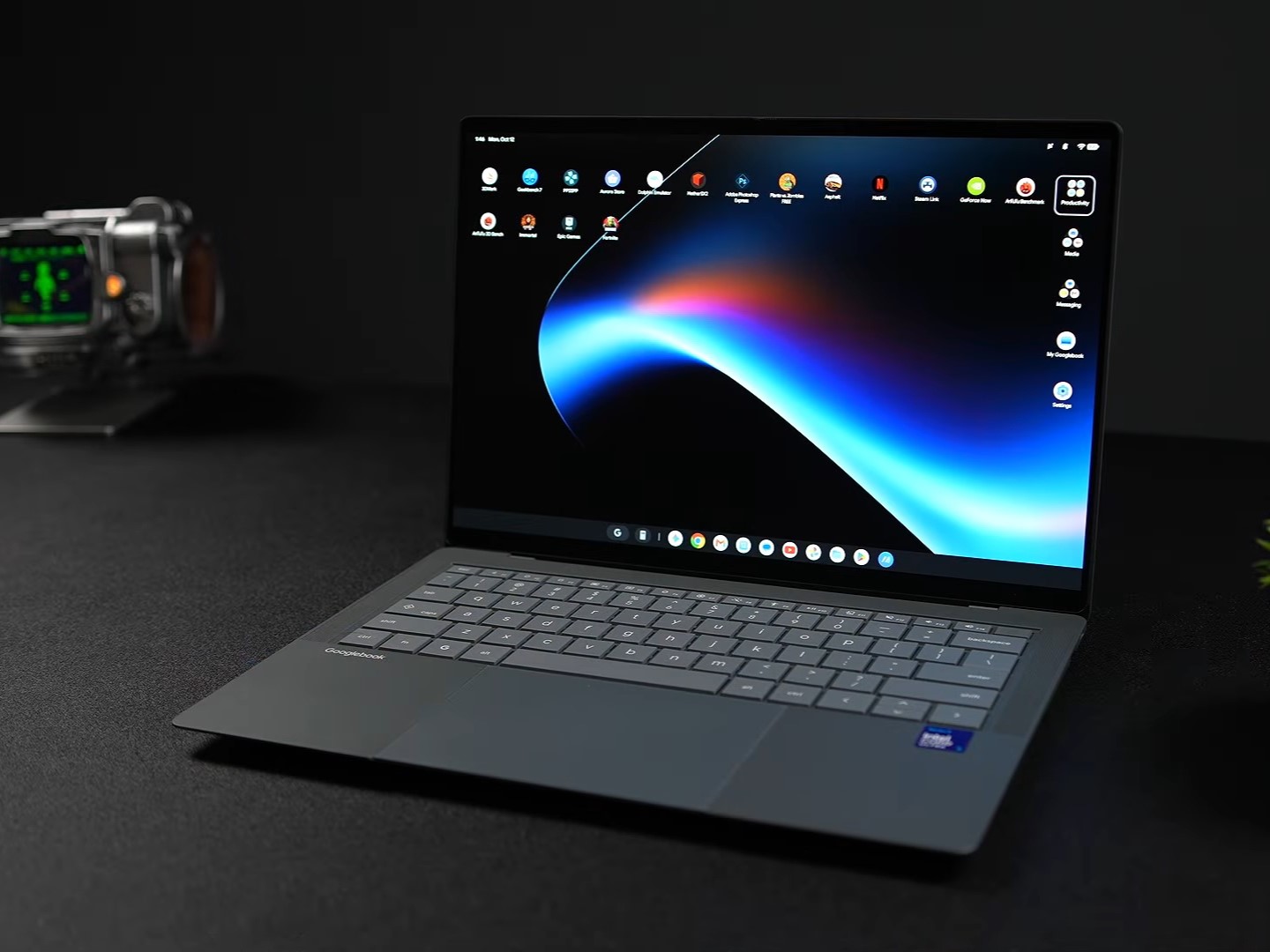
In testing shown by ETA Prime, Googlebook OS was demonstrated on the Asus Googlebook 14, a new 14-inch laptop powered by Intel’s Core Ultra Panther Lake hardware. The test unit featured an Intel Core Ultra 5 325 processor, 32 GB of LPDDR5x memory, and a sharp 3K OLED display with a 120 Hz refresh rate.
Those specs make the Asus Googlebook 14 far more capable than a basic web-browsing laptop. With a high-resolution OLED screen, smooth refresh rate, and modern Intel processor, the device looks well suited for streaming, multitasking, productivity, and casual gaming. Apps such as Netflix should benefit greatly from the vibrant 3K OLED panel, making the laptop an attractive option for entertainment as well as work.
The issue appears when Android gaming enters the picture. While Googlebook OS is expected to support Android apps, not every Android game currently works as expected. According to ETA Prime’s testing, popular titles such as Minecraft and Fortnite were not available on Googlebook OS, even though they can be played on Android smartphones.
That could be disappointing for users expecting a laptop that runs Android games as easily as a phone or tablet. Android has a massive gaming library, and strong compatibility would be one of the biggest selling points for a hybrid operating system like this. If major titles are missing at launch, Google may need to improve app support quickly to make the platform more appealing.
The good news is that Android games that do run natively on the Asus Googlebook 14 appear to perform well. The hardware itself does not seem to be the main limitation. Instead, the challenge appears to be software compatibility and availability within Googlebook OS.
Interestingly, emulation performance looks much more promising. Since Android supports several popular console emulators, the Asus Googlebook 14 can potentially work as a secondary gaming device for retro and classic console titles.
In ETA Prime’s testing, the system handled PlayStation Portable emulation impressively. God of War: Chains of Olympus reportedly ran at 60 frames per second using the PPSSPP emulator with 4x resolution scaling. That suggests PSP games should run smoothly on the Asus Googlebook 14, especially with the Core Ultra 5 325 processor and generous 32 GB of RAM.
Nintendo GameCube emulation also delivered solid results. Auto Modellista was shown running at 60 frames per second through the Dolphin emulator with 4x resolution scaling. For users who enjoy retro gaming, this could make Googlebook laptops surprisingly capable entertainment machines.
Overall, Googlebook OS looks like a promising platform with a clear identity: simple productivity first, entertainment second, and AI-powered features built into the experience. The Asus Googlebook 14 shows that the hardware side can be strong, offering a premium display, modern processing power, and enough memory for smooth multitasking.
Still, software execution will be critical. If Google can improve Android app and game compatibility, Googlebook OS could become a compelling alternative for users who want a lightweight laptop with access to mobile apps, cloud services, streaming platforms, and casual gaming.
For now, the Asus Googlebook 14 proves that the concept has potential. It can handle productivity, media streaming, and even emulation surprisingly well. But until more major Android games work properly, Googlebook OS may feel more like an exciting work in progress than a fully polished Android-powered laptop experience.


