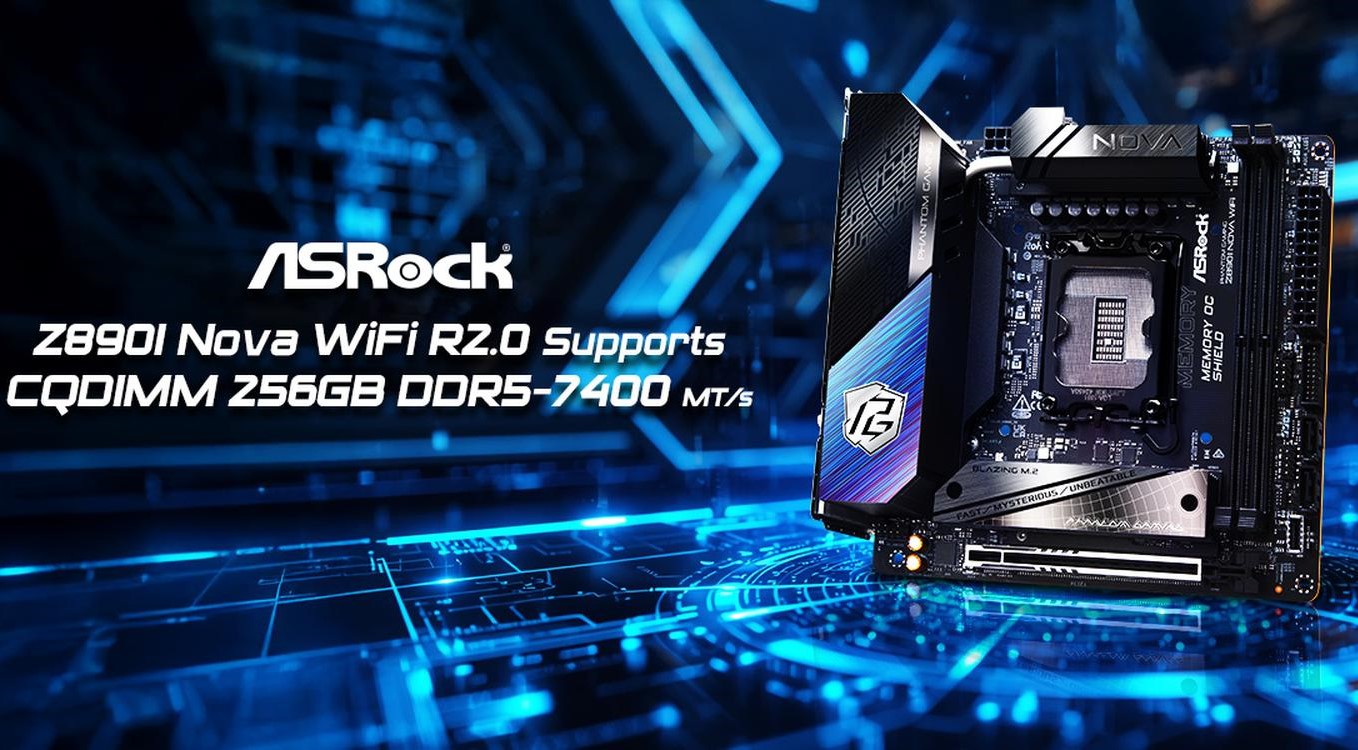
ASRock has just shown that high-speed DDR5 isn’t only for low-capacity memory kits anymore. Using its compact Z890I Nova WiFi R2.0 motherboard, the company successfully ran a massive 256GB DDR5 setup at an impressive DDR5-7400 speed, highlighting a major step forward for users who need both capacity and performance.
Hitting higher memory speeds becomes harder as RAM capacity increases. Many PC builders can reach 7000 MT/s or more with 32GB and 64GB DDR5 kits, but scaling that kind of frequency to 256GB is a different challenge. With more memory chips and heavier electrical load, signal noise and timing instability (often described as jitter) become much more difficult to control, making high-frequency operation far less reliable.
That’s where CQDIMM technology changes the game. Instead of relying entirely on the CPU’s memory controller to maintain a clean clock signal, CQDIMM adds a dedicated clock driver directly on the memory module. This clock driver regenerates the reference clock signal from the CPU and redistributes a cleaner, more stable clock across the memory chips, improving signal quality and helping larger memory configurations stay stable at higher speeds.
For its demo, ASRock paired the Z890I Nova WiFi R2.0 with 128GB 4-rank DDR5 modules from Kingston to reach the 256GB total capacity. That detail matters because 4-rank DIMMs are typically more demanding than 1-rank or 2-rank modules, putting additional strain on the memory subsystem and making high-frequency tuning even tougher. Even with CQDIMM, strong motherboard design still plays a huge role—clean trace routing, optimized circuitry, and carefully tuned firmware are essential to push memory to these speeds.
What makes this even more notable is that the Z890I Nova WiFi R2.0 is a small form-factor motherboard, where tight layouts can limit routing flexibility and increase design difficulty. ASRock’s revised R2.0 version reportedly includes circuit pathway optimizations that helped make this 256GB DDR5-7400 result possible.
This milestone also stands out compared to earlier high-capacity CQDIMM demonstrations. It follows a previous test where a 256GB DDR5 CQDIMM kit was shown running at 6400 MT/s on another Z890 platform—making ASRock’s 7400 MT/s achievement nearly 1 GHz higher at the same huge capacity.
For creators, power users, developers, and workstation-style PC builders who want 256GB DDR5 without sacrificing memory speed, this is a promising sign that high-capacity DDR5 configurations can finally move closer to the performance levels enthusiasts are used to seeing with smaller kits.