Sharp Aquos R11 Appears With an Unannounced Hexa-Core Snapdragon 8s Gen 4 Variant
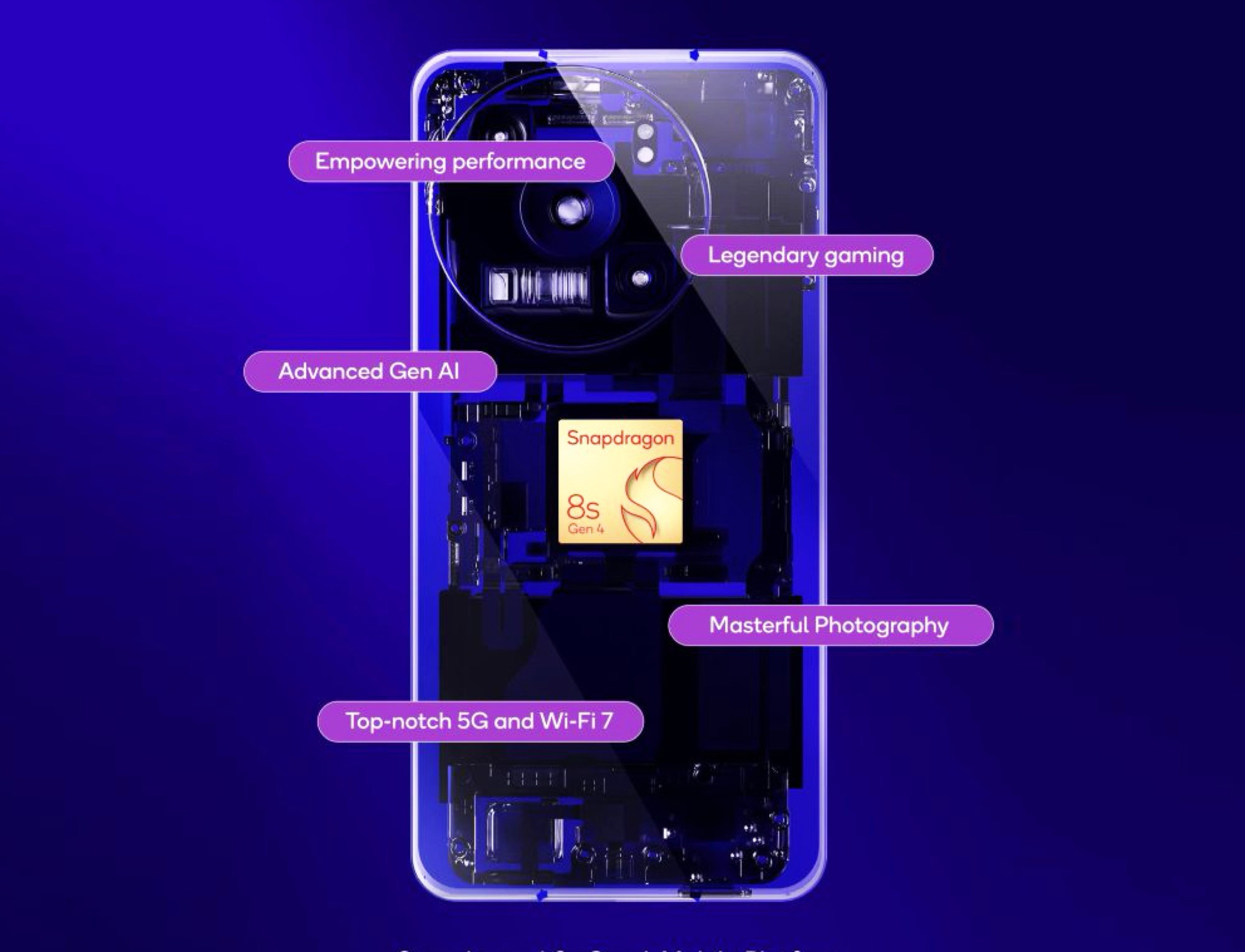
Sharp’s upcoming Aquos R11 has drawn attention after appearing with an unusual version of Qualcomm’s Snapdragon 8s Gen 4 chipset. Instead of the standard eight-core configuration, the device seems to use a six-core variant identified as the Snapdragon 8s Gen 4 SM8735Q, a model that Qualcomm has not officially introduced.
The discovery is especially interesting because this trimmed-down Snapdragon 8s Gen 4 does not appear to be a weaker chip across the board. It keeps the same powerful Cortex-X4 prime core clocked at 3.21 GHz, and the graphics hardware also remains unchanged. That means the Aquos R11 still uses the Adreno 825 GPU at the same clock speed as the regular Snapdragon 8s Gen 4.
The main change is in the CPU layout. The standard Snapdragon 8s Gen 4 uses an octa-core design arranged as 1+3+2+2. This includes one Cortex-X4 prime core, three Cortex-A720 cores running at 3 GHz, two Cortex-A720 cores at 2.8 GHz, and two Cortex-A720 cores at 2.02 GHz.
The hexa-core version found in the Sharp Aquos R11 appears to use a 1+4+1 setup. In this configuration, the 3 GHz performance cluster is removed. One of those A720 cores is dropped entirely, while the remaining two are shifted into the 2.8 GHz cluster, giving that section four cores. The low-clocked 2.02 GHz cluster is also reduced from two cores to one.
Early Geekbench 6.7 results give a clearer look at how this unusual Snapdragon 8s Gen 4 variant performs in real-world testing. The Sharp Aquos R11 reportedly scores 2,070 points in single-core performance and 5,846 points in multi-core performance.
For comparison, a device using the standard octa-core Snapdragon 8s Gen 4, such as the OnePlus Nord 6, has been seen scoring around 1,893 in single-core and 6,260 in multi-core tests. That means the Aquos R11’s hexa-core chip may actually deliver stronger single-core performance, while trailing by about 6.6% in multi-core workloads.
That result makes sense given the CPU changes. Since the prime Cortex-X4 core remains intact, single-threaded tasks can still perform very well. However, with two fewer CPU cores overall, the chip naturally has less headroom for heavier multi-threaded workloads such as rendering, multitasking, compression, and certain productivity apps.
Even with the reduced core count, the hexa-core Snapdragon 8s Gen 4 still appears to be a meaningful upgrade over the previous Snapdragon 8s Gen 3 used in the Sharp Aquos R10. The newer GPU, higher-end CPU design, and updated platform should help the Aquos R11 deliver better performance in gaming, app responsiveness, and daily use.
The biggest mystery is why this chip exists at all. Qualcomm has not publicly announced a six-core Snapdragon 8s Gen 4, so there is no official explanation for the SM8735Q configuration. One likely reason could be cost control. Another possibility is chip manufacturing yield optimization, where partially disabled silicon can still be sold and used in commercial devices rather than discarded.
This would allow Sharp to offer a high-performance smartphone while potentially keeping production costs under control. In a market where memory and component prices continue to fluctuate, using a slightly trimmed version of a premium chipset could be a practical move.
For buyers, the key takeaway is that the Sharp Aquos R11 may still offer flagship-like responsiveness, especially in everyday tasks and gaming scenarios that benefit from the strong prime core and unchanged Adreno 825 GPU. The main compromise is likely to appear in demanding multi-core tasks, where the standard Snapdragon 8s Gen 4 should maintain an advantage.
If these benchmark results reflect final retail hardware, the Aquos R11 could become one of the more interesting Android phones to watch. It combines a powerful GPU, a high-clocked Cortex-X4 prime core, and a unique Snapdragon configuration that has not yet been officially detailed by Qualcomm.