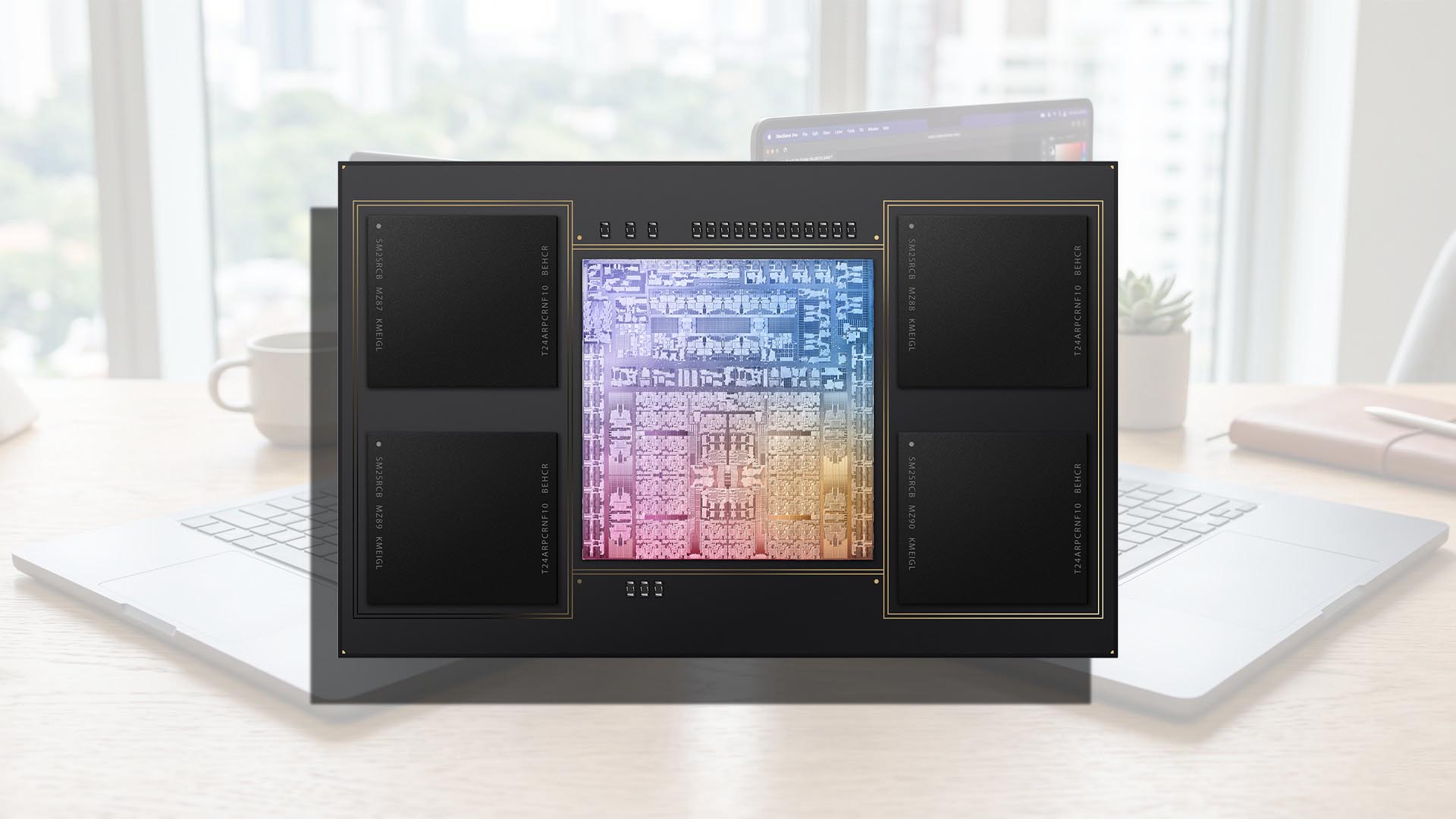
TSMC’s dominance as the world’s go-to chip manufacturer is creating an unexpected problem for some of its biggest customers. Demand for cutting-edge production has surged so sharply—largely driven by AI hyperscalers ordering massive volumes—that even long-prioritized partners are feeling squeezed. Apple, long reliant on TSMC for the chips powering iPhones, iPads, and Macs, is now reportedly exploring a major shift: spreading future Apple silicon manufacturing across multiple foundries instead of leaning so heavily on one.
According to reporting shared by Bloomberg’s Mark Gurman, Apple has begun early-stage discussions with Intel about potential manufacturing services. At the same time, Apple executives have reportedly visited Samsung’s under-construction fab in Texas to evaluate whether Samsung Foundry could become a viable option for producing Apple’s main device processors. That detail matters, because it suggests Apple isn’t just looking to outsource small, low-volume components—it’s considering alternatives for the core chips that sit at the center of its biggest product lines.
This broader search lines up with recent industry chatter that Apple may consider Intel’s upcoming 18A-P process for lower-end M-series chips expected to arrive in 2027, as well as non-Pro iPhone chips projected for 2028. There’s also speculation that a custom Apple ASIC planned for 2027 or 2028 could use Intel’s advanced packaging, including EMIB. In addition, Apple is said to have signed an NDA with Intel and obtained process design kit (PDK) samples of 18A-P for evaluation. Intel’s 18A-P is notable because it is expected to support Foveros Direct 3D hybrid bonding, a technology designed to stack chiplets using TSVs for tighter integration and potentially better performance and efficiency.
What’s pushing Apple to look around isn’t simply strategic curiosity—it appears tied to real supply pressure in the near term. During its latest earnings call, Apple acknowledged it could take months for Mac Studio and Mac mini supply to catch up with demand, pointing to agentic AI as a key driver of heightened interest in these systems. Apple also indicated the bottleneck is not memory availability, but limited access to advanced-node capacity at TSMC.
That supply crunch is showing up in how Apple is managing configurations. The base Mac mini configuration that included an M4 chip, 16GB of RAM, 256GB of storage, and a $599 price point has reportedly been removed from Apple’s configurator. A Mac Studio configuration with 512GB storage has also been pulled. While Apple hasn’t publicly framed these changes as a foundry issue, the timing aligns with growing constraints on leading-edge manufacturing capacity.
Behind the scenes, TSMC is trying to free up more 3nm production by repurposing some 4nm lines left underutilized due to softer demand for low- and mid-range smartphone chips. That effort could add roughly 25,000 wafers per month. Even so, demand may still be overwhelming, particularly because AI hyperscalers are reportedly willing to pay premiums of 50% to 100% for rush orders, crowding the queue and tightening availability for everyone else.
At the same time, TSMC’s expansion priorities appear to be shifting toward its next-generation 2nm node. Estimates suggest only modest 3nm capacity is being added (on the order of a few thousand wafers per month), while far more new capacity is being built for 2nm. Apple is reportedly reserving a significant portion of TSMC’s 2nm lines, but the catch is timing: 2nm-based Apple products aren’t expected until the second half of 2026. Until then, Apple still needs substantial 3nm volume to keep iPhone and Mac shipments on track.
That’s the heart of the problem. Apple can’t simply wait for 2nm to arrive, and it can’t easily conjure more 3nm capacity if TSMC’s lines are already packed. Exploring Samsung and Intel becomes a practical contingency plan—especially if it provides leverage, flexibility, or emergency capacity during peak demand cycles. The tradeoff is that moving high-volume, high-performance processors off TSMC raises questions about yield, efficiency, performance consistency, and overall chip quality. Still, in a market where leading-edge wafer supply is becoming one of the most valuable resources in tech, Apple’s message is clear: relying on a single foundry, no matter how strong, may no longer be enough.