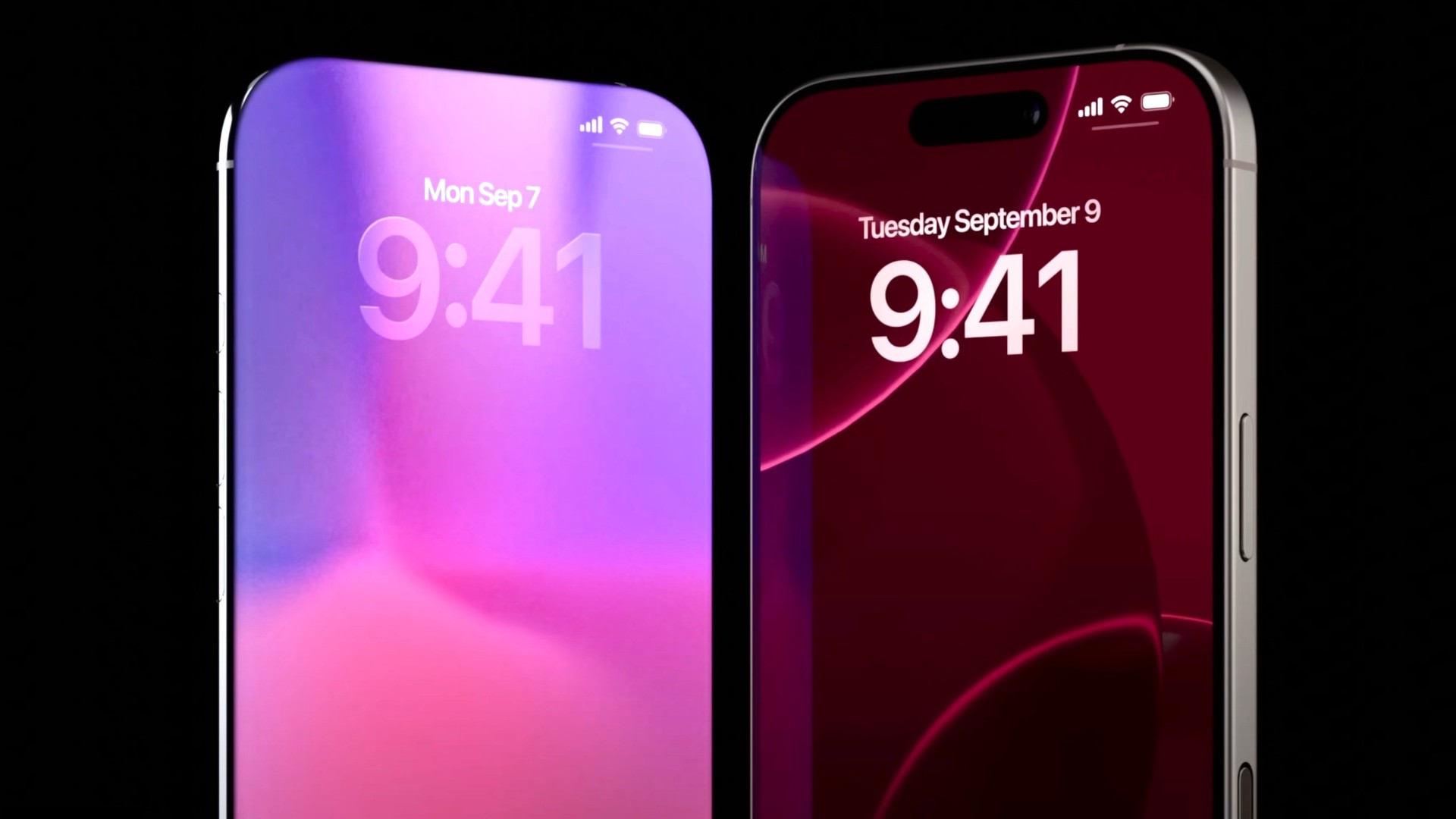
A new report out of South Korea suggests Apple’s 20th-anniversary iPhone, expected in 2027, is already reshaping plans at two of the world’s biggest display makers: LG Display and Samsung Display. Much like the iPhone X marked a major design leap in 2017, Apple is rumored to be preparing another dramatic redesign to celebrate two decades of the iPhone—one that could push current OLED manufacturing far beyond today’s limits.
The big idea is a truly all-screen iPhone. The anniversary model is said to feature a completely bezel-less display that curves on all four sides, creating a seamless “glass all around” look. On top of that, Apple reportedly wants to hide the front-facing camera and the Face ID system under the display, removing the need for a visible cutout or the Dynamic Island-style pill. If Apple pulls it off, it would be one of the most striking iPhone design changes in years, and a major milestone for under-display camera and sensor technology.
Where things get especially interesting is the supply chain. Historically, Samsung has supplied the larger share of iPhone display panels—often around 60%—with LG providing roughly 40%. But the report indicates that the balance could shift for the 2027 iPhone, with LG potentially taking on a bigger role. The reasoning is partly strategic: Samsung is reportedly concentrating heavily on producing foldable AMOLED panels for Apple’s first foldable iPhone, expected sooner than 2027. Meanwhile, industry chatter about Samsung’s readiness for the anniversary iPhone’s specific display demands is described as unusually quiet.
In contrast, LG Display is rumored to be moving aggressively. The company is said to be investing about 400 billion Korean won (roughly $271 million) toward preparations tied to Apple’s 2027 iPhone plans. That investment is reportedly driven by how different Apple’s next-generation display concept is from existing designs, including earlier curved-edge phones. A panel that appears genuinely borderless and curves on every side isn’t just a matter of bending glass—it changes how the entire OLED stack is built, packaged, and protected.
One of the biggest technical hurdles involves the edges themselves. It’s not only the screen that needs to curve; the circuitry and supporting structures around the perimeter also have to follow those contours. That adds complexity to manufacturing and lowers room for error, especially at the scale Apple requires.
Another major challenge is thin-film encapsulation (TFE), the protective layer used to shield OLED panels from moisture and oxygen. The report claims this encapsulation will need to be significantly thinner for Apple’s envisioned design. Making TFE thinner without sacrificing durability and long-term reliability is a difficult balancing act—particularly when the display is curved and intended to look borderless from every angle.
Then there’s the most ambitious piece: moving the currently visible front components under the display. Apple is reportedly aiming to hide the FaceTime camera and Face ID sensors beneath the OLED panel so the entire front becomes uninterrupted screen. Under-display cameras and sensors exist today, but meeting Apple-level expectations for image quality, facial recognition performance, brightness uniformity, and color accuracy is a far tougher standard. Achieving that at mass-production volumes could require entirely new equipment, processes, and production lines.
The report also suggests that even if Samsung appears quieter right now, it may ultimately have no choice but to expand with additional factories or dedicated production capacity to meet Apple’s requirements—because the anniversary iPhone’s display design isn’t a small tweak, but a fundamentally new manufacturing problem.
If these rumors hold, Apple’s 2027 iPhone could become a turning point not just for iPhone design, but for OLED production itself. A bezel-less, quadruple-curved screen with truly hidden cameras and Face ID would be a major flex for Apple—and a high-stakes test for LG and Samsung as they race to deliver the next leap in smartphone displays.