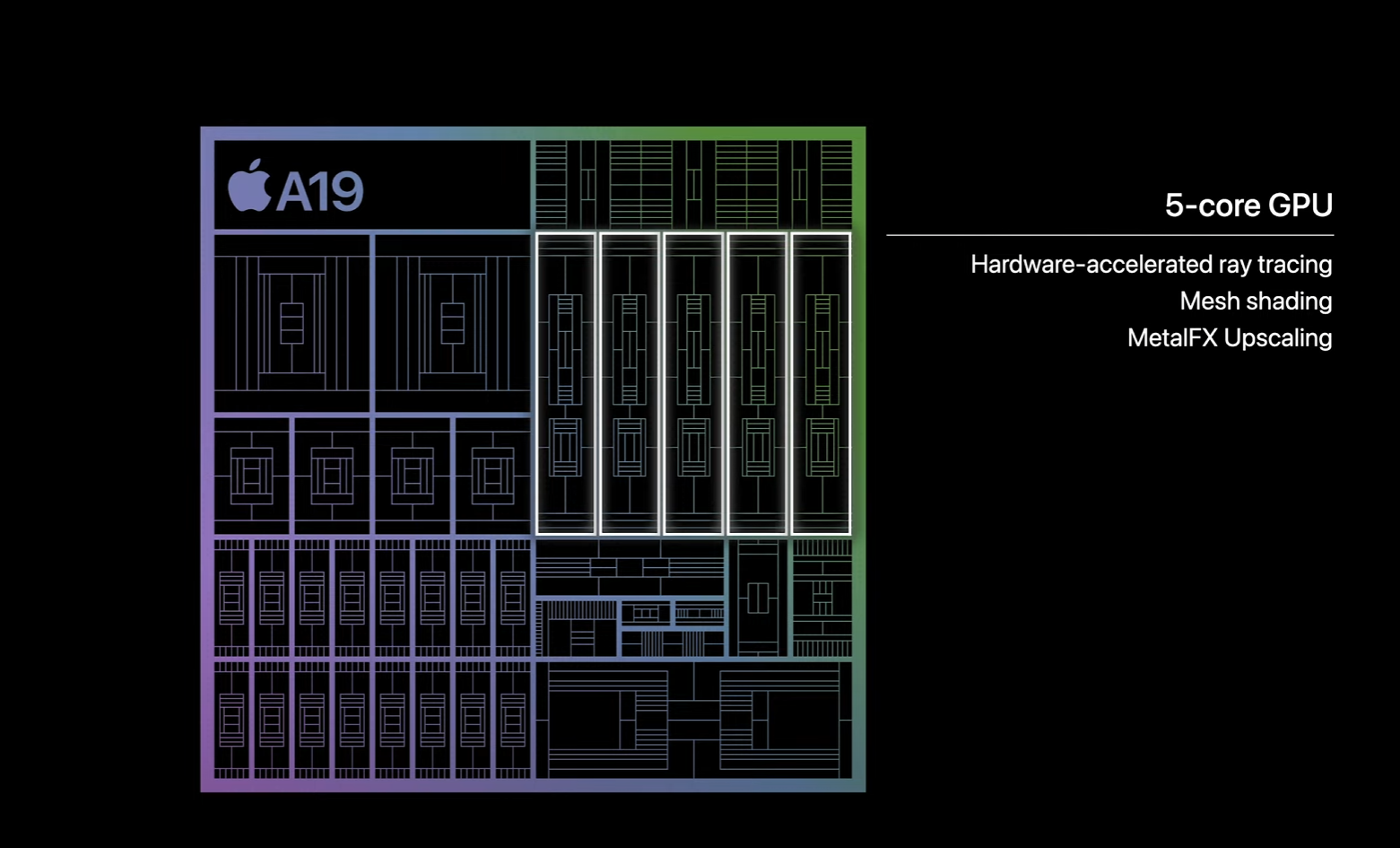
Apple’s next-generation smartphone chips are official, arriving with the iPhone 17 lineup and signaling an evolution rather than a revolution. The Apple A19 and A19 Pro stick to a familiar six-core CPU layout with two performance cores and four efficiency cores, while most of the differentiation happens on the graphics and connectivity fronts.
On the GPU side, the baseline A19 pairs the CPU with a five-core graphics unit. The A19 Pro steps up to six GPU cores, but there’s a twist: the A19 Pro configuration used in the iPhone Air reportedly drops to five GPU cores. That suggests Apple is employing aggressive binning across models. Apple also calls the Pro’s graphics a “second‑generation” architecture, aligning with premium features in the iPhone 17 Pro and iPhone 17 Pro Max. Both A19 and A19 Pro support hardware-accelerated ray tracing and MetalFX upscaling, laying the groundwork for console-style visuals and smarter rendering in mobile games and pro apps.
Wireless connectivity gets a meaningful upgrade thanks to the new N1 radio, which enables Wi‑Fi 7 and Bluetooth. That should translate to lower latency for multiplayer gaming, faster local backups, and more reliable high-bitrate audio.
Early performance messaging points to incremental gains over last year. Apple’s headline comparisons for the A19 target the older A15—up to 1.5x faster CPU and 2x faster GPU—which implies modest uplift versus the A18 generation. For the A19 Pro, Apple claims up to 40% better sustained performance than the “previous generation,” without naming a specific chip, leaving some ambiguity around real-world gains.
Both the A19 and A19 Pro are fabricated on TSMC’s third‑generation 3 nm process (N3P). With only about a 4% density bump over N3E, don’t expect massive leaps in raw performance or efficiency. The silver lining for competitors is clear: this cycle may offer Qualcomm and MediaTek a window to narrow the gap. That advantage could be short-lived, though, if the next flagship moves to TSMC’s nanosheet-based N2 node, which is widely expected to deliver a more substantial jump.
Key takeaways for buyers and enthusiasts:
– CPU architecture remains 2 performance + 4 efficiency cores across both chips
– A19 GPU: 5 cores; A19 Pro GPU: 6 cores, though some models may ship with 5
– Both GPUs support hardware ray tracing and MetalFX upscaling
– New N1 radio adds Wi‑Fi 7 and Bluetooth
– Built on TSMC N3P for modest efficiency and density improvements
– Performance messaging suggests small year-over-year gains, bigger boosts if upgrading from much older devices
What this means for you depends on where you’re coming from. If you’re upgrading from an iPhone powered by the A15 or earlier, the A19 family promises a substantial jump in responsiveness, graphics realism, and wireless speed. If you’re already on an A18-class device, the improvements look more incremental, with the biggest perks centered on ray tracing, upscaling support, and next-gen Wi‑Fi. For developers and gamers, the expanded GPU feature set could matter more than raw benchmarks, paving the way for richer visuals and more stable frame rates over time.