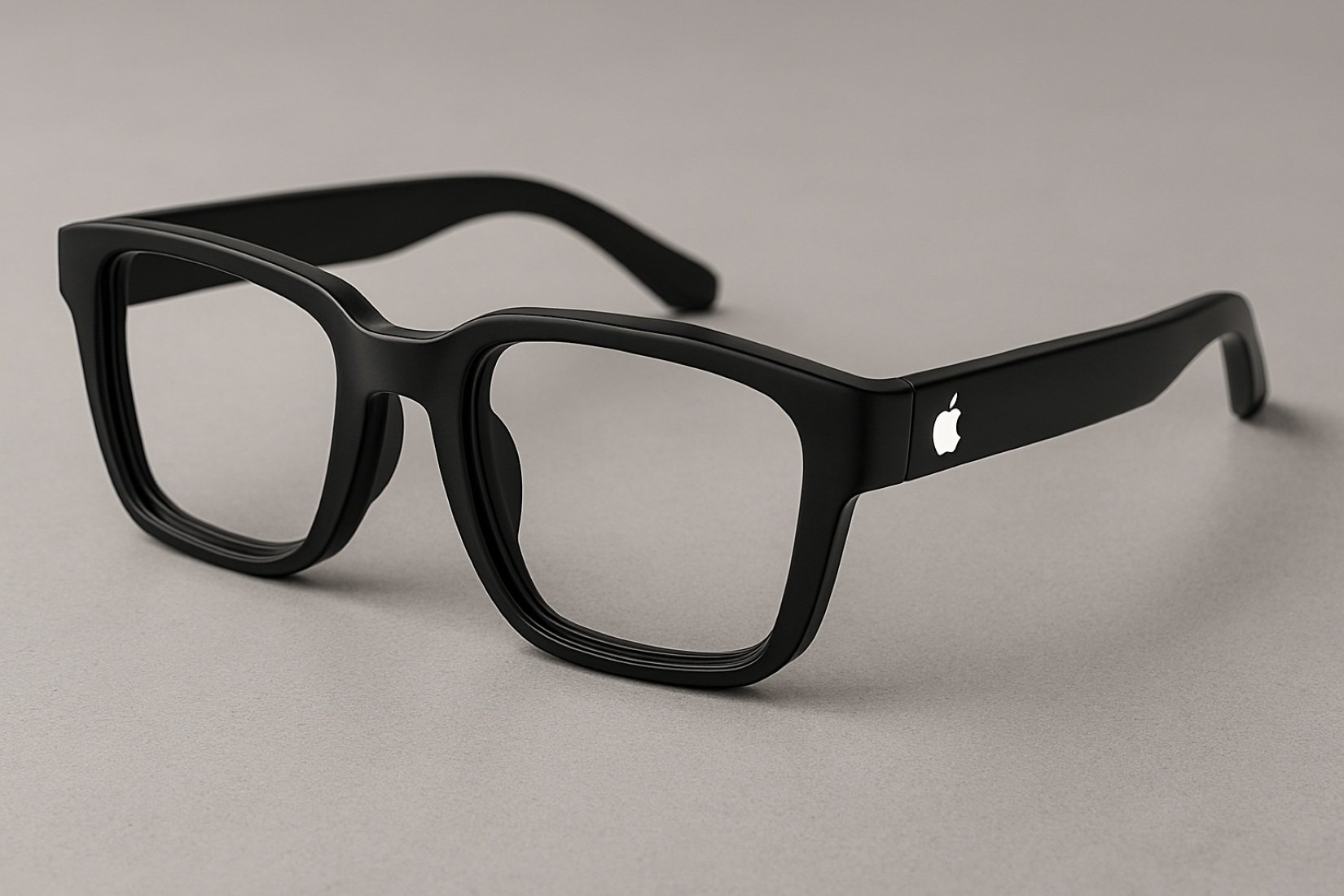
Apple’s long-rumored smart glasses face a stubborn challenge that could decide whether they become a true everyday gadget or a niche accessory: battery life. The key issue is power. A fully standalone pair of Apple Glasses would likely run out of charge in just a couple of hours, which makes it tough to position them as a realistic iPhone alternative. Earlier reports suggested Apple would need a chip offering iPhone-class performance while using roughly one-tenth the power—an extremely high bar that would require unusually efficient silicon.
A new report suggests Apple may already have the right kind of processor for the job, and it’s not from the iPhone lineup. Instead, the smart glasses may rely on Apple Watch technology. Specifically, the Apple Watch System-in-Package (SiP) is said to be a strong candidate to power the internal hardware of Apple Glasses, potentially enabling multiple cameras and a suite of AI features when the glasses are tethered to an iPhone.
The most capable Apple Watch SiP mentioned is the S10, featuring a dual-core CPU and a 4-core Neural Engine. While it wouldn’t compete with the raw speed of the latest iPhone chips like the A19 or A19 Pro, it may be comparable to older iPhone processors—more than enough for the kinds of tasks smart glasses are expected to perform. Just as important, the S10 is designed for ultra-low power operation, which is exactly what lightweight wearables need.
Battery constraints are a major reason Apple is reportedly leaning toward watch-class efficiency. For perspective, a headset like the Vision Pro uses a large 35.9Wh battery (rated around 9,498mAh at 3.8V) and still only manages up to about three hours of use. Smart glasses, on the other hand, need to be dramatically lighter and more comfortable, which likely limits battery capacity to under 800mAh. That makes power-saving components and careful system design essential.
Apple Watch efficiency provides a glimpse of what could be possible. With an efficient chip like the S10, a premium smartwatch can reportedly reach up to 42 hours in regular use and as much as 72 hours in a low power mode. Smart glasses would have very different demands—especially if they’re handling feeds from multiple cameras—but the comparison highlights why Apple might favor a wearable-focused chip rather than trying to cram iPhone-level performance into a tiny frame.
Even with a watch-style processor, Apple Glasses are expected to be feature-rich. The glasses are rumored to support functions such as capturing and processing camera footage, using Siri for voice control, and running AI capabilities when connected to an iPhone. That tethering approach could be central to Apple’s strategy: keep the glasses light and power-efficient, while leaning on the iPhone (or another Apple device) for heavier processing when needed.
Connectivity is also expected to be flexible. The first version of Apple’s smart glasses is rumored to support direct or wireless connections to an iPhone or Mac. However, the initial model may ship without a built-in display—suggesting Apple is prioritizing wearability, battery life, and core “smart” features in the first generation rather than full augmented reality visuals.
As for timing, the first-generation Apple Glasses are rumored to arrive in 2026. A second-generation model is reportedly targeted for 2027, and it could be more advanced—potentially capable of running two operating systems depending on whether it’s connected to an iPhone or a Mac. If accurate, that could point to a longer-term roadmap where Apple Glasses evolve from a lightweight companion device into something far more capable over time.
If Apple can successfully pair all-day comfort with practical battery life—and deliver useful camera, voice, and AI features without adding bulk—the Apple Watch-style silicon approach may be the breakthrough that makes smart glasses feel ready for everyday use.