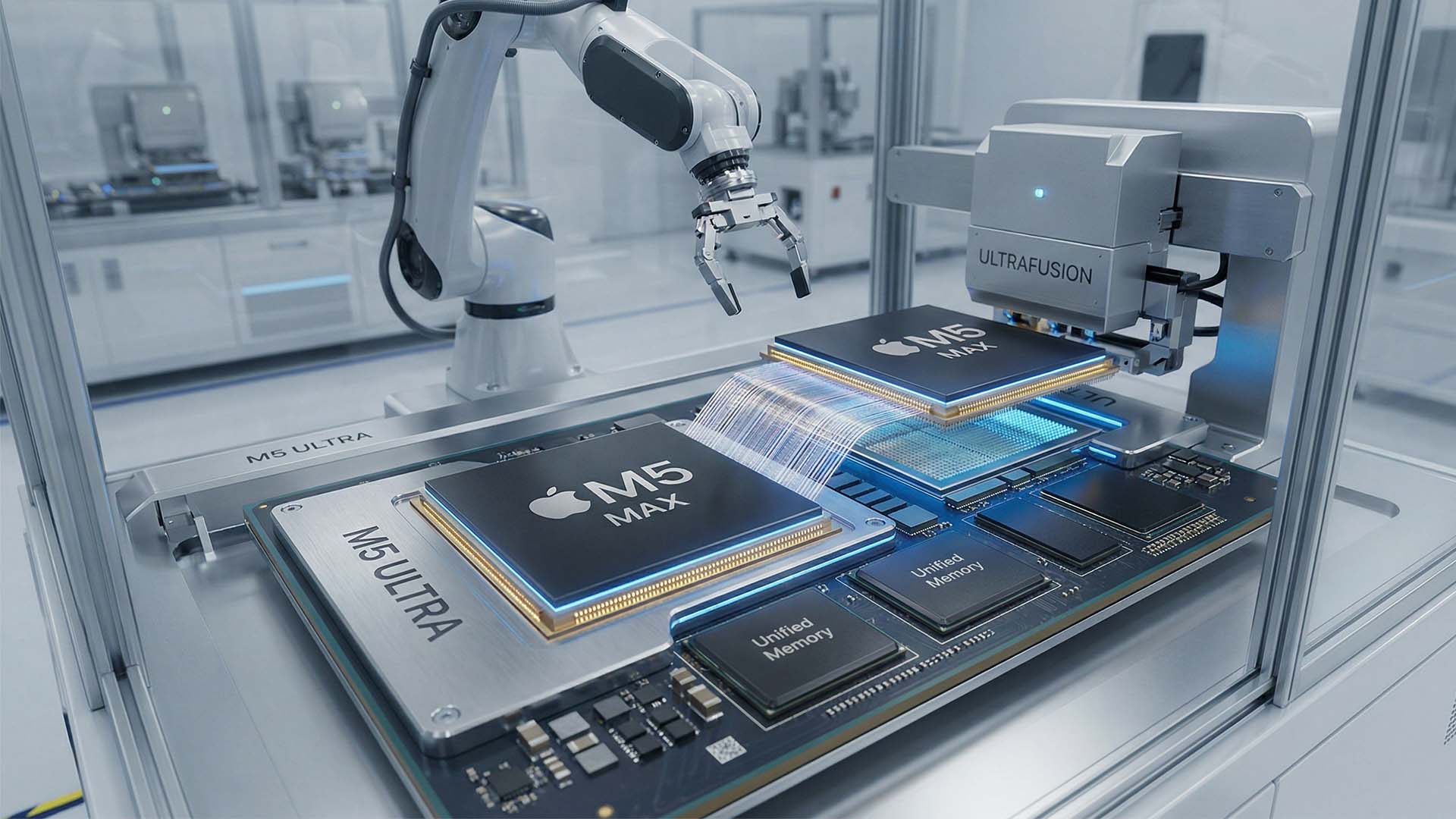
Apple’s new Fusion Architecture in the M5 Pro and M5 Max signaled a clear shift in how the company can keep scaling its chips: more CPU cores, higher clock speeds, and still the kind of power efficiency Apple Silicon is known for. With those two processors now in the spotlight, attention naturally turns to the last big piece expected in the lineup: the M5 Ultra.
Unlike the M5 Pro and M5 Max, however, the M5 Ultra remains the mystery chip. Concrete details about its final design are limited, but a few strong, logical clues point to what Apple is most likely to do next: lean on its proven UltraFusion approach again, similar to what it has used in past Ultra-class chips.
If that happens, the M5 Ultra could mark a unique moment in Apple Silicon history. It would effectively combine two different concepts into one product—Fusion Architecture at the chip level, and UltraFusion at the package level—creating a single workstation-class processor by linking two high-end dies together.
Why Apple may choose UltraFusion again for M5 Ultra
While there has been talk that Apple could build the M5 Ultra as a monolithic die, a separate claim suggests Apple will stick with the strategy that has already delivered reliable results: combining two M5 Max chips to form one M5 Ultra. The reasoning is straightforward. Apple has already used UltraFusion for multiple workstation-grade processors, and each time it has delivered meaningful jumps in both CPU and GPU performance.
More importantly, this method has real manufacturing advantages. Reusing a “battle tested” design can improve yields and keep costs more manageable—two factors that matter a lot when producing a high-end chip in volume. Higher yields mean more usable chips per wafer, and that can translate into better supply and potentially more stable pricing across the product line.
How UltraFusion could be implemented in M5 Ultra
In this expected layout, an UltraFusion interposer would sit between two M5 Max dies, allowing the CPU and GPU blocks to be linked using copper-to-copper (Cu-Cu) direct bonding. The end result would be two M5 Max units operating together as one larger processor.
There’s also a practical cost consideration here. Copper-to-copper bonding can be expensive, which makes it unlikely Apple would pursue a more complex or riskier approach when UltraFusion already has a track record. Sticking with a known solution reduces engineering uncertainty and helps keep production more predictable.
Possible core counts and performance expectations
If Apple continues the pattern of “doubling up” the Max chip into an Ultra, the top configuration could land at around a 36-core CPU paired with an 80-core GPU. That combination would position the M5 Ultra as the performance ceiling of the M5 family, built to deliver the strongest compute power and graphics throughput Apple can offer on the desktop.
Where M5 Ultra could appear
Another factor shaping this decision is product strategy. With fewer ultra-high-end desktop targets to support, Apple may not need to stretch the M5 Ultra across multiple machines. That narrows the focus to a single likely destination: a refreshed Mac Studio, which would be the natural home for a chip designed to push maximum CPU and GPU performance.
For now, the M5 Ultra remains unannounced, but if Apple plays to its strengths, UltraFusion paired with two M5 Max dies could be the most realistic path forward—balancing performance ambitions with manufacturing efficiency, cost control, and a strategy that has already worked in real-world releases.