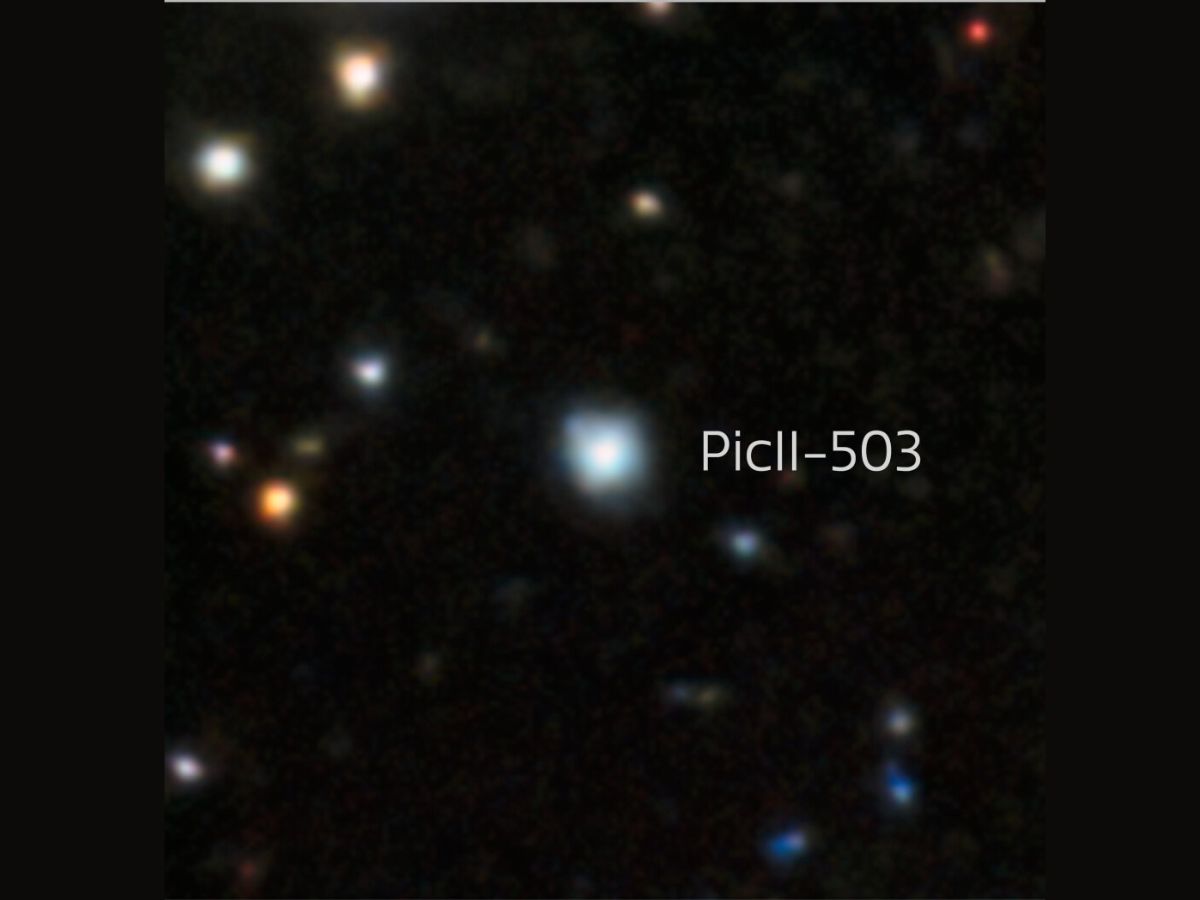
Astronomers have identified a remarkably ancient, chemically primitive star inside Pictor II, a tiny dwarf galaxy that orbits in our cosmic neighborhood. What makes this discovery so exciting is that the star appears to preserve the chemical “fingerprints” of the universe’s earliest era, when the very first stars were forming and seeding space with new elements.
Because the star is chemically primitive, it contains far fewer heavy elements than stars like the Sun. In astronomy, “heavy elements” (anything beyond hydrogen and helium) are a major clue: they build up over time as successive generations of stars live, explode, and enrich their surroundings. A star that formed before much enrichment happened is like a time capsule, holding onto the elemental recipe of the early cosmos.
Finding this kind of stellar relic in a dwarf galaxy is especially valuable. Small galaxies such as Pictor II tend to have simpler histories than massive galaxies, meaning their oldest stars can remain relatively uncontaminated by later waves of star formation. That increases the odds that astronomers are looking at material influenced by the universe’s first stars, rather than a complicated mixture produced over billions of years.
In practical terms, this “cosmic fossil” gives researchers a rare chance to study the chemical signatures linked to the first generation of stars. Those earliest stars are thought to have been massive, short-lived, and instrumental in forging the first heavy elements. While the first stars themselves are long gone, their impact can still be traced through the chemistry of ancient, metal-poor stars that formed soon after.
Discoveries like this help astronomers piece together how the universe transitioned from a simple mix of hydrogen and helium into a richer, more complex environment capable of forming planets—and eventually life. With each newly found chemically primitive star, scientists gain another crucial data point for reconstructing the timeline of early star formation and the origins of the elements we see today.