AMD Confirms Zen 7 and Zen 8 CPU Roadmaps for Future EPYC Florence and Ravenna Chips
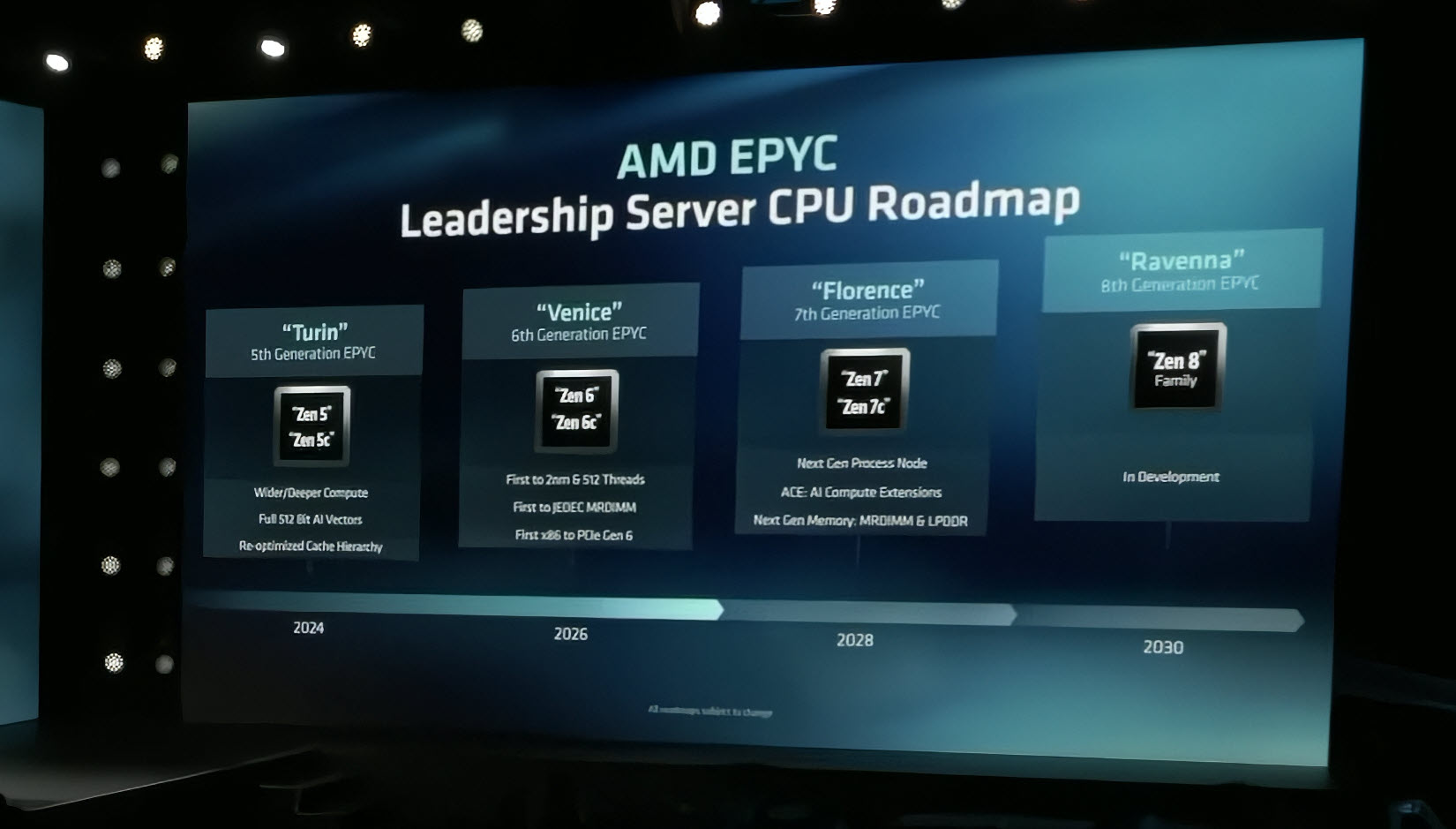
AMD has officially revealed the next major steps in its server CPU roadmap, confirming that Zen 7 and Zen 8 are on the way for future EPYC processors. The announcement gives a clearer look at how AMD plans to push high-performance computing, cloud infrastructure, enterprise servers, and AI data centers through the end of the decade.
The company recently introduced its first EPYC processors based on the Zen 6 architecture, but AMD is already looking far beyond that generation. During its Advancing AI 2026 presentation, CEO Lisa Su outlined a broad vision that spans CPUs, GPUs, AI racks, networking, and software. Among the biggest highlights was confirmation of two upcoming CPU architectures: Zen 7 and Zen 8.
Zen 7 is expected to arrive around 2028 and will power AMD’s 7th Gen EPYC lineup, codenamed Florence. This new EPYC family will continue AMD’s familiar strategy of offering both standard Zen 7 cores and density-focused Zen 7C cores, giving data center customers options for maximum performance or higher core counts in power- and space-sensitive environments.
One of the most important upgrades for EPYC Florence will be its move to a next-generation manufacturing process. While AMD has not confirmed the exact node, the chips are expected to use an advanced process in the sub-2nm class. That could place Zen 7 among the most advanced server CPU platforms of its time, with major improvements in performance, efficiency, and transistor density.
Memory support will also take a major step forward. AMD says Zen 7 EPYC processors will support next-generation memory technologies, including MRDIMM and LPDDR-class solutions. The roadmap strongly suggests support for future DDR6 memory standards, which could significantly boost bandwidth for AI, cloud, and high-performance computing workloads.
Another notable detail is platform continuity. EPYC Florence is planned to support existing SP7 and SP8 platforms. The SP7 versions are expected to target leadership core counts and top-tier performance, while SP8 variants will focus on better performance per system cost. This could help server customers upgrade more efficiently without requiring a complete platform overhaul.
Zen 7 will also play a central role in AMD’s future AI infrastructure. EPYC Florence CPUs are set to act as the host processors for AMD’s next-generation AI rack system, codenamed Ferrara. AMD is also developing an agentic AI sandbox platform known as Fidenza, based on Ferrara systems. This platform is designed for large-scale AI deployments with an emphasis on improved performance per watt.
Perhaps the most significant architectural addition for Zen 7 is support for ACE, or AI Compute Extensions. AMD describes Zen 7 EPYC as the first EPYC generation to include these extensions. ACE is part of a broader effort within the x86 ecosystem to standardize matrix acceleration features, helping future CPUs better support AI and advanced compute workloads.
This move is especially important as AI workloads increasingly depend on efficient matrix math. By adding standardized acceleration features directly into future EPYC CPUs, AMD is positioning Zen 7 not just as a traditional server processor, but as a more capable foundation for AI-driven data centers.
AMD also used the event to update its Instinct GPU roadmap. The Instinct MI500 series is planned for 2027 and will use the CDNA 6 architecture. These GPUs will bring next-generation HBM4e memory, a larger scale-up domain, and designs prepared for both copper and optical connectivity. That combination is aimed at improving bandwidth, scalability, and efficiency in massive AI training and inference clusters.
Looking further ahead, AMD is developing CDNA-Next for the Instinct MI600 series, which is targeted for 2028. This GPU generation is expected to pair with AMD’s future AI rack systems and further strengthen the company’s position in the accelerator market.
Beyond Zen 7, AMD confirmed that Zen 8 is already in development. Zen 8 will power the 8th Gen EPYC processor family, codenamed Ravenna, and is expected to arrive around 2030. While AMD has not yet shared detailed specifications, the early confirmation shows that the company is planning multiple generations ahead as demand for AI computing and data center performance continues to rise.
The Zen 8 roadmap also signals that AMD is committed to extending its EPYC momentum well into the next decade. With each generation, the company is aiming to deliver stronger performance, better energy efficiency, higher memory bandwidth, and deeper integration with AI infrastructure.
AMD’s latest roadmap makes one thing clear: the EPYC platform is becoming a core pillar of the AI data center. Zen 7 Florence will bring advanced process technology, next-generation memory, ACE support, and close integration with AI rack systems. Zen 8 Ravenna will continue that journey with another leap in server CPU design.
As AI workloads grow larger and cloud infrastructure becomes more demanding, AMD is preparing a long-term lineup that combines CPUs, GPUs, memory innovations, and rack-scale systems. If the company executes on this roadmap, Zen 7 and Zen 8 could become major milestones in the future of enterprise computing, high-performance servers, and large-scale artificial intelligence.