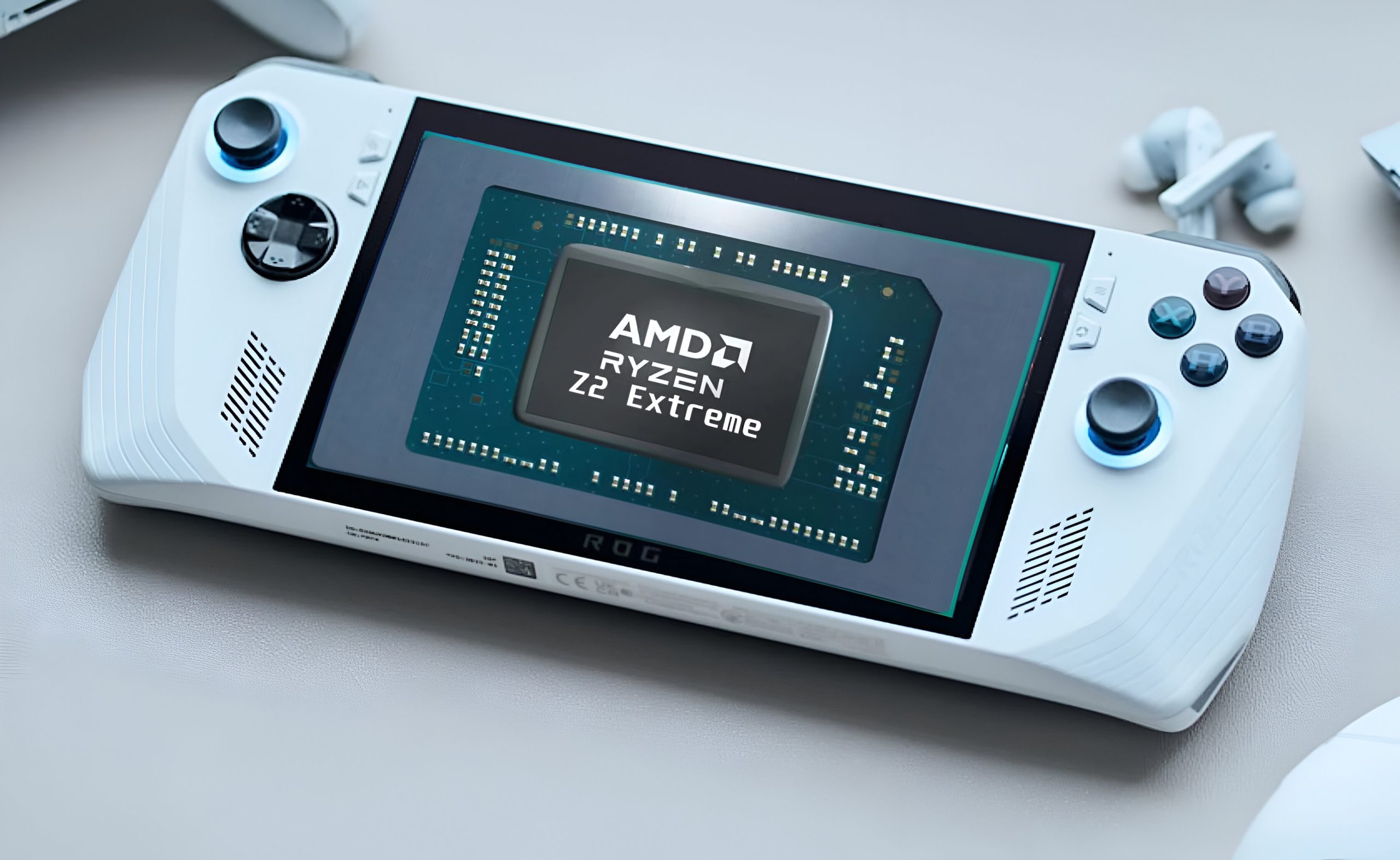
Exciting developments are underway in the world of gaming handhelds with the emergence of the AMD Ryzen Z2 Extreme APU. Anticipated to be the powerhouse behind the next generation of portable gaming devices, this advanced chip promises to redefine on-the-go gaming experiences.
The Ryzen Z2 Extreme APU aims to build on the legacy of the Z1 Extreme, which fueled devices like the ASUS ROG Ally. As AMD advances beyond its Zen 4 architecture to the innovative Zen 5, the Z2 Extreme is set to bring significant upgrades, reflecting the company’s latest technological strides seen in its Ryzen 9000 and Ryzen AI 300 lineups.
A leaked shipping manifest hints at the upcoming release, with the chip identified as “Z2X28W” bearing a “100-000001684” ID. Here, “Z2X” is shorthand for Z2 Extreme, with the “28W” specifying its thermal design power (TDP). The expectation is that its TDP will range from 9W to a capped 28W, indicating AMD’s readiness to enhance the thermal efficiency and performance of gaming handhelds.
AMD has confirmed plans to launch the Ryzen Z2 Extreme APU early in 2025. The new chip addresses the cost concerns associated with the Strix Point series, which has been deemed too expensive for handheld gaming. Meanwhile, upcoming Krackan Point APUs will target mainstream laptops. Although AMD Strix Point Ryzen AI 300 processors have surfaced in mini-PCs, they have yet to make their way into gaming handhelds.
Competing brands are also gearing up for this shift. While MSI plans to use Intel’s Lunar Lake for its Claw 8, ZOTAC has opted for a Zen 4-based solution for its Gaming ZONE series. The introduction of the Z2 Extreme could offer a robust alternative for popular handhelds like the ROG Ally and Lenovo Legion Go.
The Ryzen Z2 Extreme APU promises groundbreaking specs, including a unique 3+5 core configuration featuring 3 Zen 5 cores and 5 Zen 5c cores, complete with hyperthreading and up to 16MB of cache. Its integrated GPU will operate on RDNA 3.5 architecture with 12 Compute Units, paralleling the graphics capabilities seen in the Ryzen AI 9 HX 370 APU. This substantial upgrade is expected not only to enhance gaming performance but also to extend battery life significantly—an area that AMD’s Senior VP, Jack Hyunh, has emphasized.
A comparison of next-gen SoCs tailored for gaming handhelds reveals just how transformative the Z2 Extreme could be:
– Intel’s Lunar Lake, featuring TSMC N3B process nodes, peaks at 8 cores/8 threads with a maximum 12MB cache and GPU architecture based on Xe2 with 8 Xe-Cores.
– The AMD Ryzen Z2 Extreme and Ryzen Z2, likely using TSMC N4 nodes, stand out with up to 8 cores/16 threads, a substantial 16MB maximum cache, and GPU architecture leveraging RDNA 3.5 and RDNA 3 respectively, each sporting 12 Compute Units.
Launching in Q1 2025, these APUs are poised to usher in a new era for gaming handhelds, enhancing both the performance and efficiency of the devices we love to play on the go.


