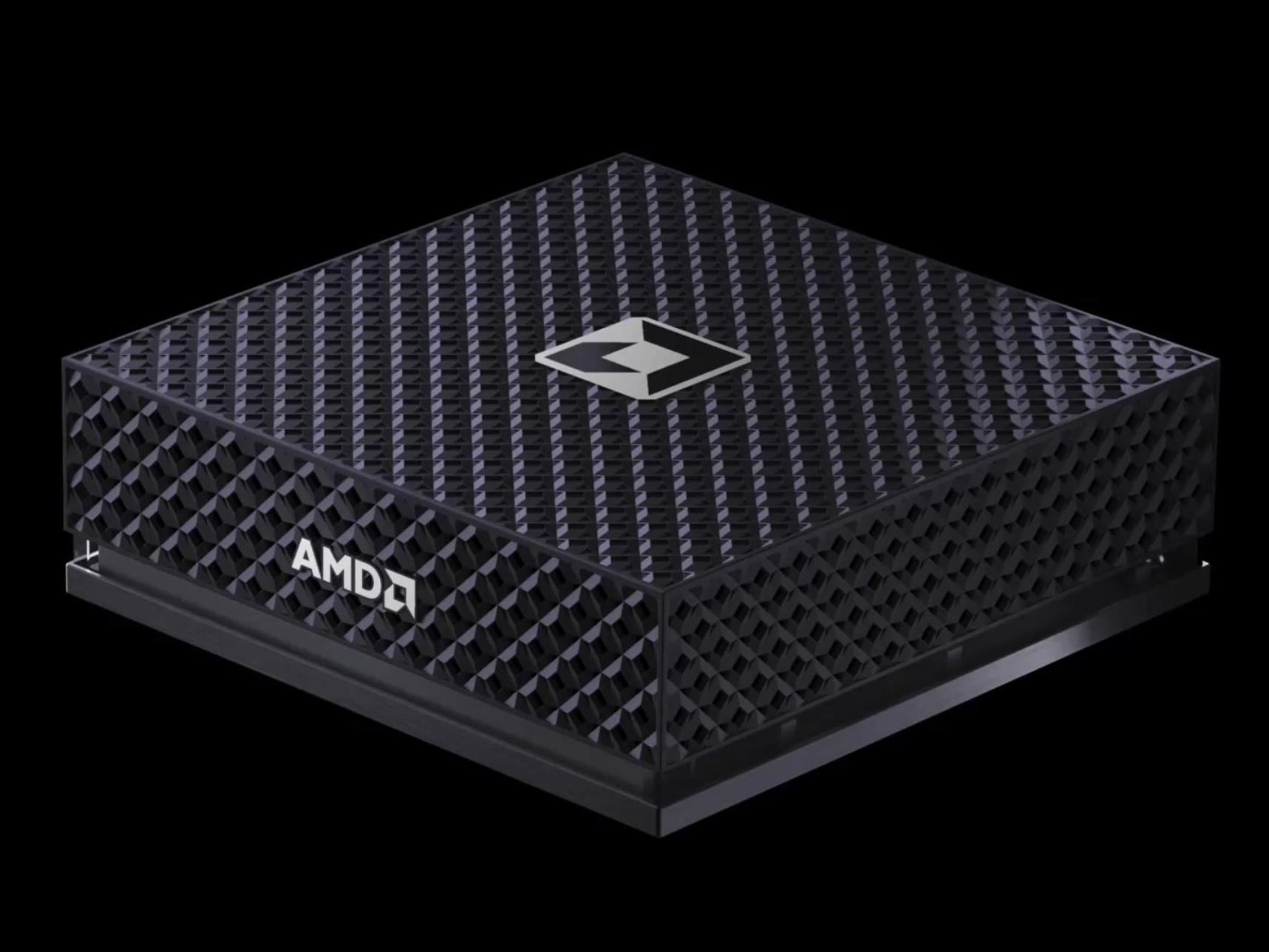
AMD Ryzen AI Halo Developer Platform Launches With Strix Halo Power for Local AI Workloads
AMD is stepping into the compact AI workstation market with its new Ryzen AI Halo developer platform, a first-party system designed to showcase the full potential of its powerful Strix Halo hardware. Although Strix Halo has technically been positioned as a laptop-class chip family, it has appeared more often in mini PCs and desktop-style systems than in traditional notebooks. Now, AMD is offering its own ready-made platform aimed at developers, AI enthusiasts, and professionals who want serious local AI performance in a small form factor.
At the heart of the AMD Ryzen AI Halo platform is the Ryzen AI Max+ 395, the company’s top-end Strix Halo processor. This chip is paired with 128 GB of LPDDR5 memory running at 8000 MT/s, giving the system enough high-speed memory capacity to handle demanding AI models and intensive productivity workloads.
Graphics are handled by the integrated Radeon 8060S GPU, which features 40 compute units. While it is an integrated GPU, it is far more capable than typical laptop iGPUs and is designed to accelerate graphics, compute, and AI-assisted tasks. The system also includes a 50 TOPS neural processing unit, giving it dedicated hardware for AI workloads.
Storage comes in the form of a 2 TB PCIe Gen4 SSD, offering fast read and write speeds for large datasets, AI model files, creative projects, and development environments.
Connectivity is another strong point. The Ryzen AI Halo developer platform includes Wi-Fi 7, Bluetooth 5.4, HDMI 2.1b, a 10 Gb/s Ethernet port, three USB-C ports, and a separate USB-C power input. While AMD has not fully detailed every USB-C specification, the ports are expected to support high-speed connectivity suitable for modern developer setups.
Despite its high-end specifications, the system remains compact. It measures 5.9 x 5.9 x 1.7 inches, making it small enough for a desk, lab, or portable workstation setup. The platform is rated for a 120-watt TDP, suggesting AMD is prioritizing sustained performance rather than ultra-low-power operation.
AMD is positioning Ryzen AI Halo as a local AI development machine, especially for users who want to run large language models without relying entirely on cloud services or recurring AI subscription costs. The company claims the platform can run large models such as GPT OSS 120B and Qwen 3.5 122B locally. AMD also states that these models do not run on Apple’s M4 Pro, highlighting the Ryzen AI Halo system’s memory capacity and AI-focused design as key advantages.
Another notable difference is operating system flexibility. Unlike some competing AI-focused desktop systems that are limited to Linux, the Ryzen AI Halo platform can also be configured with Windows. That could make it more appealing to developers, creators, and businesses already working in Windows-based environments.
With the Ryzen AI Halo developer platform, AMD is making a clear push into the growing market for compact local AI machines. By combining a powerful Ryzen AI Max+ processor, a large memory pool, capable integrated Radeon graphics, fast storage, and modern connectivity, AMD is offering a small but powerful system built for next-generation AI development, edge computing, and advanced local workloads.