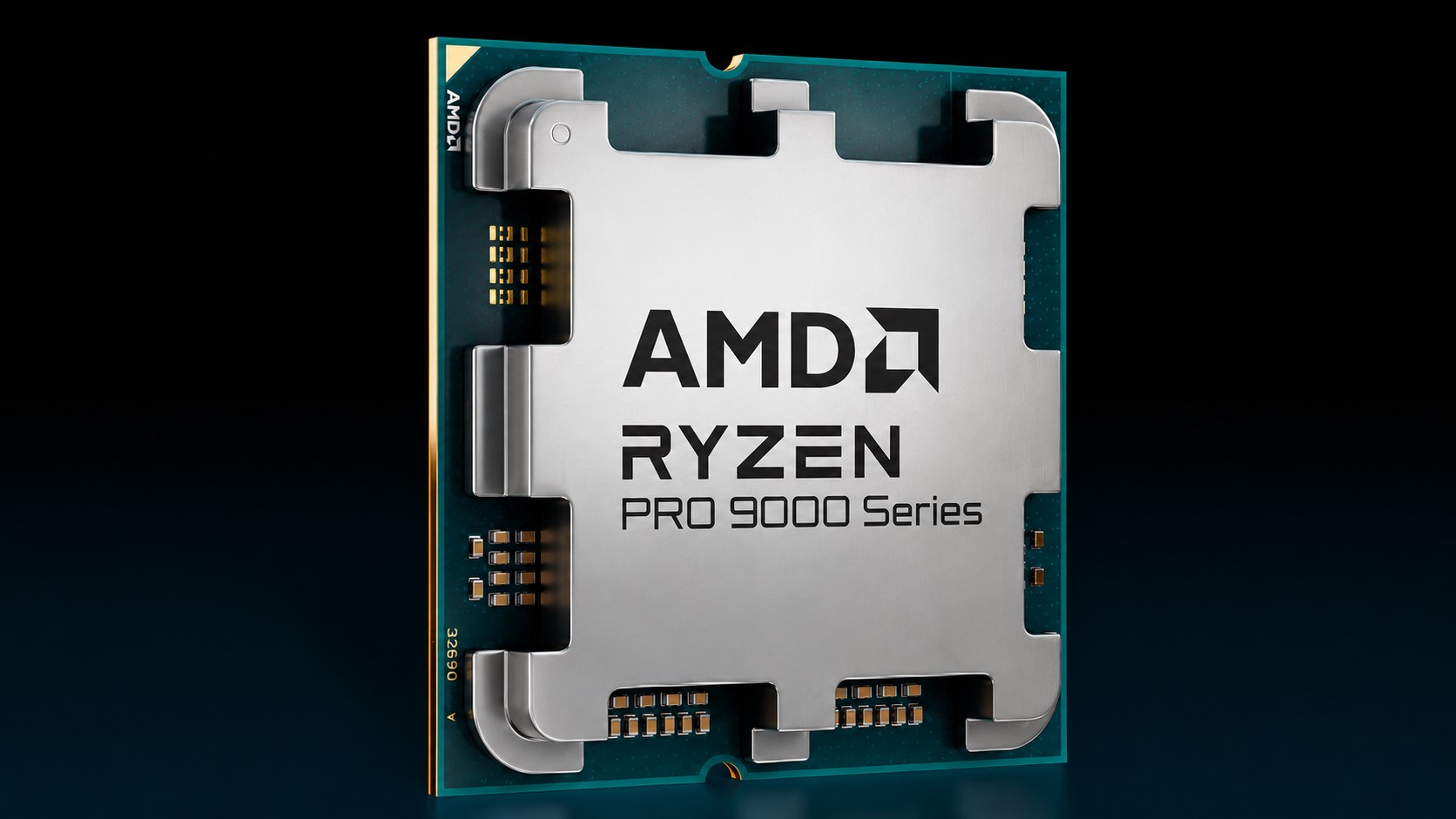
AMD is expanding its Ryzen 9000 PRO lineup with two new X3D processors built specifically for commercial workstations and business desktops, alongside four additional non-X3D PRO chips. The move brings AMD’s 3D V-Cache performance focus deeper into the professional segment, giving workstation buyers more options for high core counts, large cache, and modern Zen 5-era clocks under PRO branding.
Leading the new releases is the Ryzen 9 PRO 9965X3D, a workstation-class flagship featuring 16 cores and 32 threads. AMD lists it with a 4.3GHz base clock and up to a 5.5GHz boost clock, backed by a 170W TDP. Like other Ryzen 9000 desktop chips, it includes a small integrated graphics solution with two GPU cores based on RDNA 2, useful for basic display output and troubleshooting without a discrete GPU. The big highlight is cache: one chiplet carries an extra 64MB of L3 cache, bringing the total to 128MB L3. For cache-sensitive professional workloads, that extra L3 can help reduce memory trips and improve responsiveness in certain production scenarios.
AMD is also introducing a more mid-range PRO X3D option, the Ryzen 7 PRO 9755X3D. It comes with 8 cores and 16 threads and boosts up to 5.2GHz. Cache is substantial here as well, with 96MB of L3. AMD positions this model as a commercial-only counterpart to the well-known 8-core X3D configuration found in the consumer lineup, offering similar fundamentals but reserved for business and workstation deployments.
Beyond the two X3D additions, AMD’s new Ryzen 9000 PRO stack also includes four non-X3D processors: Ryzen 9 PRO 9955, Ryzen 9 PRO 9965, Ryzen 7 PRO 9755, and Ryzen 5 PRO 9655. These models span 6 to 16 cores, reach boost clocks as high as 5.5GHz, and carry power ratings ranging from 120W to 170W. They’re essentially workstation-segment PRO variants of existing Ryzen 9000 series parts, typically equipped with 32MB to 64MB of L3 cache depending on the model.
With these launches, AMD is clearly aiming to cover more of the professional PC market—from high-end workstations that benefit from 16-core muscle and massive L3 cache, to more mainstream business desktops that still need strong single-thread speed, multi-thread throughput, and modern platform features under a PRO-focused product line.