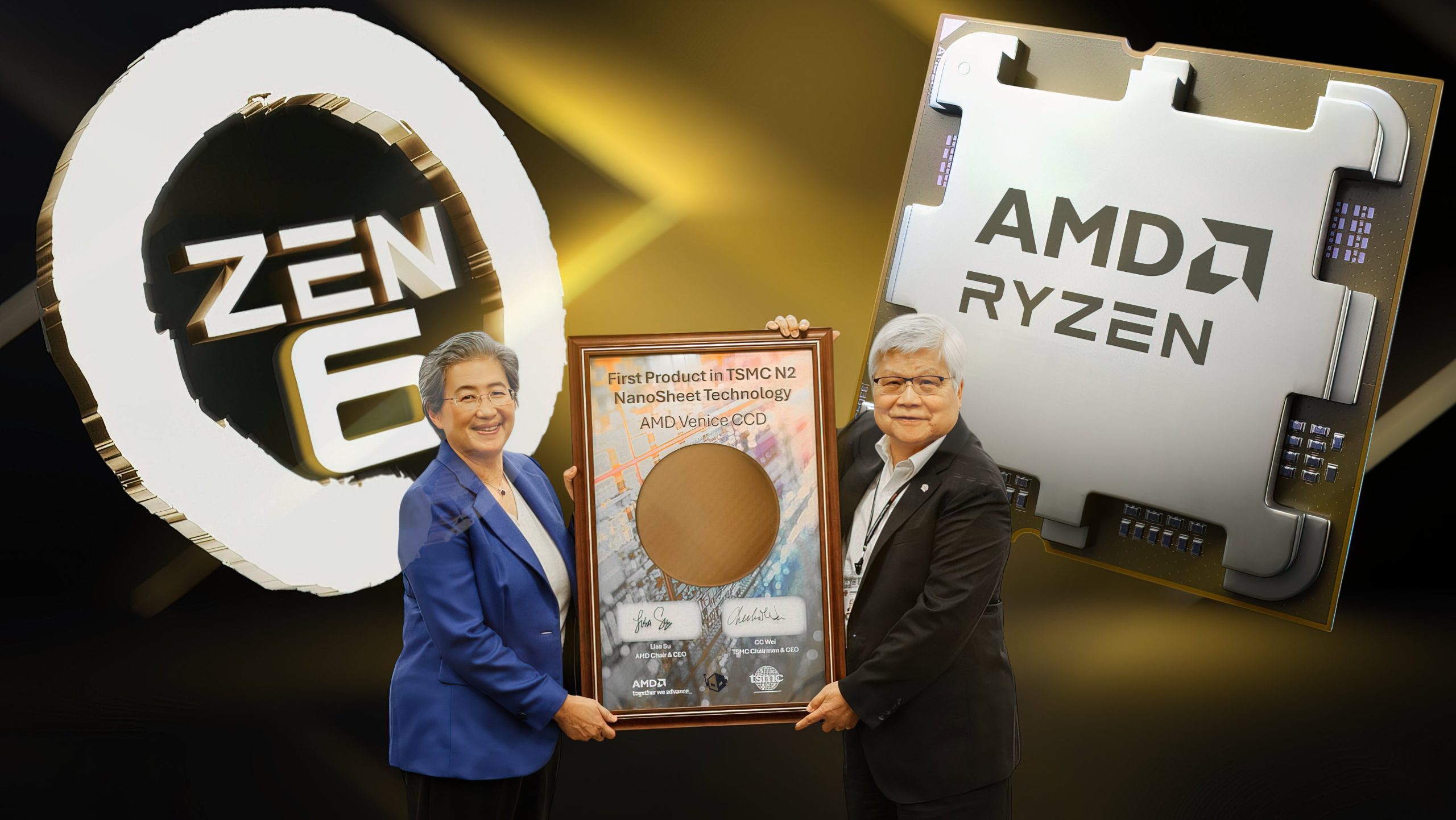
AMD’s next wave of Ryzen processors is shaping up to be a major step forward. The upcoming Zen 6 architecture is expected to marry TSMC’s cutting-edge N2P 2nm node for the core-complex dies (CCDs) with the N3P 3nm node for the I/O die (IOD), aligning performance-first silicon where it matters and cost-efficient, feature-rich silicon where it counts.
AMD has already confirmed that its Venice CCD with Zen 6 cores will be built on 2nm. New reports add that the CCDs will use TSMC’s N2P variant while the IOD will land on N3P. That split makes sense: the CCD is where high-frequency, high-efficiency cores live, while the IOD handles memory controllers, PCIe, USB, and the integrated GPU.
Compared to today’s Zen 5-based Ryzen chips, which use 4nm for CCDs and 6nm for the IOD, Zen 6 is poised to deliver a bigger architectural jump. Each Zen 6 CCD is said to feature 12 cores and 24 threads, backed by up to 48 MB of shared L3 cache per CCD—an increase from the 32 MB per 8-core Zen 5 CCD. With up to two CCDs on a desktop chip, that points to flagship configurations reaching 24 cores and 48 threads while maintaining familiar power envelopes.
What to expect from Ryzen Zen 6 on desktop
– Double-digit IPC gains
– More cores and threads, potentially up to 24C/48T via two CCDs
– Higher clock speeds thanks to advanced nodes
– Larger caches, up to 48 MB L3 per CCD
– Up to 2x CCDs paired with 1x IOD
– Faster DDR5 support
– Dual memory controllers while retaining dual-channel operation
– Similar TDPs to current generation
On timing, chatter from industry watchers suggests TSMC’s N2P will hit volume ramp in Q3 2026. If that holds, Zen 6 Ryzen desktop CPUs could arrive as early as late Q3 in limited quantities, with broader availability likely in Q4 2026. That window lines up neatly against Intel’s Nova Lake-S, part of the Core Ultra 400 series, rumored to scale up to 52 cores and 52 threads. AMD’s counterpunch may rely not only on strong per-core performance and efficiency, but also on platform stability: Zen 6 desktop CPUs are expected to keep support for the AM5 socket, a compelling advantage as competing platforms transition to new motherboards.
Between a 2nm CCD for raw compute, a 3nm IOD for robust connectivity and integrated graphics, higher L3 cache per CCD, and continued AM5 compatibility, Zen 6 looks like a significant generational leap for enthusiasts, creators, and gamers alike.
Which Zen 6 feature excites you most: the bigger caches, the expected IPC uplift, or the promise of AM5 longevity?


