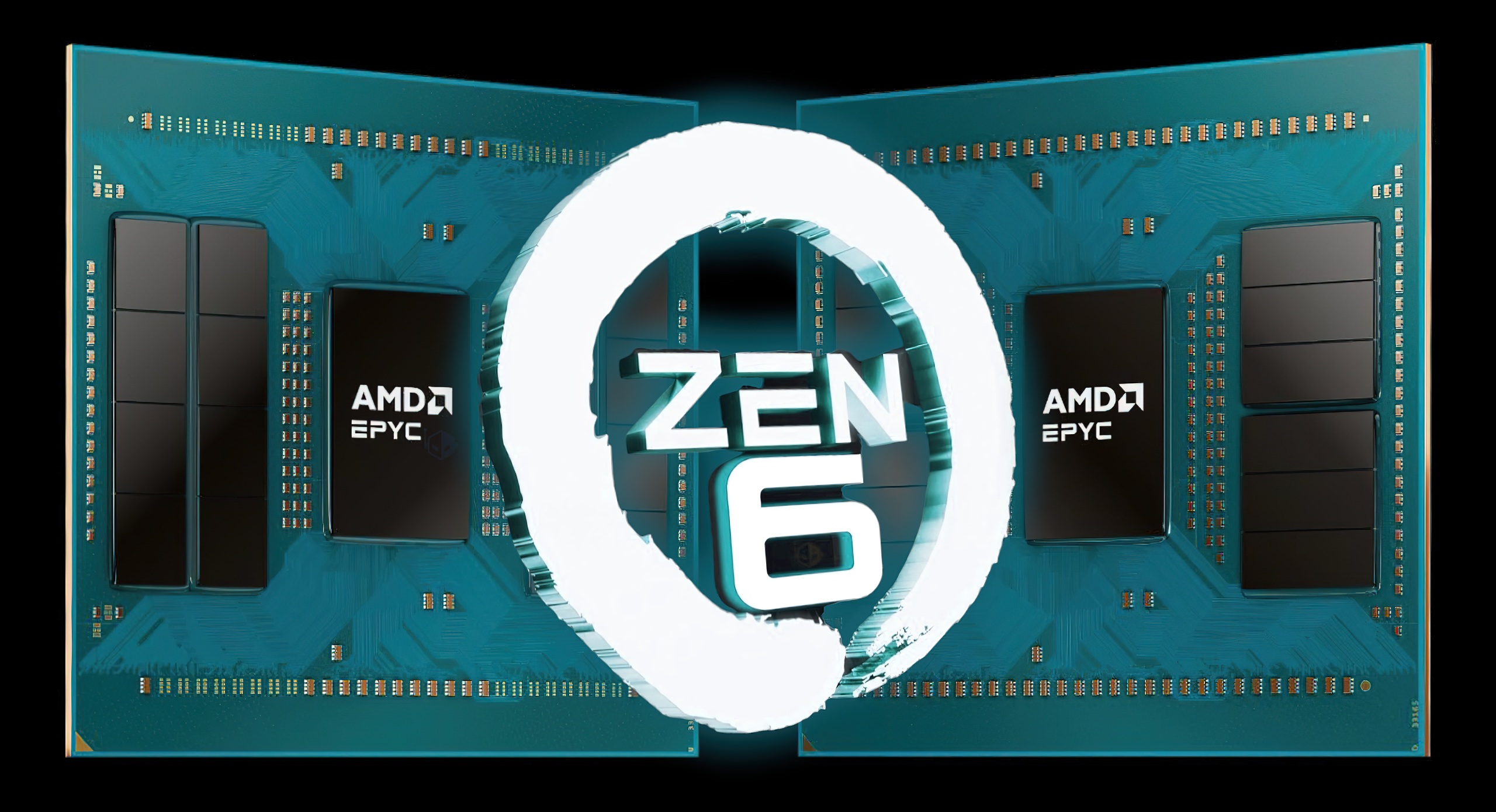
AMD EPYC Zen 6 on SP7 could push server power to a new level, with designs targeting 700W to as high as 1400W per CPU. That staggering range comes from a Taiwan Microloops presentation at the OCP APAC Summit, where the company showcased next-generation direct liquid-cooling hardware tailored for AMD’s SP7 platform. SP7 replaces today’s SP5 used by Genoa and Turin and will host EPYC Venice (Zen 6) and Verano processors, with Venice expected to scale up to 256 cores.
Rising power draw doesn’t automatically mean lower efficiency. EPYC has historically increased power budgets generation over generation while delivering outsized performance gains and better performance-per-watt. Still, moving from Turin’s current 500W ceiling to 700W—and potentially double that in certain configurations—demands a step-change in cooling and platform design.
To meet those demands, Microloops detailed a kW-class cold plate engineered for SP7. The design features a direct-to-chip plate with a single inlet and outlet, a metal stiffener secured by six mounting screws (echoing SP5’s mechanical layout), and an acrylic top cover. In internal evaluations, the company lists SP7 EPYC power scaling beginning at 700W and extending to 1400W, underscoring the industry’s rapid shift toward high-density, high-wattage compute.
For context, some enthusiast-class Threadripper parts have already been observed exceeding 1 kW under aggressive boost settings such as PBO, although EPYC is not designed around PBO. The comparison hints at where future HEDT and workstation platforms might land when pushed, and why advanced liquid cooling is becoming essential at the top end.
Cooling innovation won’t stop at conventional cold plates. At Hot Chips 2025, FABRIC8LABs outlined an Electrochemical Additive Manufacturing (ECAM) approach that rethinks cold plate internals. By 3D-printing complex microchannel geometries, ECAM enables 20% to 85% higher thermal performance versus traditional straight-channel designs and lowers thermal resistance, creating headroom for higher-TDP CPUs and GPUs while potentially reducing operating costs.
What to expect from SP7 EPYC
– Venice (Zen 6) on SP7, with core counts up to 256
– Significantly expanded I/O alongside higher power envelopes
– Direct-to-chip liquid cooling moving into kW territory
– Advanced cold plate designs from vendors like Taiwan Microloops to handle 700W–1400W scenarios
– Complementary innovations like ECAM to further improve heat removal and efficiency
Platform and market outlook
– SP7 is positioned as the successor to SP5, bringing a new mechanical and thermal baseline for high-end servers.
– A separate SP8 platform will address entry-level needs, broadening EPYC coverage across the data center.
– Venice is expected to arrive in the coming year, lining up against Intel’s Clearwater Forest Xeon E-core and Diamond Rapids Xeon P-core families.
Why this matters for data centers
– Rack and facility planning will need to accommodate higher per-socket power, including liquid distribution, power delivery, and heat rejection.
– The move to kW-class CPUs pairs with industry-wide adoption of direct liquid cooling and more sophisticated cold plate geometries.
– If historical trends hold, customers can expect notable performance-per-watt gains even as absolute power rises.
Sources: Taiwan Microloops presentation at OCP APAC Summit; FABRIC8LABs presentation at Hot Chips 2025; industry watcher HXL (@9550pro).