AMD Says It Holds 46% of the Data Center CPU Market as AI Compute Opportunity Heads Toward $2 Trillion
AMD is leaning into the AI boom with a confident outlook, saying its position in data center computing is stronger than ever. During its Advancing AI 2026 event, the company highlighted major growth across server CPUs, AI accelerators, and full-rack AI systems, while projecting that its total compute market opportunity could reach an enormous $2 trillion by 2030.
One of the biggest takeaways is AMD’s claim that it now holds 46% of the data center CPU revenue share. That is a major milestone for the company, especially as CPUs become increasingly important in modern AI servers.
While GPUs often get the spotlight for artificial intelligence workloads, CPUs remain essential to the overall system. In large AI data centers, GPUs handle the heavy mathematical work behind training and inference, but CPUs act as the system coordinators. They schedule tasks, control data movement, and help manage communication between GPUs, memory, storage, and networking components.
This role is becoming even more important as agentic AI workloads gain momentum. These workloads can involve multiple AI models, tools, and decision-making steps running together, which makes system orchestration more complex. For AMD, that creates a larger opportunity for its EPYC server processors.
A key part of AMD’s future strategy is its sixth-generation EPYC CPU, codenamed Venice. Built on the Zen 6 architecture and manufactured using TSMC’s 2nm process, Venice is designed to compete aggressively in high-performance data centers.
AMD says the new EPYC Venice processor can scale up to 256 cores and 512 threads. The chip design includes eight compute dies and two large I/O dies, giving it the kind of scale needed for demanding cloud, enterprise, and AI infrastructure workloads.
According to AMD, the sixth-generation EPYC lineup can deliver more than 70% improvements in performance and efficiency, along with more than a 30% increase in thread density. If those gains translate well in real-world deployments, AMD could continue expanding its share in the server CPU market.
Beyond CPUs, AMD is also emphasizing a broader AI infrastructure strategy. The company now sees its total compute Total Addressable Market, or TAM, growing to around $2 trillion by the end of the decade. That projection includes server processors, AI accelerators, rack-scale systems, and other data center technologies needed to support the rapid expansion of artificial intelligence.
One of the central pieces of AMD’s AI roadmap is the Instinct MI455X GPU. This accelerator is designed for large-scale AI training and inference, and it will power AMD’s Helios rack-level platform.
The Instinct MI455X is expected to deliver 40 PFLOPs of FP4 compute and 20 PFLOPs of FP8 compute. It also uses 432 GB of HBM4 memory with 19.6 TB/s of bandwidth. Those specifications position it as a powerful option for AI data centers that need massive memory capacity alongside high compute performance.
For comparison, NVIDIA’s Rubin GPU is listed with 50 PFLOPs of FP4 compute and 17.5 PFLOPs of FP8 compute, along with 288 GB of HBM4 memory and 22 TB/s of bandwidth. AMD’s advantage appears to be higher memory capacity and stronger FP8 performance, while NVIDIA leads in FP4 performance and memory bandwidth.
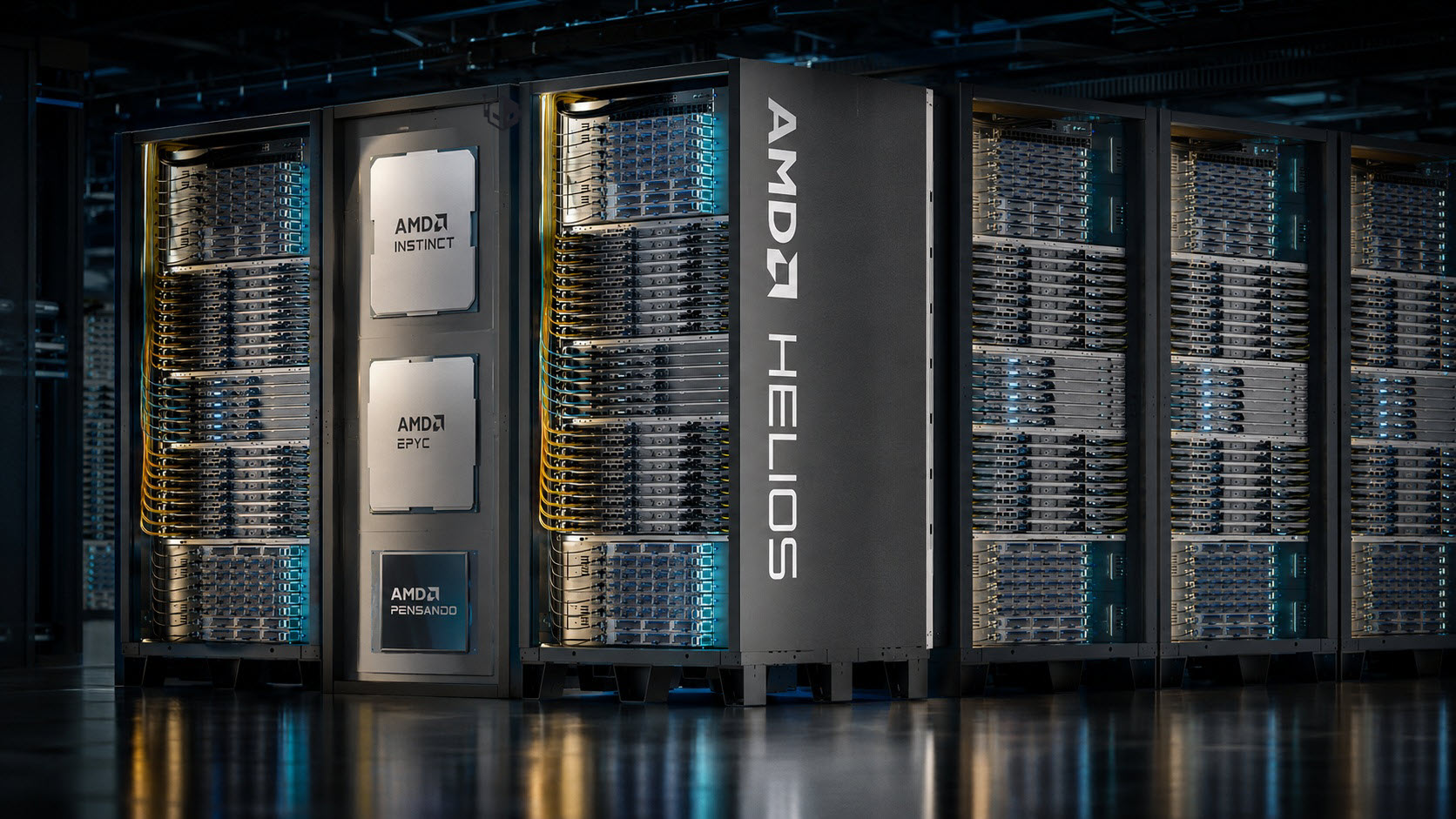
AMD’s Helios rack platform is another important part of the company’s push into AI infrastructure. Rather than only selling individual chips, AMD is moving toward full-stack rack-level solutions. This approach is designed to make it easier for cloud providers, enterprises, and AI companies to deploy large systems built around AMD CPUs, GPUs, memory, and networking technologies.
The broader message from AMD is clear: the company wants to be seen not just as a CPU or GPU supplier, but as a complete AI data center platform provider. With EPYC processors handling orchestration, Instinct GPUs accelerating AI workloads, and Helios bringing the pieces together at rack scale, AMD is positioning itself for a much larger role in the next wave of AI infrastructure.
As artificial intelligence continues to reshape the data center market, AMD’s growing server CPU share and expanding AI hardware portfolio could give it a stronger competitive position through the rest of the decade. The company’s $2 trillion compute market forecast may sound ambitious, but with demand for AI training, inference, and agentic workloads rising quickly, AMD clearly believes the opportunity is only beginning.