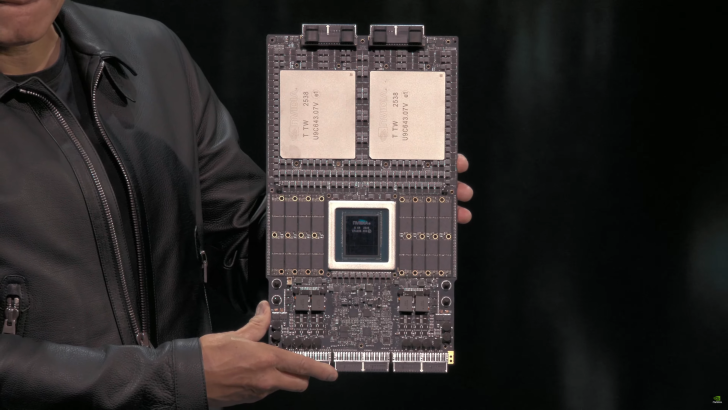
AMD and Qualcomm are reportedly taking a serious look at SOCAMM, a newer memory module approach that’s gaining attention as modern AI workloads push today’s systems to their limits. With agentic AI applications expanding quickly, memory capacity and flexibility are becoming just as critical as raw compute power, and many current platforms are running into a growing memory bottleneck.
SOCAMM (a memory standard originally positioned around NVIDIA’s needs) is built on LPDDR DRAM, the same family of memory commonly found in mobile and power-efficient devices. What makes SOCAMM different is the form factor and flexibility: unlike soldered LPDDR solutions, SOCAMM modules are designed to be upgradable rather than permanently attached to the board. That creates an appealing middle ground for AI servers and racks that need more memory options without relying solely on ultra-fast, expensive stacks like HBM.
In early deployments, SOCAMM has been closely associated with NVIDIA. Now, new reporting indicates NVIDIA, AMD, and Qualcomm are all exploring the use of SOCAMM modules in upcoming AI rack designs. The larger story here is that AI systems increasingly need a “memory hierarchy” that balances speed, capacity, power efficiency, and serviceability. HBM remains the throughput king, but as AI agents grow more capable, they also require far more short-term working memory to keep massive context windows available.
Interestingly, AMD and Qualcomm are said to be considering a different module layout than NVIDIA’s current approach. The idea involves a “square” module configuration with two DRAMs arranged across two separate rows. A key benefit of this design is improved on-module power control by placing the PMIC (power management integrated circuit) directly on the SOCAMM module. Bringing power regulation onto the module could help stabilize operation at very high speeds, while also simplifying motherboard design by removing some of the power circuitry that would otherwise need to be built into the platform.
If SOCAMM sees broader adoption across multiple AI hardware vendors, it could also increase overall DRAM demand for this specific memory type. The logic is straightforward: agentic AI makes it increasingly valuable to pair HBM with a larger pool of additional memory that can store and maintain more active data. SOCAMM is positioned as that capacity-focused companion, potentially enabling terabytes of memory per CPU in certain designs—useful for keeping enormous numbers of tokens “live” during inference and multi-step agent workflows. While SOCAMM won’t match HBM’s bandwidth, it stands out as a practical, power-friendly option when capacity and upgradability matter.
For the near future, NVIDIA is expected to move forward with SOCAMM 2 in its Vera Rubin-based AI clusters. With AMD and Qualcomm now reportedly evaluating their own SOCAMM-based implementations, there’s a strong chance this modular LPDDR-based memory standard could show up in next-generation AI clusters beyond NVIDIA’s ecosystem sooner rather than later.