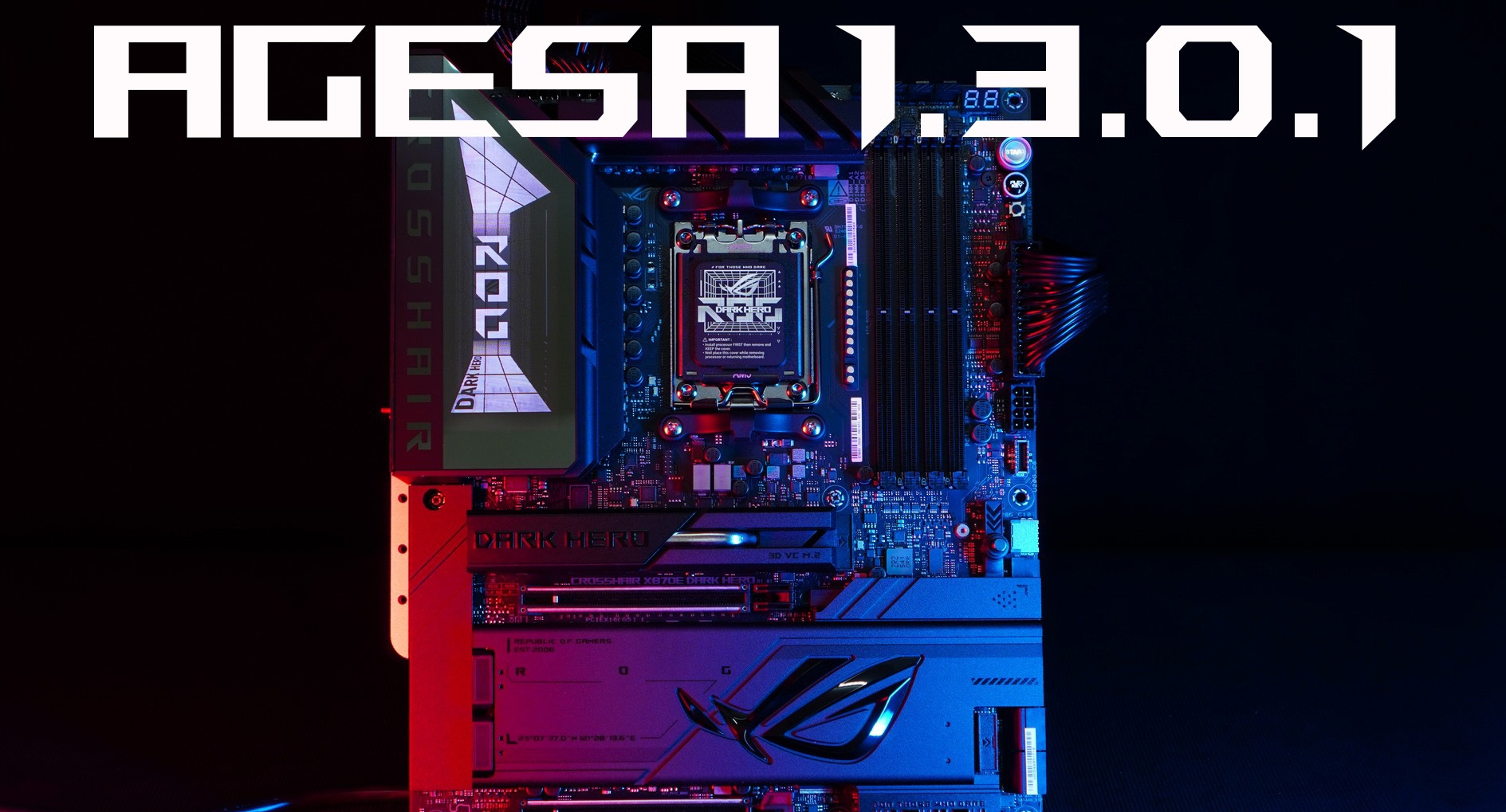
AMD AGESA 1.3.0.1b BIOS update improves DDR5 support, lowers voltages, and reduces CPU temperatures on AM5 motherboards
AMD’s latest AGESA 1.3.0.1b BIOS firmware is shaping up to be an important update for AM5 motherboard owners, especially those using DDR5 memory kits. Early testing suggests that the new firmware can deliver better memory compatibility, lower operating voltages, improved fabric clock behavior, and noticeably reduced CPU temperatures compared with older AGESA versions.
Major motherboard manufacturers, including ASUS, Gigabyte, and MSI, have started rolling out the AGESA 1.3.0.1b BIOS for AMD 600-series and 800-series motherboards. The update brings support for AMD EXPO ULL, also known as Ultra-Low-Latency memory technology, which is designed to help DDR5 kits run with tighter timings and improved performance on Ryzen platforms.
Even users without dedicated AMD EXPO ULL memory appear to benefit from the new firmware. Based on early user testing, AGESA 1.3.0.1b can improve everyday DDR5 tuning on AM5 systems by reducing the amount of voltage needed to maintain stable memory speeds.
One test used an AMD Ryzen 7 7800X3D processor installed on an MSI MPG X670E Carbon motherboard. The system was paired with two 16 GB DDR5-6000 CL30 memory modules. The same hardware was tested across three BIOS versions: AGESA 1.0.0.6, AGESA 1.2.0.0a, and the newer AGESA 1.3.0.1b.
The results show a clear improvement in voltage behavior with the newest BIOS. With AGESA 1.0.0.6, the system required around 1.35V SoC voltage. AGESA 1.2.0.0a reduced that to 1.29V, while AGESA 1.3.0.1b lowered it further to 1.24V. That is a meaningful reduction, particularly for users who care about long-term stability, thermals, and efficiency.
The memory-related voltages also improved. DRAM voltage dropped from 1.43V on the older BIOS versions to 1.40V on AGESA 1.3.0.1b. VDDQ voltage also decreased from 1.43V to 1.40V, while VDDIO saw a much larger drop, moving from 1.39V on AGESA 1.2.0.0a to just 1.26V on AGESA 1.3.0.1b.
Fabric clock performance also improved. The older AGESA versions maintained an FCLK of 2133 MHz, while the newest BIOS reached 2200 MHz. For Ryzen systems, FCLK behavior can play an important role in memory performance, especially when tuning DDR5 for lower latency and better bandwidth.
CPU power and temperature results were also encouraging. CPU PPT dropped slightly from 96W on AGESA 1.0.0.6 to 93W on AGESA 1.3.0.1b. More importantly, maximum CPU temperature fell significantly. The Ryzen 7 7800X3D reached around 88–89°C on AGESA 1.0.0.6, around 79–80°C on AGESA 1.2.0.0a, and around 77–78°C on AGESA 1.3.0.1b under similar conditions.
That temperature improvement is one of the most attractive parts of this BIOS update. Lower CPU temperatures can help maintain boost behavior, reduce fan noise, and improve overall system comfort, particularly in compact or airflow-limited builds.
Memory latency remained competitive, though not dramatically better in this specific test. The DDR5-6000 CL30 kit recorded around 58.7 ns on older BIOS versions and around 60 ns on AGESA 1.3.0.1b. The user also noted that enabling FCLK VDCI Mode could improve read and write speeds, although it may add roughly 1 ns of latency.
The DDR5 kit used in the test was based on Hynix A-Die memory, which is well known among enthusiasts for strong overclocking potential. With AGESA 1.3.0.1b, the memory reportedly handled several higher-speed configurations while keeping voltage at 1.4V.
Stable tested configurations included DDR5-6400 CL30-38-38-76, DDR5-6600 CL34-40-40-105, DDR5-6800 CL32-45-45-108, and DDR5-7200 CL34-45-45-115. These results suggest that the new BIOS may offer more headroom for users who enjoy manual memory tuning.
Another user reportedly saw similar improvements on an MSI MAG X870 Tomahawk WIFI motherboard paired with a Ryzen 7 9700X. In that case, the system used a DDR5-6400 CL30 memory kit and also benefited from lower voltages after moving to the new BIOS.
Overall, AMD AGESA 1.3.0.1b appears to be a valuable update for AM5 motherboard users. The biggest advantages include lower SoC voltage, reduced VDDIO voltage, improved DDR5 support, better FCLK potential, and lower Ryzen CPU temperatures.
For users running AMD Ryzen 7000, Ryzen 8000, or Ryzen 9000 processors on AM5 motherboards, this BIOS update may be worth checking through the motherboard vendor’s support page. Availability will vary depending on the brand and model, and some manufacturers may prioritize higher-end boards such as X670, X670E, X870, and X870E models before expanding support to the rest of the lineup.
As always, updating a BIOS should be done carefully. Users should read the release notes, avoid interrupting the flashing process, and recheck memory settings after installation. But for those looking to improve DDR5 stability, reduce voltages, and potentially lower CPU temperatures, AGESA 1.3.0.1b looks like one of the more useful AM5 firmware updates so far.


