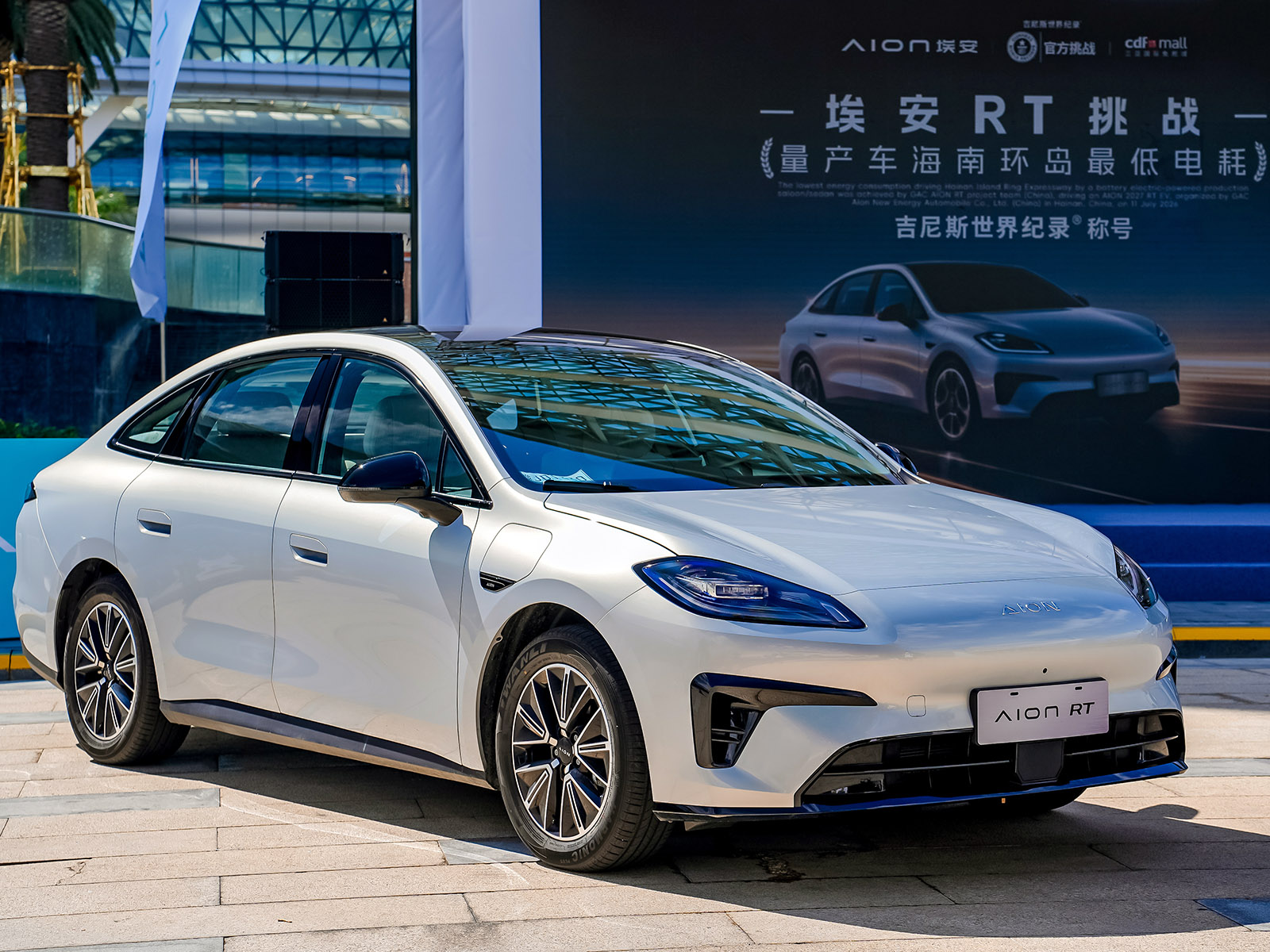
GAC Aion RT Sets Guinness World Record for EV Efficiency Ahead of August Launch
GAC’s Aion brand has made a major statement in the electric vehicle market with its upcoming 2027 Aion RT sedan. Before its official release on August 10, the new EV achieved a Guinness World Record for the lowest energy consumption by a production electric car, recording just 8.571 kWh per 100 km, or about 13.79 kWh per 100 miles.
That figure is remarkably low for a real-world electric sedan. In everyday driving, many mass-market EVs consume roughly twice as much energy. Popular electric sedans often sit closer to the 12–14 kWh per 100 km range under favorable conditions, while larger premium models known for efficiency can also hover around 14 kWh per 100 km at steady speeds. The Aion RT’s result puts it well ahead of many established benchmarks in the EV efficiency race.
What makes the achievement even more impressive is that it was not recorded in a controlled laboratory test. The Aion RT completed its record run on Hainan’s coastal loop, a real driving route covering around 400 miles. That gives the result added weight, as real roads introduce variables such as changing speeds, weather, traffic conditions, elevation changes, and driver inputs.
The choice of Hainan as the location for the record attempt is also significant. The island province recently confirmed plans to become the first province in mainland China to completely ban the sale of new internal combustion engine vehicles by 2030. Hainan is already one of China’s strongest regions for electric vehicle adoption, and officials are aiming to push EV market share above 45% by the end of the decade.
To support that transition, Hainan is expanding charging infrastructure and increasing its reliance on renewable energy. Against that backdrop, the Aion RT’s record-setting drive carries symbolic importance. It demonstrates how far EV efficiency has progressed on the same roads where new gasoline-powered cars will soon disappear from showrooms.
GAC has not yet revealed the full technical specifications of the 2027 Aion RT, so it remains unclear how the company achieved such low power consumption. Key details such as battery size, motor output, vehicle weight, aerodynamics, tire choice, and driving mode have not been fully disclosed. These factors will be important in determining whether the Aion RT can deliver similar efficiency in the hands of everyday drivers.
Still, the early signs are promising. The previous Aion RT was positioned as an affordable compact electric sedan, with pricing equivalent to roughly $14,000. If the 2027 model remains close to that price range, it could become one of the most compelling budget EVs on the market.
A low-cost electric sedan with record-breaking efficiency would be a powerful combination. It would appeal not only to buyers looking for affordable transportation, but also to drivers who want lower charging costs, longer range from a smaller battery, and reduced environmental impact.
The achievement also highlights the growing competitiveness of China’s EV industry. Chinese automakers are no longer focusing only on low prices. They are increasingly pushing boundaries in battery technology, software, charging speed, aerodynamics, and real-world energy efficiency. The Aion RT’s Guinness World Record adds another milestone to that trend.
With its official launch scheduled for August 10, the 2027 GAC Aion RT is now one of the most interesting electric sedans to watch. If its production version can combine affordability, practical range, and class-leading efficiency, it could challenge far more expensive EVs and raise expectations for what an efficient electric car should deliver.