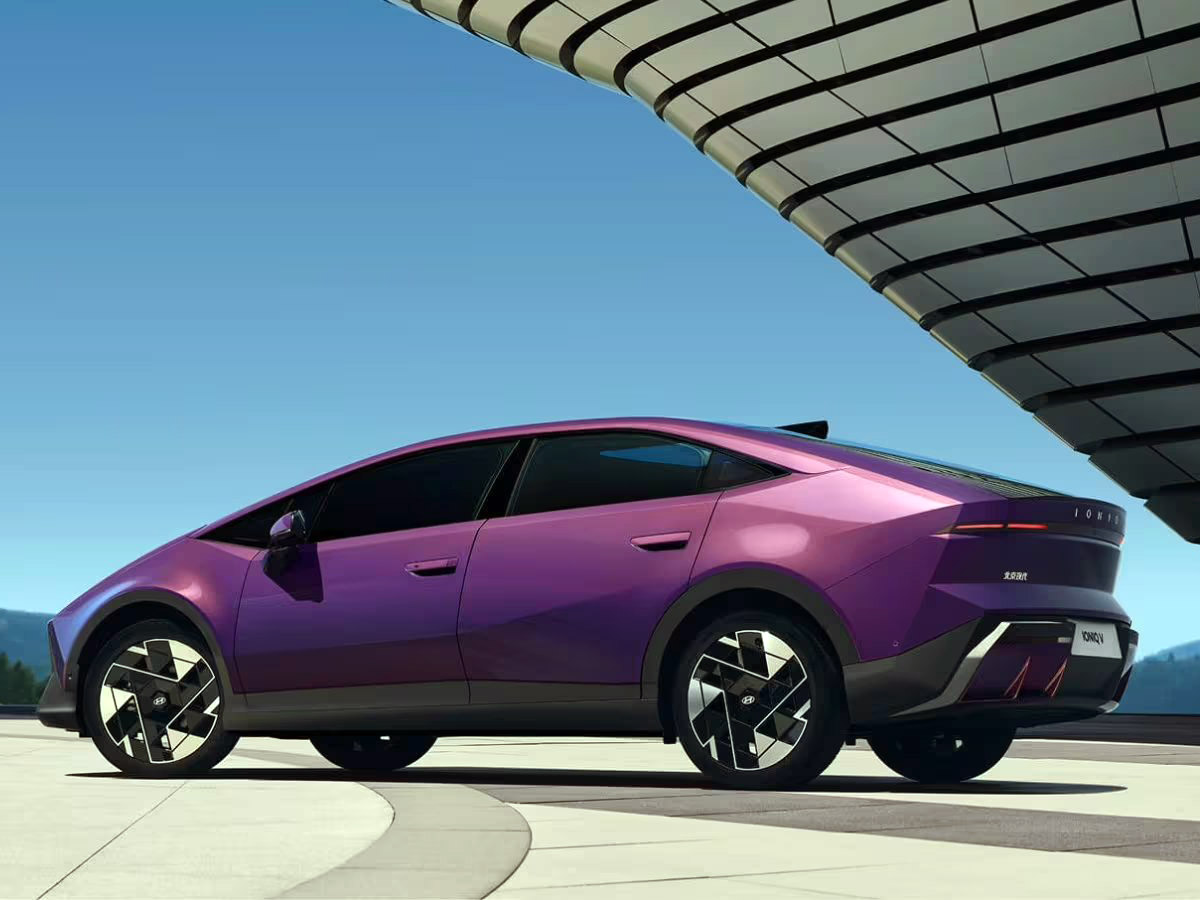
Hyundai Ioniq V Debuts in China With Lifetime Warranty, Low Price, and Up to 650 km Range
Hyundai is making a fresh push in China’s booming electric vehicle market with a new Ioniq lineup designed specifically for local buyers. Leading the charge is the Hyundai Ioniq V, a sleek fastback-style electric sedan with a sharp design, competitive range, advanced in-car technology, and an eye-catching starting price of about $14,820.
The Ioniq V is not just another affordable EV entering an already crowded market. Hyundai is trying to stand out with a bold ownership promise: a lifetime vehicle warranty for the first owner. That offer covers major electric vehicle components, including the battery, electric motor, and electronic control system, giving the new model a strong selling point against domestic Chinese EV brands.
One of the biggest highlights of the Hyundai Ioniq V is its lifetime warranty package. While many global Hyundai EVs come with a traditional long-term battery warranty, the China-focused Ioniq V goes further as part of its launch benefits.
For the first owner, Hyundai’s warranty includes lifetime coverage for the battery, electric motor, and electronic control unit. The company is also offering battery replacement if capacity falls below 70% within eight years or 100,000 miles. In certain cases, the policy also includes full battery replacement for capacity loss rather than simple repairs.
Hyundai is also addressing battery safety more directly. The warranty package includes compensation provisions in the rare event of spontaneous battery fires, reflecting China’s increasingly strict EV battery safety regulations.
China’s new GB38031-2025 battery safety standard is among the toughest in the world. Instead of simply requiring early warning systems before a battery fire, the new rules demand that batteries must not catch fire or explode for at least two hours after thermal runaway begins. The standard also requires that smoke does not enter the passenger cabin.
By aligning the Ioniq V with these new safety expectations, Hyundai is positioning the car as an affordable EV that does not compromise on long-term reliability or peace of mind.
The Hyundai Ioniq V measures 4,900 mm in length and rides on a 2,900 mm wheelbase, giving it the proportions of a spacious midsize electric sedan. All versions are front-wheel drive and deliver 250 Nm of torque.
Buyers can choose between two battery and powertrain configurations. The entry version uses a 53.48 kWh CATL LFP battery pack paired with a 140 kW electric motor. This model offers a claimed CLTC driving range of 540 km.
Higher trims come with a larger 66.85 kWh battery and a more powerful 168 kW motor. These versions are rated for up to 650 km of CLTC range.
Hyundai claims energy consumption of 11.1 kWh per 100 km, which should make the Ioniq V appealing to buyers looking for an efficient daily electric car. The model also supports DC fast charging, with Hyundai quoting a 20-minute fast-charge time under suitable conditions.
The Ioniq V will be sold in five trims in China: 540 Pro, 540 Max, 540 Max+, 650 Max, and 650 Max+. The Max+ versions add more advanced driver-assistance features, giving buyers the option to choose between affordability and extra technology.
Inside, the Ioniq V is packed with features designed for Chinese consumers. The cabin includes a large 27-inch 4K display powered by a Snapdragon 8295P chip. Hyundai has also included a detachable physical keypad for key functions such as volume and climate controls, which may appeal to drivers who prefer real buttons over touchscreen-only operation.
The car also features Doubao and Baidu AI assistants, four-zone voice control, Dolby Atmos audio, and navigation support from Baidu and Amap. These local software integrations are important in China, where buyers often expect EVs to deliver a smart, connected experience beyond basic transportation.
For driver assistance, the Ioniq V uses a camera-based Momenta system. It supports highway navigation assist and parking functions. Hyundai says memory parking and urban navigation features will arrive later through over-the-air software updates.
Practicality has also been considered. The front seat can fold fully flat, and the trunk offers 465 liters of cargo space. Safety equipment includes nine airbags, while a heat-pump air conditioning system helps improve efficiency in colder weather.
The Ioniq V will also be available in several distinctive exterior colors, including Cyber Gold and Gamma Green, giving the car a more youthful and expressive character.
With a starting price equivalent to roughly $14,820, the Hyundai Ioniq V enters the Chinese EV market as a serious value-focused contender. It combines long range, modern cabin technology, strong warranty coverage, and a design that helps it stand apart from the many locally built electric sedans already on sale.
Hyundai also plans to extend the first-owner lifetime warranty strategy to future electric vehicles launched in China. This suggests the Ioniq V is only the beginning of a broader effort to rebuild Hyundai’s EV presence in the world’s largest electric car market.
A global launch has not been confirmed. The car could eventually be offered outside China, but Hyundai has not announced timing, pricing, or whether it would keep the Ioniq V name in other markets. For now, the model remains a China-focused EV with a very aggressive mix of price, range, technology, and warranty protection.