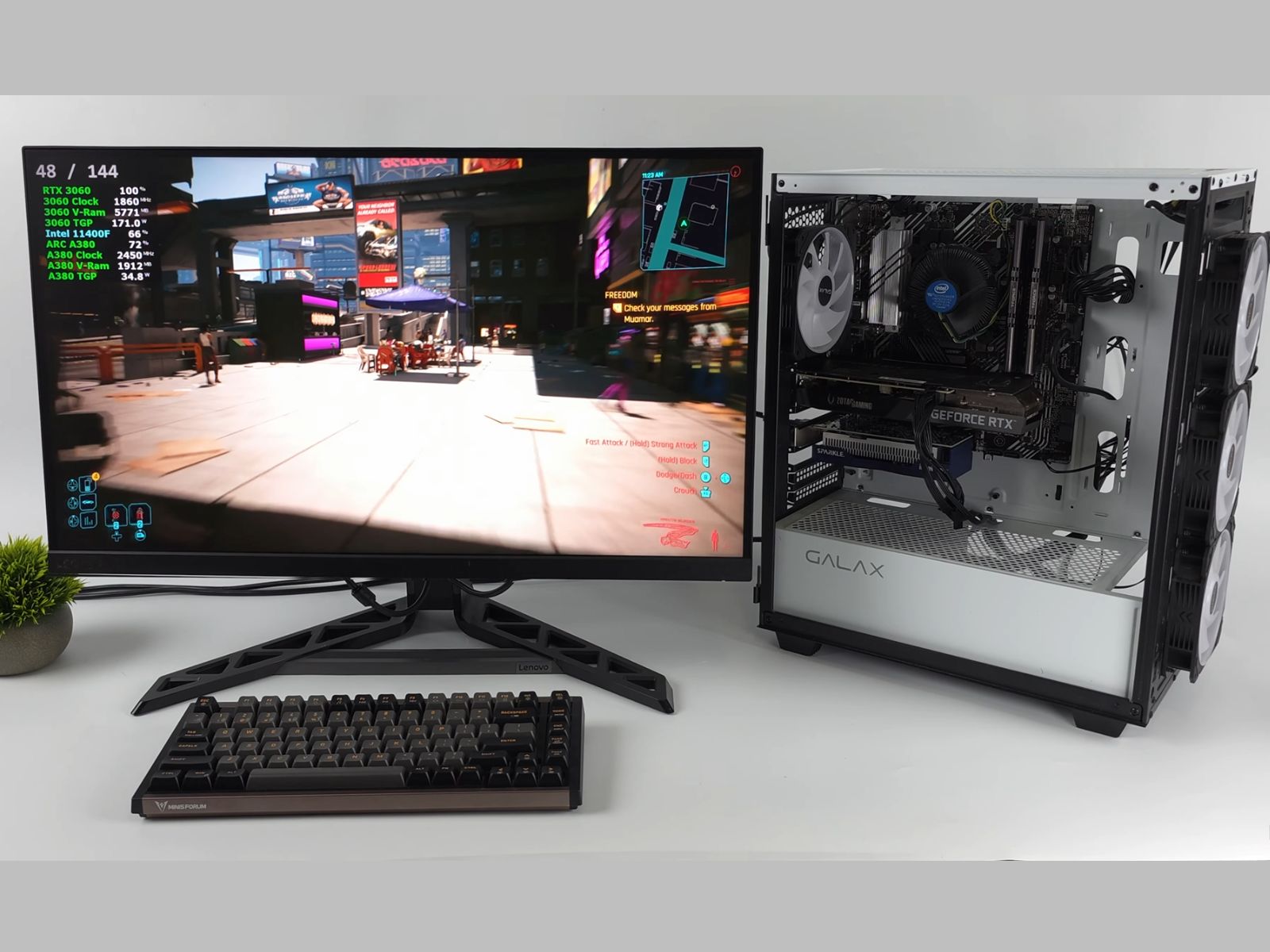
Turn your mid-range gaming PC into a high-FPS machine with a clever dual-GPU trick. In a recent test, a budget Intel Arc A380 was dedicated to frame generation via Lossless Scaling, while an RTX 3060 handled the actual rendering. The result? Massive performance gains in demanding titles without a major hardware upgrade.
Using a fixed 2x multiplier in Lossless Scaling, the system sailed past 120 FPS with no noticeable input lag, according to the YouTuber who ran the tests. Even a 3x multiplier remained stable, though 2x delivered the best balance of speed and responsiveness.
Cyberpunk 2077 was the star showcase. At 1440p ultra settings with DLSS on quality, the RTX 3060 alone averaged around 48 FPS. Offloading frame generation to the Arc A380 pushed performance into the 150 FPS range. Previous headaches with HUD elements and crosshairs—common issues in older builds of the app—were largely resolved, delivering smooth, consistent gameplay.
Oblivion Remastered told a similar story. At 1440p high settings, the RTX 3060 sometimes dipped below 60 FPS on its own. With Lossless Scaling set to 2x on the A380, average frame rates comfortably cleared 100 FPS, underscoring how effective a secondary GPU can be for frame generation.
What makes this setup especially compelling is efficiency. The Arc A380, a low-power card that doesn’t need external power, handled frame generation at around 70–80% utilization while drawing roughly 34 W. Meanwhile, the RTX 3060 stayed busy rendering at 90–100% utilization. It’s not a substitute for a modern high-end GPU, but it’s a smart way to squeeze extra life and performance out of existing hardware.
The community feedback reflects that excitement. One user remarked that their 1050 Ti has “a new life,” while another plans to pair an RTX 1660 Ti with an RTX 2070 Super to try a similar approach.
If you’re curious about replicating the results, the creator walks through the process in their video. In short, the main GPU renders the game while the secondary GPU runs Lossless Scaling to generate additional frames—2x is the recommended sweet spot for most scenarios. Results will vary by game and system, but for many players, this dual-GPU method could be the most cost-effective path to triple-digit frame rates.