Ryzen 7 9800X3D Temperatures Drop by 19°C With a Massive 3D-Printed Chimney Cooler
AMD’s Ryzen 7 9800X3D is widely known as one of the fastest gaming processors available, thanks to its 3D V-Cache technology. That extra cache helps deliver outstanding frame rates in games, but it also brings a familiar downside: heat. The stacked cache design can act like an insulating layer, making it harder for heat to move away from the CPU, even when a capable cooling setup is installed.
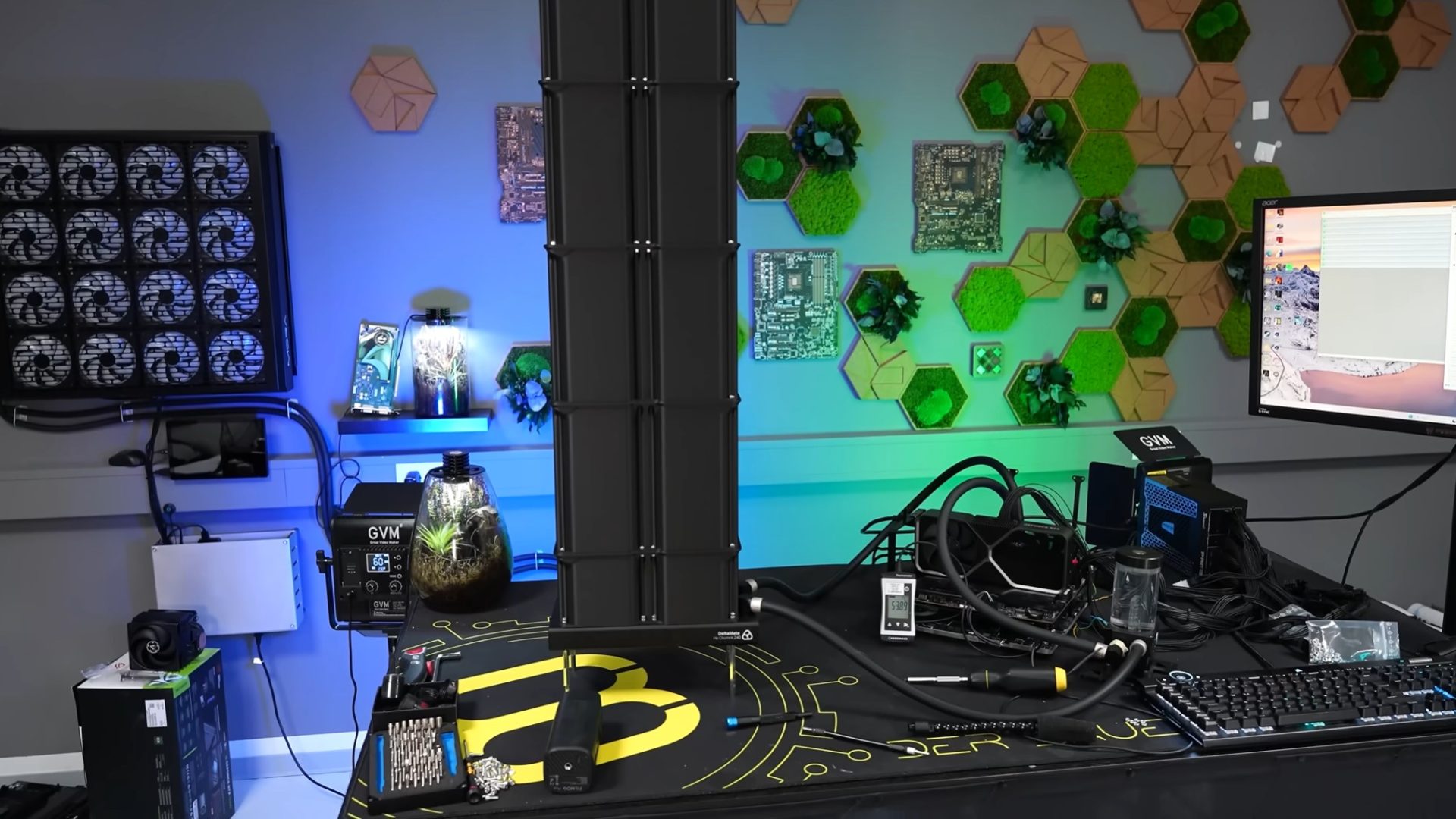
A recent cooling experiment from overclocker and YouTuber der8auer showed just how much CPU temperatures can improve with a very unusual approach. Instead of relying on traditional radiator fans, he built a tall 3D-printed chimney system and attached it to a water-cooling setup. The result was a dramatic 19°C temperature drop for the Ryzen 7 9800X3D.
The test used a 240mm radiator connected to the processor’s liquid cooler, but the radiator was not cooled with fans. Instead, multiple 3D-printed chimney sections were stacked vertically above the radiator. The idea was to use the natural “stack effect,” where warm air rises because it is less dense than cooler surrounding air. As the hot air travels upward through the chimney, it creates a pressure difference that pulls cooler air in from below, helping move heat away from the radiator.
Even a single 20cm chimney section produced a small improvement while the Ryzen 7 9800X3D was drawing around 100W of power. But the real surprise came when the chimney was extended much higher.
Once the structure reached approximately 110cm, nearly touching the ceiling in the test environment, the cooling performance improved significantly. To prove that airflow was actually being generated without fans, der8auer used a fog gun. The fog clearly showed air being drawn into the chamber and moving through the chimney, confirming that the passive cooling effect was working.
At the maximum height tested, the Ryzen 7 9800X3D temperature dropped from 90°C to 71°C. That 19°C reduction was far better than expected and showed that natural convection can be surprisingly effective when the chimney is tall enough.
However, this is not a practical cooling solution for everyday PC builders. A chimney over one meter tall would never fit inside a normal desktop PC case. Anyone trying to recreate the setup would need an open test bench, plenty of vertical space, and a willingness to build a very unconventional cooling system.
Still, the experiment is a fascinating demonstration of airflow physics and CPU cooling behavior. It also highlights why the Ryzen 7 9800X3D can run hot despite strong cooling hardware. The processor’s 3D V-Cache design is excellent for gaming performance, but it can make heat transfer more challenging.
While gamers should not expect chimney-style coolers to appear in standard gaming PCs anytime soon, the test proves that creative cooling designs can make a major difference. For enthusiasts, overclockers, and hardware modders, it is another reminder that airflow design can be just as important as the cooler itself.