Intel’s next-gen Panther Lake platform just stepped into the spotlight thanks to a freshly tested engineering sample of a Core Ultra Series 3 chip. The early silicon offers a revealing glimpse at what to expect from the upcoming mobile lineup, including power limits, core layout, memory support, and integrated graphics—while reminding us that ES results rarely reflect final performance.
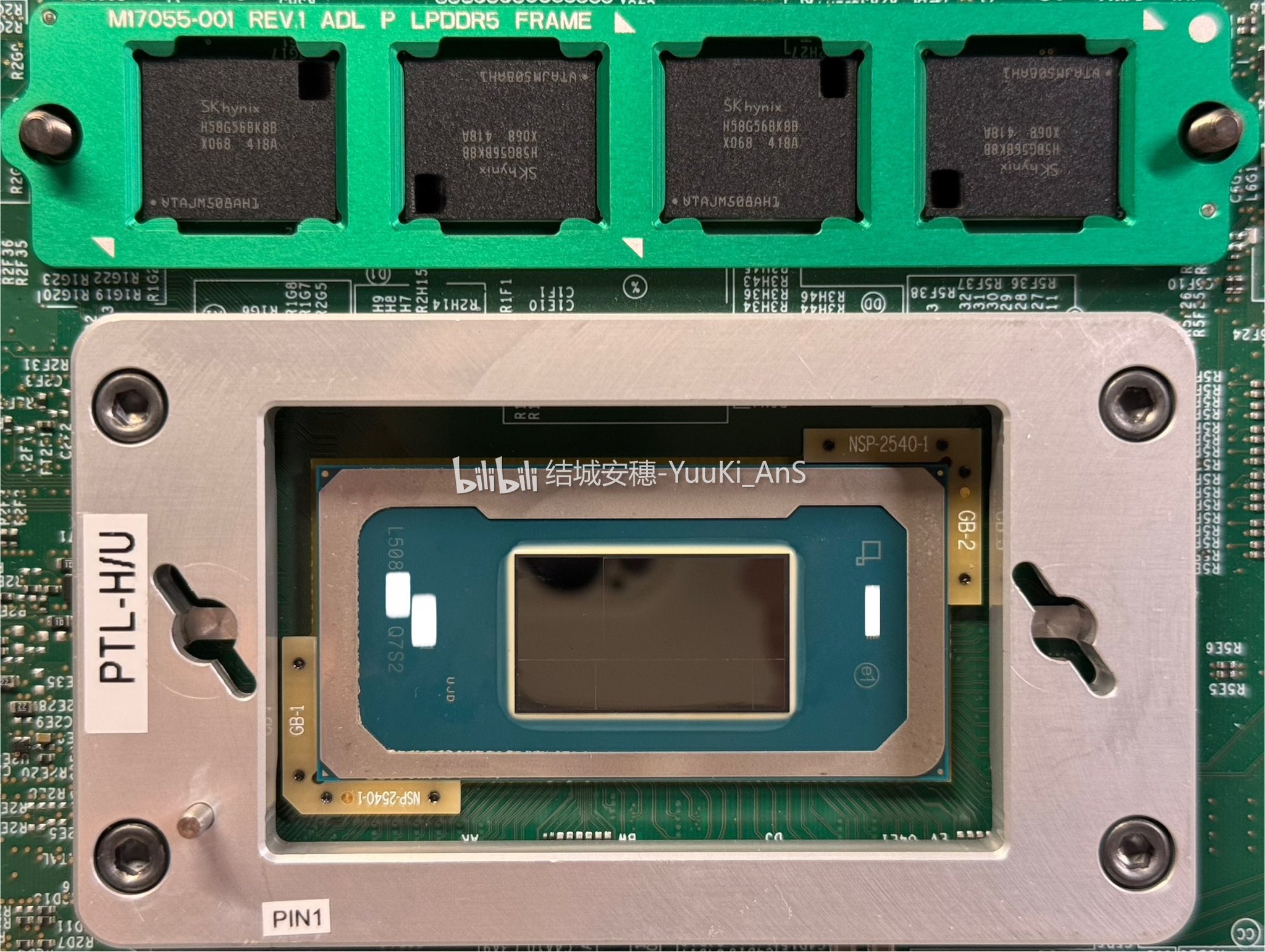
The sampled processor is built on a PTL die with support for up to 16 CPU cores and 4 Xe3 GPU cores, packaged on a BGA-2540 substrate with four active tiles and a filler tile. Identified by device ID 000C06C0 and marked as A0 stepping, this unit ran on Intel’s Reference Validation Platform, which accommodates both LPCAMM2 and LPDDR5X memory. For testing, it used 16 GB of LPDDR5X assembled on an Alder Lake-style frame with SK hynix modules rated at 7467 MT/s. That’s lower than what retail Panther Lake systems are targeting—9600 MT/s and beyond—so memory bandwidth on this ES setup isn’t representative of shipping hardware.
Core configuration is where things get interesting. This engineering sample features 10 CPU cores split into 2 performance cores, 4 efficiency cores, and 4 low-power efficiency cores. It packs 11 MB of L2 cache and 12 MB of L3 cache, with clocks set to 3.0 GHz base and up to 3.2 GHz boost. The P-cores reportedly hold 3.0 GHz across all cores, while the E-cores reach up to 2.6 GHz across four cores. Graphics are handled by 4 Xe3 iGPU cores, and the platform notes a 2.5 GT/s PCIe link allocation.
Power targets align with a thin-and-light profile. This looks like a Panther Lake-U class chip rated at 25W PL1, with short-term turbo rising to 65W PL2 and a PL4 ceiling of 160W. Thermal limits top out at 100°C TjMax. CPU-Z single- and multi-thread results were captured, but as expected for early silicon with conservative clocks and pre-release firmware, scores don’t reflect where finalized retail parts should land.
One noteworthy detail: this 10-core 2P+4E+4LP-E configuration doesn’t line up with the previously leaked consumer SKUs, reinforcing the idea that this is an internal validation variant. If it does translate into a retail model, it would likely slot in under the Core Ultra 5 or Core Ultra 3 tiers.
Early information on the broader lineup points to two families:
– Panther Lake-H for performance notebooks, with higher turbo budgets and configurations scaling up to 4 P-cores, 8 E-cores, and 4 LP-E cores, plus larger Xe3 iGPU blocks on select models.
– Panther Lake-U for ultraportables, centered on lower-power mixes such as 4 P-cores paired with up to 4 LP-E cores, and more modest integrated graphics.
Manufacturers are already evaluating memory speeds north of 10 GT/s for Panther Lake, which should provide a tangible uplift for integrated graphics and bandwidth-sensitive workloads. Combine that with refined hybrid core scheduling across P, E, and LP-E clusters and Intel’s newer Xe3 graphics architecture, and the platform is shaping up to be a notable step forward for power-efficient laptops.
Intel is expected to introduce the first Core Ultra Series 3 Panther Lake laptops later this year, with a full reveal anticipated around CES 2026. As always, treat engineering-sample data as a preview, not a verdict—final silicon, firmware, and higher memory clocks should move the needle on both performance and efficiency when retail units arrive.