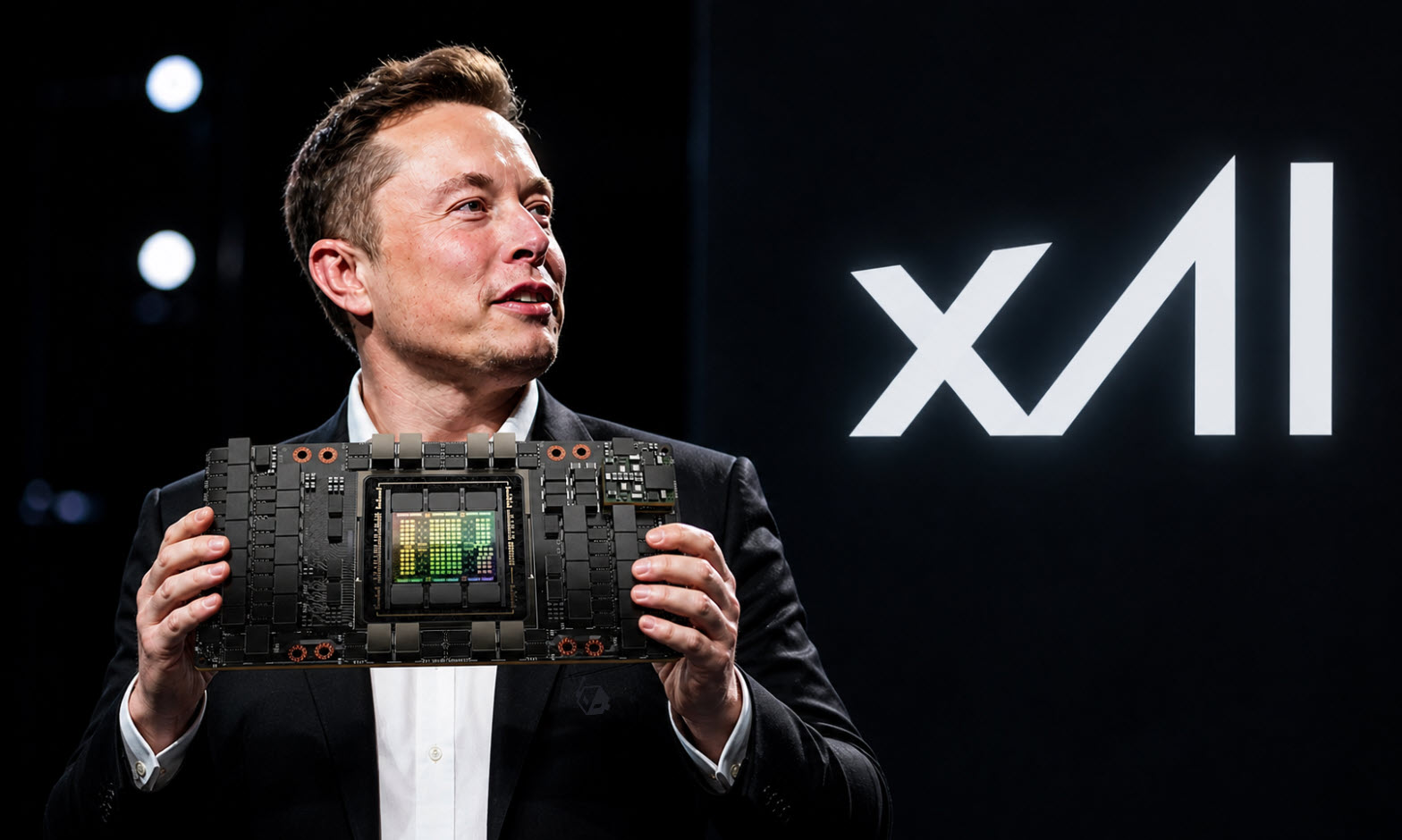
A new report suggests xAI is currently getting surprisingly little real-world performance from its massive NVIDIA GPU investment, highlighting a problem that’s quietly affecting the entire AI industry: scaling AI software efficiently is far harder than buying more hardware.
According to the report, xAI is operating a GPU fleet of roughly 550,000 NVIDIA accelerators, made up of H100 and H200 models. These GPUs are deployed across xAI’s large computing environments, including its Memphis site and the Colossus cluster, with some systems using liquid cooling. While these chips aren’t the newest generation compared to NVIDIA’s latest lineup, the sheer size of the deployment still places xAI among the biggest AI compute owners in the world.
The issue is utilization. The report claims xAI is only using about 11% of its installed GPU capacity. Put another way, the company may be getting the equivalent effective output of around 60,000 GPUs, while the rest of the hardware sits underused due to inefficiencies across training and data workflows. With hardware this expensive, that kind of idle time becomes a major operational and financial bottleneck.
Why does this happen? At smaller scales—say, clusters with 1,000 to 10,000 GPUs—inefficiencies can be manageable. But once AI training infrastructure grows to hundreds of thousands of GPUs, even small delays compound dramatically. Synchronization overhead, networking constraints, data pipeline stalls, scheduling issues, and software stack immaturity can leave large portions of a fleet waiting instead of training. As AI clusters expand, the “wasted seconds” turn into massive lost throughput, and utilization can drop quickly.
The report frames this as an industry-wide scaling challenge, not an isolated xAI problem. Getting high GPU utilization in distributed AI training requires an optimized end-to-end stack: data ingestion, preprocessing, distributed training frameworks, networking, storage, checkpointing, monitoring, and orchestration all need to work smoothly at extreme scale. When any piece becomes a bottleneck, GPUs starve for data or wait on synchronization—burning time without producing useful training progress.
Some tech giants are reportedly doing better, achieving utilization rates above typical ranges, thanks to mature infrastructure and deep investment in software optimization. Examples cited include Meta at around 43% and Google at around 46%, suggesting that strong engineering discipline and a refined distributed training stack can translate into dramatically better hardware efficiency.
For xAI, the report points to a distributed training network and software stack that may not yet be fully mature at this size. The result: repeated slowdowns in the data pipeline and analysis stages, plus longer GPU idle times during large-scale training runs. In practical terms, that can mean more time waiting on input pipelines, greater communication overhead between nodes, and less consistent throughput across enormous training jobs.
xAI reportedly intends to improve this situation substantially, targeting 50% utilization in the future. No timeline was provided, but reaching that goal would likely require serious changes across infrastructure, scheduling, and software stack optimization—exactly the areas that matter most when trying to turn giant GPU clusters into consistently productive AI factories.
The report also suggests xAI could explore renting out portions of its GPU capacity, especially as it shifts future workloads and prepares for new “agentic AI” demands. With such a huge installed base, offering GPU rental services could help offset idle capacity during transitions and smooth out utilization dips while the software stack catches up.
Looking further ahead, the report notes Elon Musk is pushing hard on a major effort called TeraFab, aimed at developing multiple in-house silicon designs as part of an “AI” chip family, while also leveraging Intel’s 14A process technologies. The implication is that xAI and Musk’s broader ecosystem—potentially including SpaceX and other ventures—may rely more heavily on custom hardware over time to better match their workloads and reduce reliance on off-the-shelf solutions.
If xAI can solve the utilization problem, the upside is enormous: turning a half-million-GPU footprint into a high-efficiency training engine could dramatically accelerate model training, reduce the effective cost per training run, and open the door to much larger-scale projects—potentially even ambitious applications like next-generation generative AI experiences and fully realized AI-driven games. For now, the numbers underscore a reality across modern AI: the real competitive edge isn’t just owning GPUs—it’s making them work.