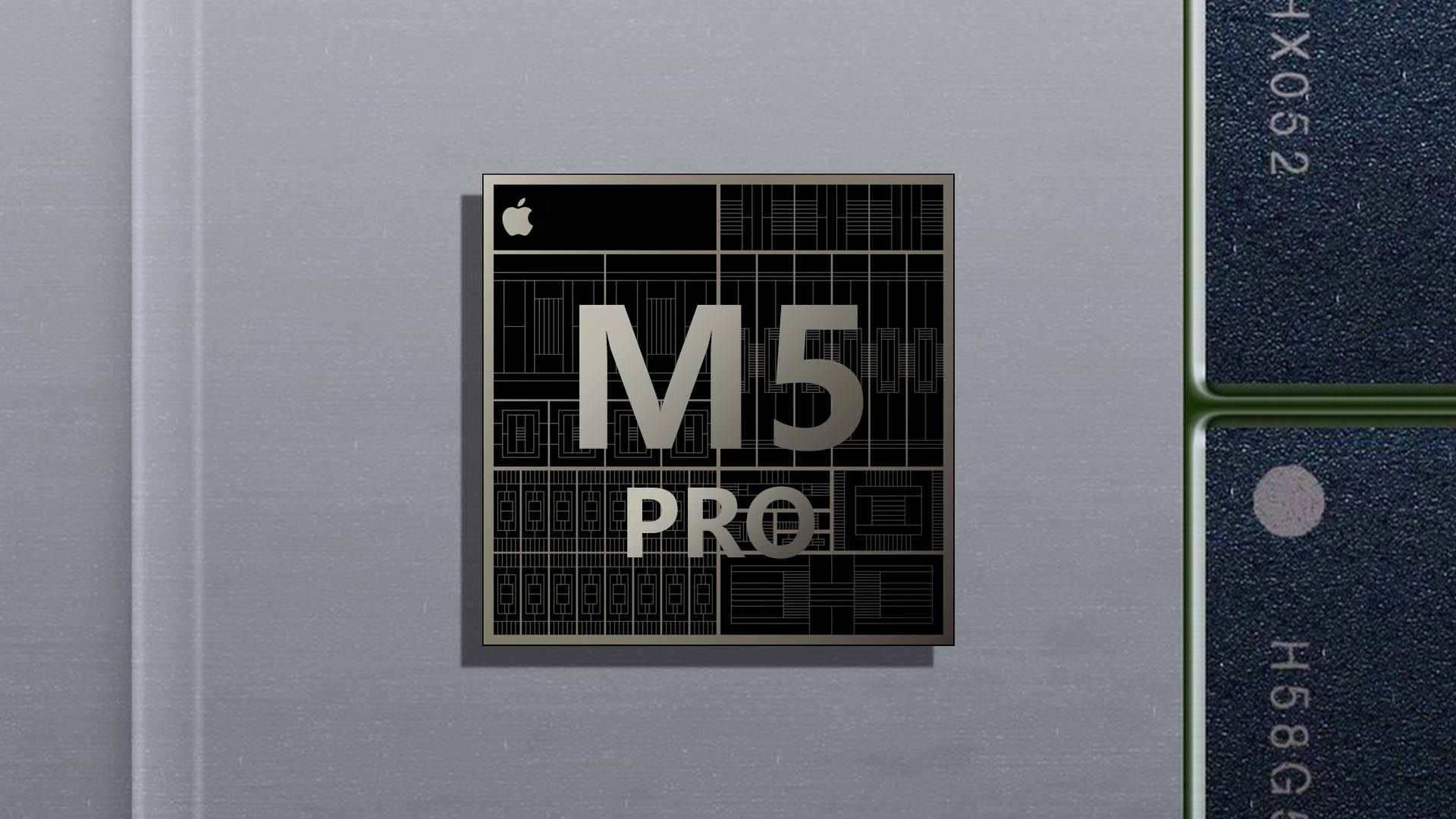
Apple is still keeping everyone guessing about its next wave of Apple Silicon, with the M5 Pro and M5 Max launch timeline feeling unusually hazy. So far, the only solid expectation is that these chips are set to arrive in the first half of 2026. Adding to the mystery, a recent iOS 26.3 beta reference reportedly mentioned the M5 Max and M5 Ultra, but the M5 Pro was nowhere to be found—an odd omission for what’s typically a centerpiece chip in Apple’s lineup.
Now, a new theory is gaining traction: the M5 Pro may not be missing at all. Instead, it may be essentially the same silicon as the M5 Max—just configured differently and sold under a different name.
The idea comes down to Apple’s expected shift to TSMC’s 2.5D packaging technology. Compared to older approaches like Integrated Fan-Out (InFO), this newer packaging method can make it easier for Apple to build multiple products from a single underlying chip design. In other words, Apple could create one primary die design, then use it to produce both M5 Pro and M5 Max variants by selectively enabling or disabling CPU and GPU cores.
Why would Apple do this? Because chip design is expensive—extremely expensive. Each unique die requires its own development work, validation, and a costly tape-out process before it can even begin mass production. If Apple can rely on one die design for multiple models, it could potentially save millions by reducing engineering overhead, streamlining manufacturing, and cutting down the number of separate product SKUs it has to support.
According to commentary from YouTuber Vadim Yuryev of Max Tech, the M5 Pro could effectively be a “binned” version of the M5 Max. That means chips that don’t meet the top-tier performance targets (or that have部分 cores that don’t pass validation) could still be sold as a slightly lower-tier product—without Apple needing to create a totally separate design. With 2.5D packaging, Apple could produce a single M5 Max-style die, then ship it as an M5 Pro when certain performance or GPU cores are disabled, and label the fully enabled versions as M5 Max.
This theory also fits with earlier expectations that the M5 Pro and M5 Max would adopt a new design approach with separate CPU and GPU blocks, opening the door for more flexible configurations based on different workloads. If Apple truly is moving toward a more modular or scalable structure, it would make even more sense to unify the underlying design to maximize efficiency.
There may be additional benefits beyond cost savings, too. A unified design strategy paired with advanced packaging could improve thermal behavior by helping reduce resistance and enhancing heat dissipation. That matters, especially when high-performance chips are pushed hard. The post also notes that the base M5 can reportedly reach up to 99 degrees Celsius under heavy load, so any improvement in thermals and efficiency would be a meaningful win for performance consistency.
Of course, nothing is confirmed yet. While the M5 Pro’s absence in early code references sparked the speculation, Apple could also simply add identifiers later. Still, the “single die, multiple tiers” theory is a compelling explanation that aligns with how modern chip companies often optimize yield, manage costs, and simplify production.
The remaining question is whether Apple would extend this approach even further—potentially applying a similar strategy to the M5 Ultra as well. For now, that part remains unclear, but if more beta code references or supply-chain leaks appear, we may get a clearer picture of how Apple plans to structure the M5 Pro, M5 Max, and M5 Ultra family ahead of their expected 2026 debut.