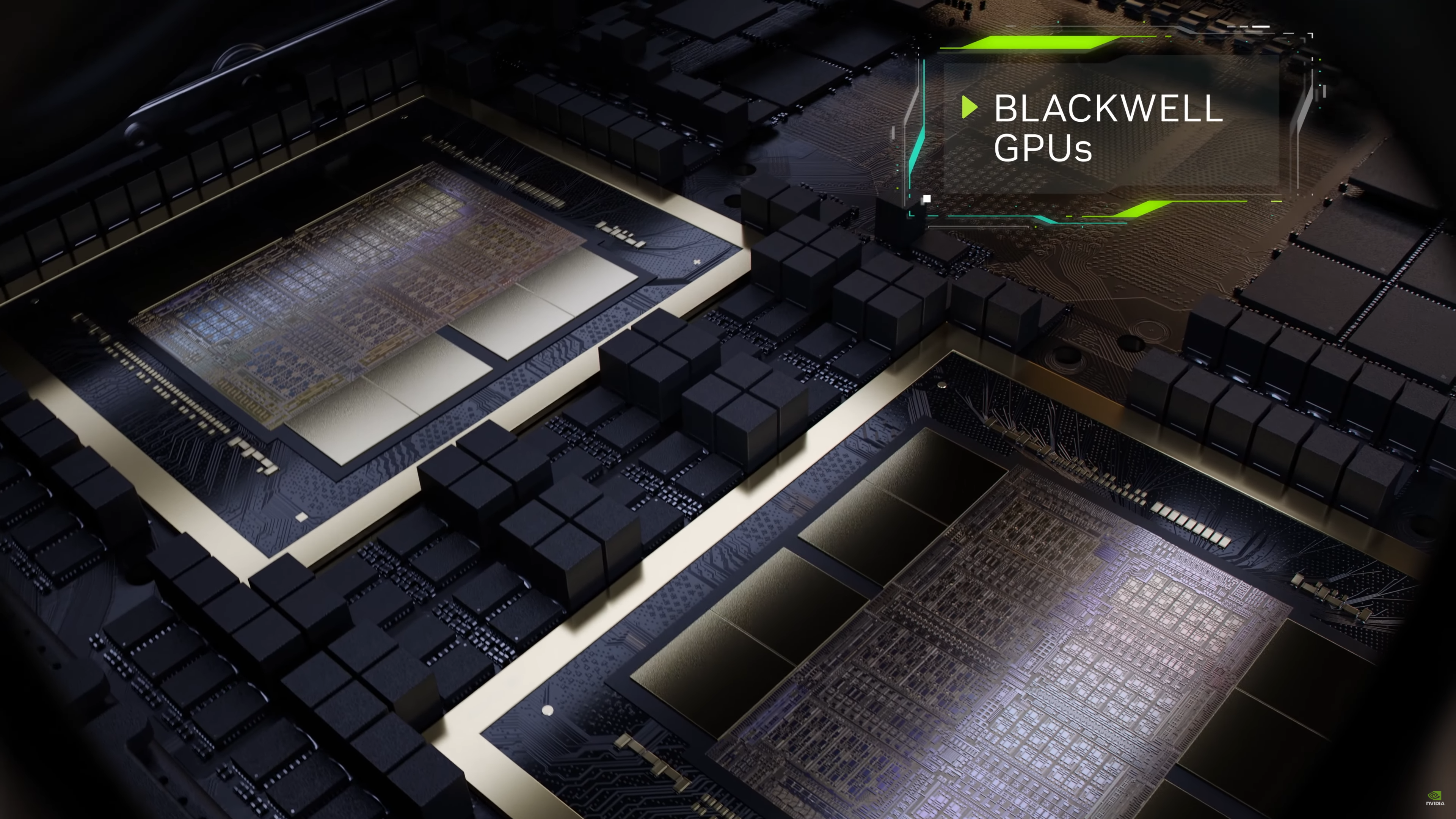
NVIDIA has recently shared additional performance statistics for their latest Blackwell GPU architecture, showcasing significant improvements in scientific research, AI, and simulation functions compared to their previous Hopper chips and traditional x86 CPUs. Blackwell GPUs demonstrate exceptional capacity for tasks like quantum computing, drug discovery, fusion energy, and scientific computing.
One of the primary goals NVIDIA aims to achieve with Blackwell is a reduction in cost and energy usage for massive computational tasks. The company claims that the Blackwell architecture can simulate weather patterns at a fraction of the cost and energy – 200 times lower in cost and 300 times less energy. Additionally, digital twin simulations representing our entire planet could see a 65x cost reduction and 58x energy savings.
The Blackwell GPUs boast a 30% increase in double-precision FP64 (Floating Point) compute capability over the Hopper generation. For example, a Hopper H100 GPU provides around 34 TFLOPs of FP64, while a Blackwell B100 GPU can deliver about 45 TFLOPs. When considering the GB200 Superchip, which pairs two Blackwell GPUs with a Grace CPU, computing power nearly doubles to around 90 TFLOPs of FP64.
Interestingly, AMD’s competing MI300X and MI300A Instinct accelerators deliver 81.7 and 61.3 TFLOPs of FP64 compute performance on a single chip, respectively. Despite these numbers, Blackwell’s performance in other areas should not be overlooked. For simulations like the Cadence SpectreX, a Blackwell GB200 runs up to 13x faster, with computational fluid dynamics showing a 22x gain when compared to ASICs and CPUs. Moreover, AI tasks on the Blackwell GB200 GPU experience up to a staggering 30x performance increase over the H100.
In the field of supercomputing, NVIDIA’s Grace Hopper GH200 platform continues to dominate, running on nine different supercomputers worldwide. Together, they provide an extraordinary combined computing capability of 200 Exaflops. New Grace Hopper-based supercomputers are being implemented internationally and are expected to further strengthen NVIDIA’s position in the market.
Although the spotlight is on Blackwell, analysts forecast that NVIDIA will maintain its dominance through 2024 and beyond, especially once Blackwell GPUs become available to customers. Beyond Blackwell, NVIDIA is not slowing down, as there is anticipation for the next-gen Rubin R100 GPUs, which are expected to begin production by late 2025. Based on initial information, these GPUs are likely to provide unprecedented performance levels, continuing NVIDIA’s impressive innovation trajectory.
In summary, NVIDIA’s advancements with Blackwell GPUs are set to revolutionize performance statistics in various high-compute fields, offering more power-efficient and cost-effective solutions than ever before. As AI demands grow, NVIDIA GPUs are positioned to meet these challenges head-on, maintaining their lead in the market and signaling a bright future for computational advancements.