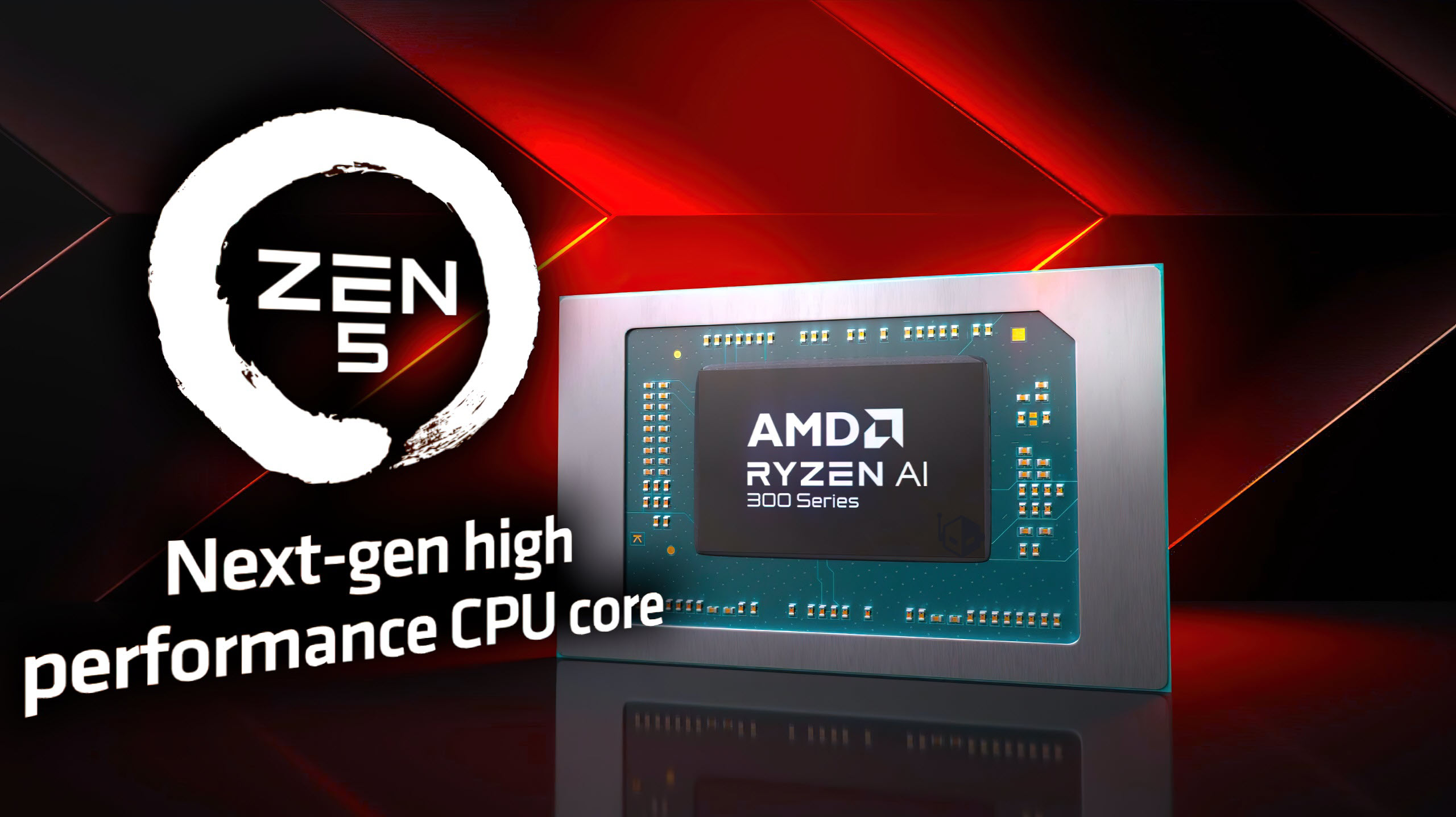
As AMD gears up for the launch of its Ryzen AI 9 365 “Strix Point” APU, the tech world is abuzz with details about its performance metrics. The highly anticipated APU is built on AMD’s Zen 5 architecture and an array of benchmarks has revealed insights into its instruction per cycle (IPC), latency, throughput, and other performance features.
According to an in-depth analysis of an engineering sample, which could differ slightly from the finalized product, the AMD Ryzen AI 9 365 is showing significant improvements in certain areas. The early tests used a laptop equipped with the Ryzen AI 9 365 SKU and 32 GB of LPDDR5x-7500 memory to assess various aspects of the APUs capabilities.
The Zen 5 architecture has made key advancements, including increasing the throughput of scalar ALU instructions and enhancing branch processing capability. However, it’s worth noting some of the changes come with trade-offs. The SIMD throughput for mobile units remains unchanged due to a reduced number of vector units, even though certain SIMD store operations have doubled, indicating an overall improvement.
Changes like increased latency for certain SIMD integer addition calculations are thought to enable the maintenance of higher frequencies. Additionally, the architecture has adjusted logical register operations, resulting in a mixture of improvements.
One area of focus in the benchmarks was the new Parallel dual pipe front-end, which influences the instruction fetch, decoding, and macro-op cache. Unlike previous generations, Zen 5 adopts a wide multi-front-end design with two 4-wide x86 decoders, enhancing the ability to rename and fetch instructions simultaneously. This results in improved performance, especially in branch-dense scenarios.
Performance was put to the test with SPEC CPU 2017 and Geekbench 6, comparing Zen 3, Zen 4, and the full capability of Zen 5 cores, including a comparison with Zen 5C cores running at lower clock speeds. The findings showed a noteworthy performance uplift for Zen 5, with over 9% improvement in SPEC CPU 2017 over Zen 4, and over 22% compared to Zen 3. Zen 5C core performance closely matched Zen 4 despite lower clock speeds.
The Geekbench 6 benchmarks reflected even more impressive gains, with up to 41% improvement over Zen 3 and around 13% over Zen 4 in single-core tests. For multi-core performance, “Strix Point” APUs outperformed their predecessors by over 55% compared to Zen 3 and over 24% compared to Zen 4, although it should be considered that Zen 3 and Zen 4 chips were tested at a lower thermal design power (TDP).
It is important to keep in mind that the data used in these findings are based on an engineering sample that doesn’t necessarily mirror the finalized product, so while the results are promising, they are not set in stone.
The Ryzen AI 9 365 is expected to be the first to feature Zen 5 cores, with an average IPC uplift of 16% across various workloads. The official launch schedule places the debut of Strix Point APUs in mid-July, followed by the introduction of Ryzen 9000 series high-performance desktop chips toward the end of the month. Enthusiasts and professionals alike eagerly await the official roll-out to witness firsthand the capabilities of AMD’s newest innovation in processor technology.