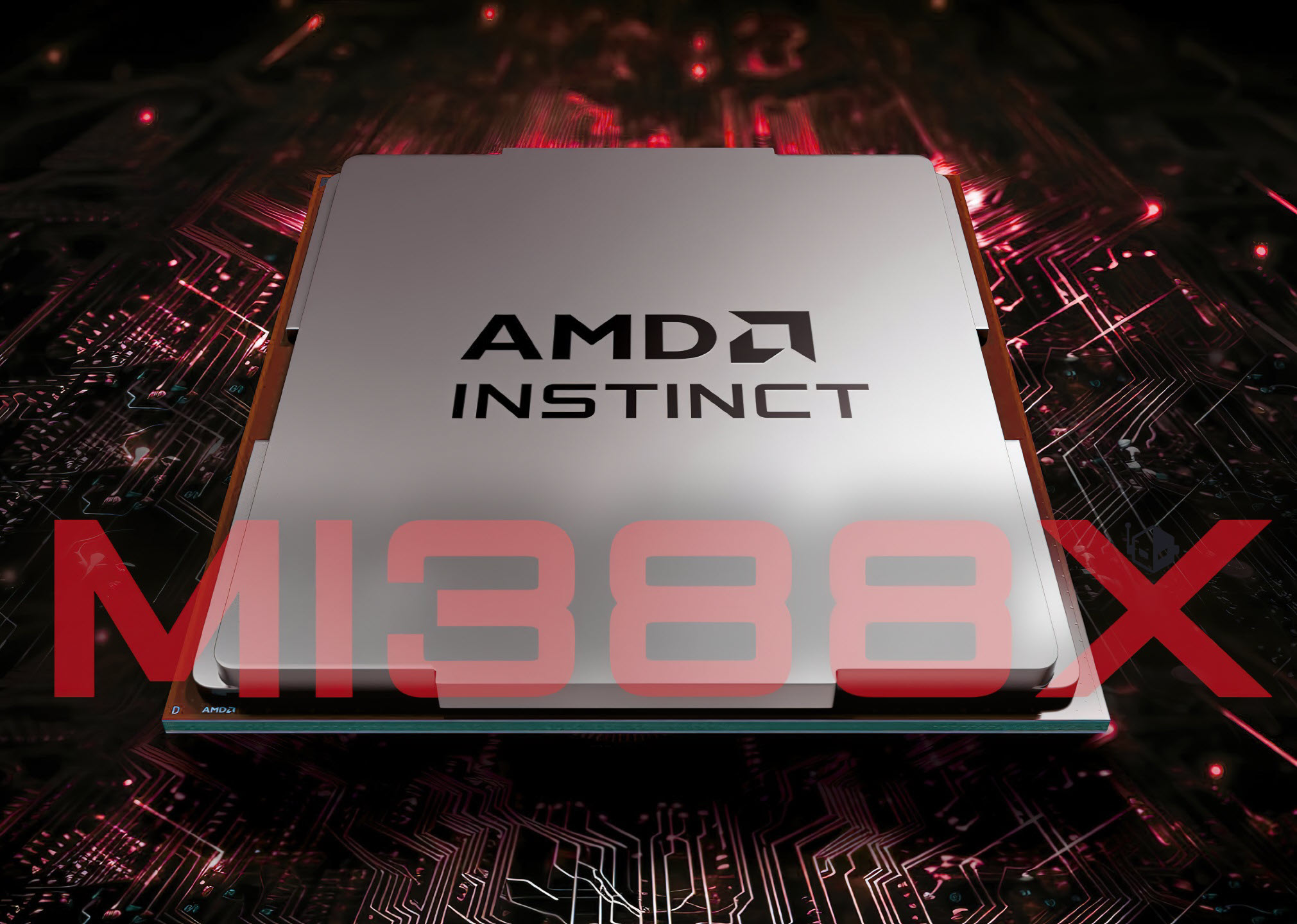
In the rapidly advancing field of AI accelerators, AMD is reportedly gearing up to introduce a new contender in their Instinct series—the Instinct MI388X AI accelerator. According to recent financial disclosures, this unannounced product has sparked interest for potentially being the fastest AI accelerator in AMD’s lineup.
The Instinct MI388X AI accelerator made its debut in an SEC filing made by AMD, a standard procedure where publicly traded companies must reveal financial and operational information, including future product plans. Such filings often give us a sneak peek into upcoming technologies and innovations yet to be announced publicly.
In particular, the mention of the Instinct MI388X, along with AMD’s current accelerator models—Instinct MI250, MI300X, and MI300A—indicates an expansion of AMD’s portfolio in high-performance AI computing. The filing specifies that these products cannot be exported to China due to stringent U.S. regulations.
While specific details on the Instinct MI388X accelerator are currently sparse, the naming convention suggests that it could sit at the pinnacle of AMD’s AI accelerator series. This product might represent the apex of what is possible with AMD’s current AI technology before the anticipated leap to the MI400 series, slated for release around 2025.
There is speculation that the Instinct MI388X could be a beefier iteration of the CDNA 3 GPUs, possibly incorporating increased high-bandwidth memory (HBM) capacities and even leveraging faster HBM3e memory dies. These enhancements could mean significant performance boosts in AI and machine learning tasks, where memory bandwidth and capacity are critical factors.
However, as with all unconfirmed product developments, it’s worth considering that plans could change. An example of this is AMD’s Instinct MI309 AI GPU, which was designed for the Chinese market but never materialized due to the aforementioned U.S. export controls.
The implications of a potential Instinct MI388X AI accelerator are vast. For industries craving greater AI computational power, from data analytics to deep learning, such an accelerator could drive innovation and efficiency. Moreover, it could contribute significantly to global competition in AI hardware, challenging other players in the space and pushing the boundaries of what current technology can achieve.
As of now, the tech community eagerly awaits more information about the Instinct MI388X AI accelerator. Should it come to fruition, AMD may well reinforce its position as a leader in the high-stakes domain of AI computing hardware.