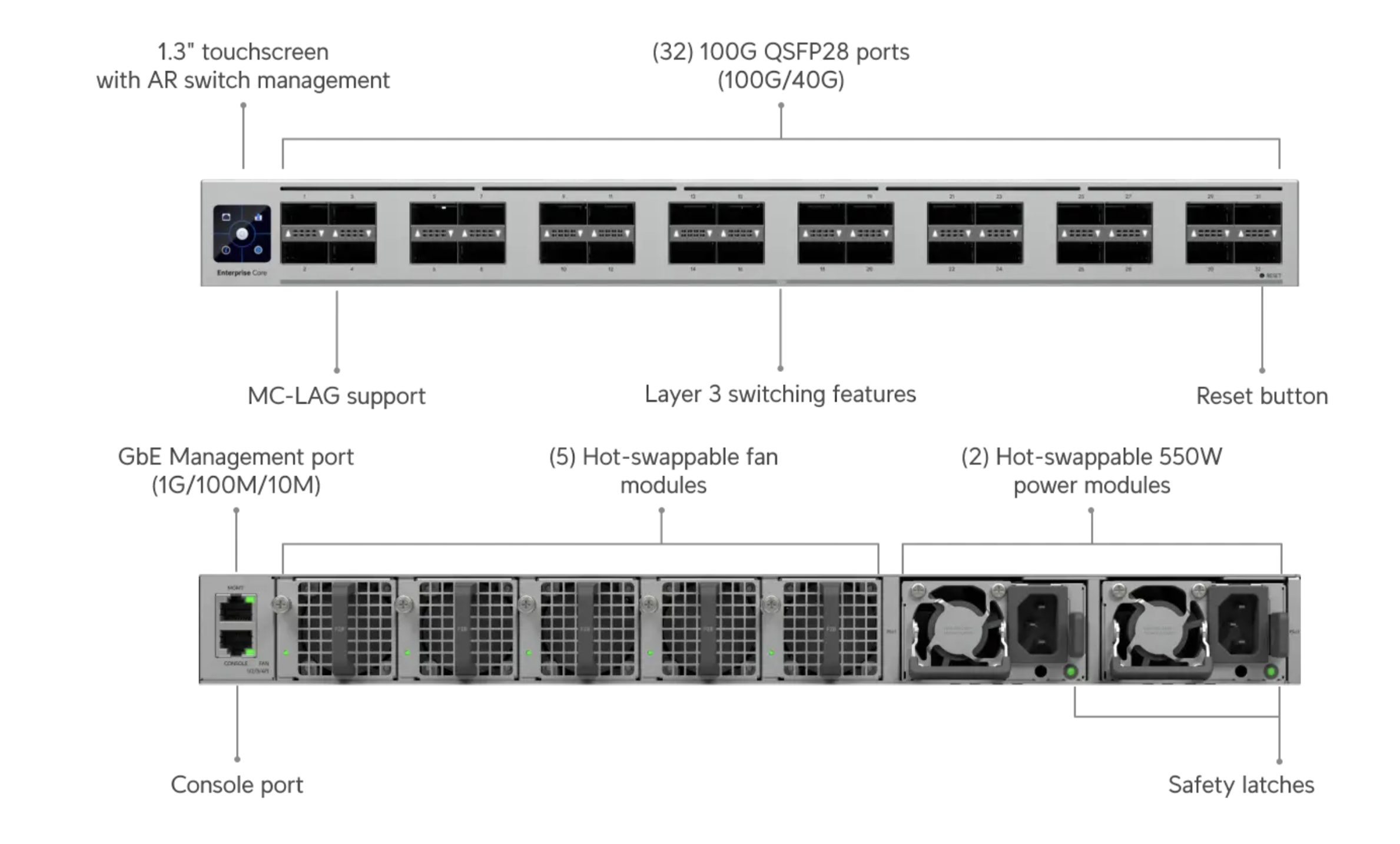
Ubiquiti has expanded its enterprise networking lineup with a new Enterprise Campus Switch Core designed for large-scale deployments that require high bandwidth, reliability, and advanced Layer 3 switching. Built for demanding campus environments, the new switch targets businesses, institutions, and data-heavy networks that need a resilient core with room to grow.
The new Enterprise Campus Switch Core is made to sit at the center of larger network installations. It fits into a standard 19-inch rack and occupies 1U of rack space with a full-depth chassis. Ubiquiti is positioning the switch for high-availability network designs, where uptime and redundancy are critical.
One of its key features is support for Multi-Chassis Link Aggregation, better known as MC-LAG. This allows two switches to operate together for redundancy and load balancing. In practical terms, if one switch or connection experiences an issue, network traffic can continue flowing through the other path. For enterprise campus networks, this can help reduce downtime and improve overall network resilience.
Performance is a major focus of the new switch. The higher-end model delivers a switching capacity of 6.4 Tbits/s, with total non-blocking throughput rated at 3.2 Tbits/s. It also supports up to 1,000 VLANs and 128,000 MAC addresses, making it suitable for complex enterprise environments with many users, devices, and segmented networks.
Ubiquiti describes the flagship model as a high-density 100G Layer 3 Ethernet core switch. It comes equipped with 32 QSFP28 ports, which can be configured for either 100GbE or 40GbE connections. This gives network administrators flexibility when connecting aggregation switches, servers, storage systems, or other high-speed infrastructure.
There is also a lower-throughput version with 1.8 Tbits/s of capacity. Instead of QSFP28 ports, this model uses SFP28 ports, making it a more affordable option for organizations that do not need the full 100G density of the flagship version.
For connectivity, Ubiquiti offers compatible direct-attach copper cables and optical transceivers. Direct-attach cables are priced at around $35, while transceivers are listed between $169 and $299 depending on the module. This gives businesses multiple options for building out their network backbone depending on distance, budget, and performance needs.
Management and troubleshooting are also part of the design. The switch includes an RJ45 console port for on-site access, which can be useful during configuration or diagnostics. However, adoption must be handled through a QSFP28 port, as the rear out-of-band management port cannot be used for that purpose.
Reliability is strengthened by redundant hardware components. The switch includes two hot-swappable power supply units and five hot-swappable fans, all accessible from the rear. This allows administrators to replace critical components without fully taking the switch offline, an important feature for networks that must remain operational around the clock.
On the front, Ubiquiti has included a small touchscreen that displays basic status information. This can provide quick visibility into the switch’s condition without requiring immediate access to management software.
Pricing starts at $5,393 for the QSFP28 version, including a $394 memory surcharge. The SFP28 version is priced at $4,314. With these models, Ubiquiti is clearly aiming at enterprise customers looking for a powerful but comparatively streamlined core switching solution.
The Enterprise Campus Switch Core line marks another step in Ubiquiti’s push into higher-end enterprise infrastructure. With 100G support, Layer 3 switching, MC-LAG redundancy, hot-swappable components, and high throughput, the new switches are built for organizations that need a robust network backbone for modern campus deployments.